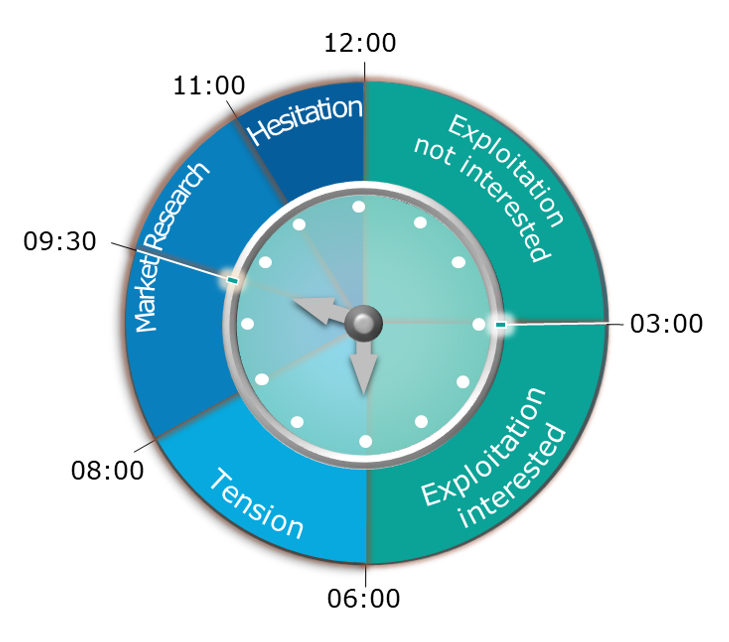


Suppose your company is ready to make its next investment. You might be planning to change your ERP system, start e-commerce, re-do the website or even buy new office premises.

There are various milestones to take into account when considering where you are in your buying process:

  • Are you 100% sure you want to change the existing situation?
  • What will your new purchase enable you to do?
  • Have you already calculated the costs and ROI?
  • What criteria will you use to compare suppliers?
  • Have you compared the differences and benefits of the various options?
  • How can you guarantee that your future supplier will not disappoint you in the long run?
  • Have you checked if the new solution will cause any new problems?

You’re probably not the only person involved in this buying process: do you think your CFO and other colleagues will give the same answers to the questions above?

Everyone goes through the same mental stages in the buying process

Keep the future investment in mind for a moment. Do you realise that all your colleagues, like any individual, go through the same mental stages before making a decision to buy? Scientific research shows that every buying process follows the same sequence of mental stages. This ‘buying clock’ is a good tool for working out the readiness to buy of everyone involved in the decision-making process.

This doesn’t mean that everyone’s buying clocks are synchronised, however; the speed at which people go through the various stages depends on various factors:

  1. Experience of buying a similar solution
  2. The extent to which we can differentiate the impact of the various options
  3. The importance and impact of the decision on ourselves and/or the organisation

The mental journey through the whole buying cycle can take seconds, months or even years before all relevant decision-makers have completed it at their own pace and a contract can be signed.

Increase your company profits with these insights

The next stage: apply the ‘buying clock’ to the sales process in your company. Are your sales and marketing personnel aware of clients’ mental buying clocks? Wouldn’t it be great if your team could detect your clients’ readiness to buy correctly, and then act accordingly? For example: no sales person with good knowledge of the buying cycle will talk about a product’s specific features until the client is convinced they need something even similar to your solution. The client will feel better understood if you address them in a language that matches where they are in the buying process.

More sales with higher margins at a lower cost

At an organisational level, your company will develop a common language that helps to align sales activities and vastly increase efficiency and effectiveness. If you want to be able to achieve the following, consider making the readiness to buy the reference point for every action you undertake for individual clients. You will gain various benefits from applying these insights:

  • A common language to improve the sharing of experiences and improving team performance
  • Accurate timing of actions, resulting in a lower cost of sales and higher ROI on marketing
  • Higher conversion rates
  • Less margin erosion
  • Predictable, objective forecasts

Buying behaviour has fundamentally changed over the past ten years. But there are still lots of companies approaching buyers of today with outdated best practices and mindsets, or continuing to advocate the old way of selling.

Until recently, it was still possible to achieve reasonable B2B sales results by simply highlighting solution benefits. Clients had no alternative but to take the sales person’s advice when making their buying decisions. People who still have this mindset should beware: buyers have taken over the sales process, and now they have the power. And they want to avoid risk as much as possible.

How can we adapt to today’s buyer?

A lot has already been said about the switch from product sales to solution sales, or from transactional into consultative selling. But we still see that neither has delivered on its full potential, and results remain far below expectations. This is why:

  • Both aim to implement a repeatable, linear and mechanical step-by-step process (not a ‘real’ sales environment!)
  • The sales support environment is not upgraded simultaneously; bonuses, product training and literature, events, CRM and even reporting remain largely unchanged
  • Management tries to resolve this with sales skills training and there is no change programme

You can fix this by focusing on the buyer, and learning about your clients and their markets.It’s also important to factor in risk mitigation. The ‘customer trust equation’ by David Maister, one of the world’s leading authorities on the management of professional service companies, is an excellent formula for clarifying the idea of risk mitigation:

T = (C+R+I) / S

T: trustworthiness (or perceived risk of working with you)

C: credibility = words (I can trust what he says)

R: reliability = actions (I can trust him to …)

I: intimacy = emotions (I feel comfortable discussing the subject)

S: self-orientation (I can trust that he cares)

The denominator of this fraction is (of course) what has the biggest impact here. You have to convince your clients that you really understand their requirements and objectives. The conversion rate will be lower if the client thinks the seller is focussing on themselves, regardless of the quality of your products or your sales person’s knowledge. In this case the seller is not being driven by the client but by a bonus that depends on the deal being struck, the internal pressure of a forecast, the special offer they want to sell, management’s desire to sell more of these solutions, or the belief that they’re an expert and want to prove it to you.

So consider risk management and look at all the conditions that can have an impact on sales when deciding how to improve your sales performance.


Scientific research has shown that every buying cycle is a sequence of the same mental processes; almost as certain as a law of nature. Our Buying Clock is an easy way to see the willingness to buy of everyone involved in a potential sale.

You can work out where the client is on Buying Clock by asking questions such as:

  • Are you 100% sure that the current situation has to change?
  • What will the impact be of the new solution?
  • Have you calculated the cost and ROI?
  • What criteria will you use to compare suppliers?
  • Are you trying to understand the differences and benefits of the various options?
  • How do you guarantee your future supplier won’t eventually fail on your expectations?
  • Have you checked whether the new solution won’t bring new problems?
Perpetos Buying Clock

The buying cycles are far from always synchronized

You know ‘what time it is’ in the buying cycle when you’ve got answers from everyone who is influencing the decision. Everyone goes through the same mental processes in a purchase, and it’s very plausible that different people are in different stages.

The speed at which we go through the various stages of the buying cycle depends on various factors: experience of buying similar products or services, understanding the various options’ impacts, the decision’s importance and impact on us and our organization. A buying cycle can last from a few seconds to months or even years depending on these factors. Being able to detect and influence buying readiness and helping to synchronize the buying clocks will not only shorten the buying cycle. It will also improve conversion rates and decrease discounts.

Understanding the buying cycle leads to better results

Do your sales and marketing teams know what time it is on every client’s Buying Clock®? Wouldn’t it be great for your team to discover how ready your client is to buy, so they could approach them in the right way? Then sales would never start talking about product features before the client is ready to even consider buying that type of product. And marketing wouldn’t overload anyone with too much information about all the benefits. Clients will feel better understood, and make a decision faster, when approached with messages that match their buyer readiness.

When everyone in your organization can detect the client’s buying cycle, you can develop shared terminology to align your sales and marketing activities and increase your efficiency and effectiveness. To maximize your organization’s potential, make your client’s readiness to buy the reference point of your sales strategy and process. This can lead to the following impact:

  • Shared terminology for sharing experiences will improve the whole team’s performance
  • Precise timing of your actions, resulting in lower cost of sales
  • Higher conversion
  • Less margin erosion and discounts
  • Objective, predictable forecasts
  • In summary: more sales with higher margins at a lower cost

Curious how to prepare your commercial team for the empowered customer?