

On a recent lead generation training course, I was very surprised to find a large majority of salespeople among the participants. It turned out that these sales reps were attending because their marketing wasn’t delivering leads that made sense from a sales perspective. Some of them had KPIs for cold calling, and results were reportedly getting worse and worse.

This situation again illustrates that the majority of businesses in Europe haven’t yet realised we’ve arrived in the ‘age of the customer’. Not that the customer has changed, but thanks to the internet, social media and new mobile possibilities, buyers have changed the way they interact with us. Organisations that want to secure or grow their business shouldn’t wait any longer to start looking at ways of meeting the empowered customer’s needs.

A well-oiled sales and marketing machine is essential

Buyers today can find loads of information about your products, and your competitors’, in just a few clicks. If you want to do business with leads who are looking for a solution like yours, it’s the marketing department’s job to provide the right information in the right form, at the right time in your lead’s buying cycle.

Cost efficiency and volume are key: marketing generates leads in a one-to-many digital approach. Only leads that meet specific marketing criteria (MQL) are being handed over to sales, who then take over from there. Sales qualifies both the contact and the buyer readiness (SQL), and leads rejected by sales are recycled by marketing into campaigns that can be made very specific thanks to the new insights gained by sales.

One marketing activity that is often forgotten is demand generation: besides capturing ready-to-buy leads, marketing can also create demand through inbound marketing. Leads from these campaigns can be nurtured to hopefully become sales-ready one day. Without demand generation, sales will keep on complaining about the quantity and quality of leads provided by marketing.

So has your machine been oiled to meet new customer demands?

How to get the machine running

If your machine’s a bit sluggish, it’s probably time to stop the ongoing battle between sales and marketing. Take a new look at activities and responsibilities, and create a value chain that helps your customers buy from you.

Here are a few tips to get sales and marketing collaboration on track.

  • Share common goals
    Across departments, increase awareness that we’re all trying hard to achieve the same company targets. Collaboration is key!
  • Share a common vocabulary
    In the age of the customer, replace your sales process with a buying process, and make sure both sales and marketing are speaking the same language. Introduce a clear demand-generation process with milestones based on commonly agreed definitions to make it work
  • Co-development and best practice
    Work together as one team. Both sales and marketing can add lots of value, insights and messaging to improve traction, conversion and ROI on marketing activities. Sales meetings are an ideal platform to keep marketing up-to-date with what’s happening in the market; marketing can take the stage to inform sales about ongoing results and planned activities in line with the sales organisation’s needs, again reinforcing the importance of common goals
  • Marketing: messaging should allows the building of customised content
    Research has shown that that up to 90% of content created by marketing goes unused by sales. Implement a content strategy that enables the building, sharing, measurement and improvement of messaging quality. Messaging should allow the building of content that is customised for different roles, their individual buyer readiness, and context
  • Marketing: ‘why change’ content
    The majority of content aims to convince us why we should choose company X or product Y. But research shows that 60% of opportunities are neither won nor lost; they simply disappear without a sale. The content that explains why customers should change is therefore crucial for creating demand and increasing conversion

Want to find out more and see the whole picture? Watch the webinar ‘How to Align Sales and Marketing’ with guest speaker Pascal Persyn, CEO at Perpetos, and moderator Deva Rangarajan, Associate Professor at Vlerick.

Perpetos WebinarHow to Move Stalled Sales Opportunities?

[ON-DEMAND WEBINAR]
How to Move Stalled Sales Opportunities?

  Procrastination comes in different guises. 3 steps to avoid procrastination
  Dealing with Late Cycle Concerns

Zetes realised how much the profile of B2B decision-makers and DMU complexity were changing. It therefore chose to start using Buyer Aligned Selling® to align the organisation with the ‘better informed customer’ and the way in which buying decisions are made in this day and age. One year after implementing this solution, Zetes was sealing 10% more deals with customers also making faster decisions.   

Zetes specialises in the provision of identification and mobility solutions for the supply chain and people identification. The company has its head office in Brussels and is active in 21 countries across Europe, the Middle East and Africa.

Main competitor was the customer ‘taking no decision to buy’

Zetes was founded in 1984 and so has a mature sales team. But even so, it was clear to Hervé Toussaint, Country Manager for Zetes Belgium(1), that the company wasn’t maximising its sales potential:

‘We noticed that the B2B buyer profile was changing dramatically. The DMU (decision making unit) and the way in which buying decisions are made have become more complex. But our sales organisation was still qualifying leads and approaching sales opportunities in the same way as previously. One of the symptoms of this was that our main competitor was customers who were stopping the buying process themselves or not finalising a decision to buy because there wasn’t enough budget or no sponsor, for example, and so continuing to work using old methods.’

Align the organisation with how the customer wants to buy from us

Hervé Toussaint therefore wanted to create awareness in the organisation that times were changing. Perpetos has helped Zetes’ marketing department successfully in the past, by aligning its approach with the way customers buy today, and has now been asked to extend this approach throughout the entire organisation.

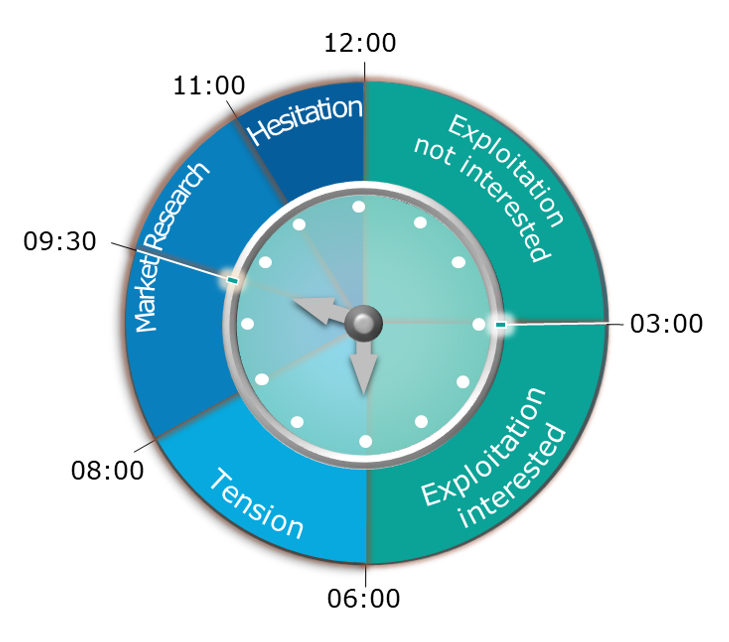
‘Buyer Aligned Selling® by Perpetos has ensured that our sales people no longer think in terms of their ‘sales’ process, but instead follow the logical stages that occur in the customer ‘buying’ cycle. This methodology is based on the Buying Clock® which presents the mental phases in the buying cycle in a useful and convenient way: the idea of a clock is easy to remember, was accepted by everyone and quickly led to a common language between our pre-sales, business consultants, marketers and sales people.’

‘Workshops interspersed with ‘coach the coach’ sessions helped the team become familiar with the new method, which has also been embedded in our CRM system.’

Higher hit-rate, less opportunities that are lost

Zetes is now able to achieve more with a sales team the same size. Sales people can detect how far along the buying process a customer is, so they can undertake the right actions at the right times. This means they know which messages are required in which buying phases, so offers are sent at the right time, and they know which types of actions fit in with the customer’s mindset at what times.

The sales team can qualify leads better and so make optimal use of their time according to potential. Where they previously were mainly in contact with technical people, now they also have the right skills, tools and messaging in place to approach the DMU more broadly and so sell higher up in the organisation. They work on more opportunities at a lower cost per opportunity. Hervé Toussaint explains specifically what Buyer Aligned Selling® gives to Zetes:

‘One year after implementation, 56% of all opportunities in Zetes’ pipeline are being converted into sales, compared to just 46% one year ago. The number of opportunities that are lost to competitors or stopped by the customers themselves has fallen by about 50%. And customers are making the decision to buy faster too: one year after implementation, the number of opportunities that are converted into sales within six months has increased.’

Perpetos ‘walks the talk’

‘We chose Perpetos because of the quality and experience of its business coaches, and because they walk the talk. The methodology gives us the right insights into how customers want to buy.’

‘We’re planning to optimise the results that we’ve already achieved in Belgium further with processes for pipeline coaching, cross-selling, up-selling and messaging, amongst other things. We strongly believe that this further development of our messaging in line with the methodology won’t just increase the impact for customers; it will also help new employees get up to speed faster.’ 

Following the successful implementation of Buyer Aligned Selling® in Belgium, Perpetos is also rolling the methodology out for Zetes Corporate in all the other countries where the organisation is active.

(1) Hervé Toussaint is currently Corporate Marketing Director at Zetes


Suppose your company is ready to make its next investment. You might be planning to change your ERP system, start e-commerce, re-do the website or even buy new office premises.

There are various milestones to take into account when considering where you are in your buying process:

  • Are you 100% sure you want to change the existing situation?
  • What will your new purchase enable you to do?
  • Have you already calculated the costs and ROI?
  • What criteria will you use to compare suppliers?
  • Have you compared the differences and benefits of the various options?
  • How can you guarantee that your future supplier will not disappoint you in the long run?
  • Have you checked if the new solution will cause any new problems?

You’re probably not the only person involved in this buying process: do you think your CFO and other colleagues will give the same answers to the questions above?

Everyone goes through the same mental stages in the buying process

Keep the future investment in mind for a moment. Do you realise that all your colleagues, like any individual, go through the same mental stages before making a decision to buy? Scientific research shows that every buying process follows the same sequence of mental stages. This ‘buying clock’ is a good tool for working out the readiness to buy of everyone involved in the decision-making process.

This doesn’t mean that everyone’s buying clocks are synchronised, however; the speed at which people go through the various stages depends on various factors:

  1. Experience of buying a similar solution
  2. The extent to which we can differentiate the impact of the various options
  3. The importance and impact of the decision on ourselves and/or the organisation

The mental journey through the whole buying cycle can take seconds, months or even years before all relevant decision-makers have completed it at their own pace and a contract can be signed.

Increase your company profits with these insights

The next stage: apply the ‘buying clock’ to the sales process in your company. Are your sales and marketing personnel aware of clients’ mental buying clocks? Wouldn’t it be great if your team could detect your clients’ readiness to buy correctly, and then act accordingly? For example: no sales person with good knowledge of the buying cycle will talk about a product’s specific features until the client is convinced they need something even similar to your solution. The client will feel better understood if you address them in a language that matches where they are in the buying process.

More sales with higher margins at a lower cost

At an organisational level, your company will develop a common language that helps to align sales activities and vastly increase efficiency and effectiveness. If you want to be able to achieve the following, consider making the readiness to buy the reference point for every action you undertake for individual clients. You will gain various benefits from applying these insights:

  • A common language to improve the sharing of experiences and improving team performance
  • Accurate timing of actions, resulting in a lower cost of sales and higher ROI on marketing
  • Higher conversion rates
  • Less margin erosion
  • Predictable, objective forecasts

Scientific research has shown that every buying cycle is a sequence of the same mental processes; almost as certain as a law of nature. Our Buying Clock is an easy way to see the willingness to buy of everyone involved in a potential sale.

You can work out where the client is on Buying Clock by asking questions such as:

  • Are you 100% sure that the current situation has to change?
  • What will the impact be of the new solution?
  • Have you calculated the cost and ROI?
  • What criteria will you use to compare suppliers?
  • Are you trying to understand the differences and benefits of the various options?
  • How do you guarantee your future supplier won’t eventually fail on your expectations?
  • Have you checked whether the new solution won’t bring new problems?
Perpetos Buying Clock

The buying cycles are far from always synchronized

You know ‘what time it is’ in the buying cycle when you’ve got answers from everyone who is influencing the decision. Everyone goes through the same mental processes in a purchase, and it’s very plausible that different people are in different stages.

The speed at which we go through the various stages of the buying cycle depends on various factors: experience of buying similar products or services, understanding the various options’ impacts, the decision’s importance and impact on us and our organization. A buying cycle can last from a few seconds to months or even years depending on these factors. Being able to detect and influence buying readiness and helping to synchronize the buying clocks will not only shorten the buying cycle. It will also improve conversion rates and decrease discounts.

Understanding the buying cycle leads to better results

Do your sales and marketing teams know what time it is on every client’s Buying Clock®? Wouldn’t it be great for your team to discover how ready your client is to buy, so they could approach them in the right way? Then sales would never start talking about product features before the client is ready to even consider buying that type of product. And marketing wouldn’t overload anyone with too much information about all the benefits. Clients will feel better understood, and make a decision faster, when approached with messages that match their buyer readiness.

When everyone in your organization can detect the client’s buying cycle, you can develop shared terminology to align your sales and marketing activities and increase your efficiency and effectiveness. To maximize your organization’s potential, make your client’s readiness to buy the reference point of your sales strategy and process. This can lead to the following impact:

  • Shared terminology for sharing experiences will improve the whole team’s performance
  • Precise timing of your actions, resulting in lower cost of sales
  • Higher conversion
  • Less margin erosion and discounts
  • Objective, predictable forecasts
  • In summary: more sales with higher margins at a lower cost

Curious how to prepare your commercial team for the empowered customer?


Does this sound familiar?

  • The customer is interested but the criteria for making decisions keep changing.
  • You sound out prospective customers for information – such as their current way of working and associated challenges – so that you can design your sales pitches accordingly, but they don’t bite.
  • You work with the same contact person throughout the entire sales process, and they are really interested, but suddenly replaced by a reluctant colleague in the final stage.
  • You have to send several quotes for the same sales opportunity
  • A deal gets called off just before it’s concluded. Subsequent inquiries show that the customer never even made a purchase order request.

Perhaps in all the above cases you are the victim of your own sales processes, which don’t take the customers’ readiness to buy into account. Too many companies fall into this trap, often lured by companies selling marketing techniques, training courses, CRM and marketing automation, consultants and software suppliers. They did a one-off analysis of a buying cycle, which was then converted into a sales process and uniformly applied to all customers and sales opportunities.

Navel-gazing leads you down a dead end

People who use sales processes as their guide instead of the customer’s buying cycle often find themselves down a dead end. This is just plain logic, because you are ignoring the customer’s reality in favour of your own reality. But it’s the customer who ultimately decides if and how much to buy.
You’re also asking your sales and marketing departments to convert all their external interactions into a linear and company-internal process. This never corresponds with the customer’s situation, by definition.

Briefly consider the following (and perhaps decide to get rid of the sales process):

  • There’s no such thing as one sales process for every sales opportunity. Each individual has their own dynamics and insights.
  • A sales process shifts the focus from the customer to the seller. A lack of focus on the customer leads to the right actions being taken, but at the wrong time.
  • Sales-oriented processes don’t offer any scope for sales to adapt their speed and communications to the customer, or to coach the customer according to their situation.
  • Someone who assumes their own processes can rarely make an accurate forecast: they only consider their own logic, and not the customer’s readiness to buy.

Copernican revolution

Another way is possible. There are models and tools that focus on the customer’s buying cycle rather than the sales cycle. Scientific research has shown that everyone goes through the same mental phases for every decision we make. It’s a mental phase that is not related to gender, age, job or nationality. Placing these mental phases in a model enables us to make this buying cycle predictable and so design a company’s actions to match it.

Sellers more important than ever

In this new model the role of the seller is more important than ever before. Every customer has their own way of indicating which phase they are currently in. The more important the purchase for the company, the longer the decision-making process can be expected to last. Only sellers who can correctly detect the buyer readiness of everyone in the buying cycle will conclude the majority of sales opportunities successfully. Because they are keeping their finger on the pulse, everything will run smoothly, as long as the customer allows. This doesn’t just improve your win ratio; it also keeps the buying cycle as short as possible.

Lower sales costs

So get rid of your sales process as quickly as possible and change your way of working, reporting and coaching to match the individual buyer readiness of all concerned. And sell more at a lower sales cost.