


In a world where customer relationships are the backbone of successful businesses, Customer Relationship Management (CRM) is at the heart of company strategies. Yet, the stark reality is that many CRM implementations don’t deliver the expected results. CRM implementations often fail due to reliance on standard configurations, a focus on financial rather than sales support, and a narrow view of the sales funnel. To improve outcomes, customize your CRM to reflect your unique sales processes, simplify data entry to enhance adoption, and tailor screens and reports for operational support. Want to learn more? Continue reading. 

Failure of CRM implementations leads to frustration within teams, wasted investments, and ultimately, a disconnect between what sales teams expect and what CRM systems deliver. But why do so many CRM initiatives fail, and more importantly, what can we do to overcome these challenges? 

Core Reasons for CRM Implementation Failures 

1. Standard Configurations vs. Customization 

Many organizations start with a standard CRM configuration that isn’t finetuned to their unique processes and needs. This one-size-fits-all model often overlooks the specific dynamics and requirements of the business, resulting in underutilization of the system.  

2. Focusing on Financial Drivers Over Sales Support 

Another common issue is that CRM systems are primarily set up to feed financial systems, with little consideration for the actual support of sales processes. This creates a gap between what salespeople need and the functionalities of the system. 

3. Limited Focus on the Final Stages of the Funnel 

Many CRM solutions concentrate only on the last steps of the sales funnel, ignoring crucial aspects of the entire customer journey. This leads to an incomplete understanding of the customer experience and missed opportunities for early engagement. 

The result of these missteps is a CRM system that is perceived as more of a burden than a tool, with inaccurate data due to a lack of use by the sales teams. 

Can you avoid this? Yes you can. Read on to find out how. 

Solutions for More Effective CRM Implementations 

Reflect Reality in Your CRM 

It’s crucial that your CRM system is an accurate reflection of how your customers actually buy. This requires a thorough analysis and customization of the system to accurately mirror the unique selling and buying processes of your organization. Is your sales process aligned to the way your customer buys? Does your sales process support the different product/market combinations, or is it too rigid to support these different situations?  For example, you can start applying the Buying Clock® methodology, very easily in your CRM.

Simplify Data Entry 

By limiting data entry to essential information, the CRM system is perceived as a supportive tool rather than an administrative burden. This significantly increases adoption among salespeople and improves data quality. Don’t expect salespeople to document elaborate sales reports in your CRM.  By limiting to those parameters that allow the salesperson as the manager to think strategically about the opportunity, the CRM becomes a strong sales tool and not a necessary admin application. 

Effective CRM Implementations - Customize Screens and Reports 

Customize Screens and Reports 

Make the CRM tool truly valuable for your team by defining screens and reports that support day-to-day operational activities. This ensures that the tool is seen as an integral part of the sales process. 

Conclusion and Call to Action 

A thoughtful, customized approach to CRM can bridge the gap between technology and user, making your investment truly pay off. Different customers already benefit from this approach.

If you recognize these issues and are seeking expert help to refine your CRM strategy and prevent failure, it’s time to take action. 

Is this limited only to those who are implementing a new CRM.  Certainly not, even with existing CRM applications you can create a strong impact on the effective use of your CRM with a minimum of modifications. 

Reach out to experts with deep experience in tailoring CRM systems to the unique needs of businesses. Together, we can chart a course to a CRM solution that not only meets the needs of your financial system but also empowers your sales team and contributes to a seamless, effective customer journey. 


In the competitive world of sales, success isn’t stumbled upon—it’s crafted, honed, and perfected much like the journey of a top athlete in the realm of sports. This comparison might initially seem far-fetched to some, but upon closer examination, the parallels between excelling in sales and succeeding in top-level sports are strikingly clear. Both arenas require relentless practice, a dedicated coach to guide and refine techniques, and an unwavering commitment to improving performance despite the absence of immediate results. While we wrote before on sales as a team sport, this article focuses more on the individual. It explores the compelling reasons why sales can be compared to top sport and why understanding this analogy is crucial for those looking to excel in their sales careers.

The Importance of Practice

In top-level sports, the saying goes, “practice makes perfect.” This mantra is equally applicable to sales. Just as athletes spend countless hours perfecting their skills, sales professionals must also dedicate themselves to mastering the art of selling. This involves not just understanding the product or service but also developing the ability to read the buying readiness of potential clients, navigate to next objectives, and help the customer to buy. Just like in sports, the practice in sales is continuous, aimed at refining and improving every aspect of the sales process. Having a customer agnostic sales process, that aligns with the buying readiness of the customer, gives you a big advantage creating clarity on what to practice.

The Role of a Coach

The Role of a Coach

Behind every successful athlete is a coach who has guided, mentored, and pushed them to achieve their best. Similarly, in sales, having a mentor or coach can significantly impact a sales professional’s growth and success. A good sales coach provides invaluable feedback, helping to identify areas for improvement and adjust strategies as necessary. They offer an outside perspective that can highlight blind spots and open up new avenues for development that the salesperson might not have considered. Unfortunately, very often, sales managers don’t take up the role as coach because they lack time, because they were never trained to coach or simply lack the capability. On top of that, they hardly get questions from their manager on the coaching results, but get daily or weekly questions on the numbers.

The Challenge of Immediate Results

As sales is percieved as a number game, sales people are biased towards immediate results. One of the biggest challenges both athletes and sales professionals face is exactly this expectation of immediate results. In sports, the impact of a new training regimen or technique might not be evident in the short term. Likewise, in sales, efforts to improve practices or implement new strategies do not always lead to instant success. This delay in seeing results can be discouraging, but it is a critical phase where the foundational elements for future success are laid down.

Traditional Training vs. Continuous Improvement

This expectation of instant gratification is where traditional sales training often falls short. Traditional methods may provide a foundational knowledge of sales techniques and processes, but they fail to account for the individual’s need for continuous improvement and adaptation. Just as athletes must constantly evolve to stay competitive, sales professionals must also continually refine their approach to stay ahead in a dynamic market. Implementing next practices and integrating feedback from a coach are crucial steps that move the needle towards achieving commercial excellence.

Conclusion


Companies invest a lot of money in developing content that supports sales, but often see no return on their investment. The reason for this is that the sales organization does not use the developed content, or isn’t using it enough. So what’s going on?  

The impact of content usage and, by extension, sales enablement has been demonstrated many times before. According to figures from Miller Heiman Group in 2019, organizations without sales enablement achieve average win rates of 42.5%, while organizations with sales enablement achieve an average win rate of 49.0%, a huge 15.3% increase. 

Sales content is not marketing content  

Content plays a crucial role in different phases of the buying cycle. It can accelerate the sales process and significantly reduce sales costs. But what exactly do we mean by sales content?  

Typical sales funnel

Content for: 

  • onboarding when launching new products or services
  • important announcements with regard to the sales strategy
  • preparing for customer contact moments
  • during the contact moment
  • follow-up after the contact moment
  • training and coaching salespeople

Apparently, it turns out that salespeople don’t find enough of this kind of content in the materials produced by marketing departments. The reason for this comes from the purpose that marketing content serves, i.e. to influence the market based on its own strengths, and to lead as many interested parties as possible through the famous marketing funnel, with little variation in the message – ‘one-to-many communication’ – as quickly as possible, from awareness to buying intent.  

Content that is developed for this purpose has some specific characteristics:  

  • the customer searches for and discovers the content under their own initiative (inbound marketing) 
  • the content reaches the customer online or via an automated process (outbound marketing)
  • the effectiveness of the content is measured using KPIs such as clicks, reading time or number of shares
  • the ultimate goal of the content is to generate Marketing Qualified Leads (MQL)

From funnel to unique journey  

Many organizations still believe the MQL simply needs handing over to the salesperson who then just has an easy tap-in to score the goal. The customer has already passed through the entire marketing funnel, so all sales has to do is cash in on the marketing effort.  

But this belief is – of course – misguided. The idea that a customer will dutifully go through a content funnel, and immediately be willing to buy at the end of that journey, is not the case in practice. Content is consumed for various reasons in this marketing funnel, and there are sure to be interested parties for your product, but people also download your ebook out of curiosity, or scroll through your website, to ultimately discover it’s not what they’re looking for. So who says your MQL has the required budget, or can make a decision or even influence it?  

The marketing funnel in no way helps to predict the customer’s buying intent or willingness to buy. And it tells us little about which phase in the buying journey the customer finds themselves. The buying journey is therefore anything but linear, and it’s unique for each customer. When the salesperson starts working with an MQL, they always intervene at a different moment in the buying journey. And that requires specific content.

Sales content that works  

It’s impossible for the marketing content mentioned above to satisfy the non-linear need. After all, marketing content is fundamentally different from sales content. The latter needs to support a salesperson before, during and after sales conversations. The customer does not consume it directly; they access it through personal interaction with the salesperson.  

To increase the use of content in sales and so improve sales productivity, make sure your sales content has these characteristics:  

  • Snackable: short and powerful, simple to use and easy to understand
  • Accessible and quickly findable, so salespeople can spend more time selling and less time searching for content
  • Adapted to the customer’s mental stage in the buying journey
  • Interactive: inviting participation and interaction
  • Just in time: supportive for the salesperson in every phase – from preparing for the customer conversation, to interactions with the customer, and in the follow-up process
  • Focused on action: usable, helpful and encouraging action.  

Are you ready to get to work on your sales content strategy? Let us know!


In our conversations with CEOs and sales and marketing directors, we keep hearing the same comment – that fewer and fewer salespeople are meeting their targets. And further investigation has made the reason for this very clear: salespeople have insufficient knowledge of their customers and the market, and are lacking some of the specific competencies required in today’s marketplace. 

Various research has shown that revenue and sales quotas are becoming increasingly difficult to achieve. For example, one study by Sales Insights Lab in 2021 demonstrated that only 24.3% of salespeople were managing to exceed their sales quota. So is there a problem with salespeople’s productivity?  

Much depends on how we present sales productivity, because the concept is very often seen as a combination of efficiency and effectiveness.  

Sales Productivity

And this presentation is a good reflection of traditional sales training, where the main aim is to clone top salespeople’s behaviour into the DNA for other salespeople. According to figures from the Association for Talent Development, the US alone spends $24 billion per year on this.  

But this approach has a disappointing outcome. Fewer and fewer salespeople are achieving their quotas, and fewer and fewer companies are achieving their revenue targets. So the main challenge is no longer effectiveness, but a lack of knowledge about the customer and an inability to link any available knowledge to products and services.  

What has changed? 

Almost everyone agrees that customers are much better informed nowadays. And one consequence of this is that customers prefer it when we are less active in trying to sell. They don’t want us to try to convince them, and instead like to make their own minds up. So traditional methods of talking about the company, products and services simply don’t work anymore because customers can find all the information they need on the internet. They used to accept the information we gave them and were happy with that because there was no alternative, but now they can find all the information they need about products and services without any help or intervention from salespeople. 

The fact that customers can now serve themselves with this information also has a significant downside, however. How do they deal with conflicting information and advice? How do they know what is correct or relevant?  

And this is where the opportunity now lies for customer-facing professionals: providing added value, offering useful content, and having meaningful conversations. These are now the most important reasons for customers wanting to engage in dialogue with a salesperson. They expect the salesperson to know their environment and responsibilities, and don’t want to have to bring them up to speed themselves. But they do expect the salesperson to engage in dialogue, share their experiences from other companies, and enhance the buyer’s perspective.  

What has not changed? 

All of this has led to a steep rise in content production over recent years because we want to ensure customers can inform themselves. Some suppliers and analysts even claim that content marketing is taking over from sales. Unfortunately, however, it’s not quite that simple.  

Customers may well be informing themselves more, but content marketing has not solved the problem of declining sales quotas and salespeople productivity. In B2B, digital interactions are just as necessary as personal interactions with sales – as a recent study by Forrester confirms (Sales Enablement: Planning Assumptions 2022, Forrester Research Inc., September 2021). Interactions with customers have only increased recently, e.g. from 16 to 17 between 2017 and 2019, and from 17 to 27 during the pandemic. Customers are seeking out information for themselves, but they still need answers. And this is where the salesperson comes in – because they are still seen as a partner here.

Furthermore: the type of interaction (digital versus personal with the salesperson) is independent of the phase in the buying process. It’s not the case that a salesperson is only forced to join in at the end of the buying cycle. So we need to make sure we interpret the almost mythical figure – that 57% of the buying cycle is completed before a salesperson is involved – from research firm CEB (now Gartner), correctly. As mentioned above, the customer is better informed these days. So their decision criteria have typically already become more influenced.  

A salesperson with the right knowledge can therefore engage in dialogue with the customer and avoid this pitfall. It’s all about having meaningful conversations. And it’s not relevant whether these conversations take place through personal interaction or indirect communications – as long as the buyer finds answers in every phase of the buying cycle. Again: content marketing is essential, just like sales. And one cannot do without the other in complex B2B environments. 

And what about training?  

Traditional sales training has become outdated, just like the focus on quotas based on efficiency and effectiveness. What we need today, more than ever before, is more focus on sharing knowledge and experiences (see graph). 

Our advice to sales managers is therefore to enable salespeople to share useful information with customers during sales conversations, and to introduce a common language in your training that encourages team selling and experience sharing. Customer-facing professionals want to be able to have meaningful conversations that are relevant to the context and the customer’s phase in the buying cycle. ‘Just in time’ is the key phrase here. We are therefore seeing increased benefits in training that teaches competencies which allow salespeople to introduce contextually relevant cases, from themselves or at least from their environment. 

Increasing sales productivity again 

Our analyses consistently show that salespeople who possess the right knowledge, skills and tools are more likely to meet their quotas. This clearly falls under the realm of sales enablement, a continuous process of giving your customer-facing employees the knowledge, skills and tools they need. 

Figures from Miller Heiman Group from 2019 support this claim (see graph below), and they show the impact of sales enablement in their 5th Annual Sales Enablement Study. Organizations without sales enablement achieve a win rate of 42.5%, 3.9% lower than the average (46.4%). Organizations with sales enablement achieve an average win rate of 49.0%, a huge 15.3% increase. 

Win Rates for Forecast Deals

Win Rates for Forecast Deals

Creating an environment like this in your organization can therefore significantly improve your sales results. But how do you do that? First and foremost, you need a company culture that encourages continuous learning and improvement. Additionally, it’s also best to make relevant content available in bite-sized pieces, easily accessible, and with clear instructions on when and with whom to use it.  

In other words, the solution lies in continuously sharing knowledge and experiences to improve the productivity of salespeople and the entire sales team.  

To find out more, get in touch with one of our experts who will be happy to provide you with specifically tailored and actionable input. Book your appointment today. 

Want to learn more? Download our eBook:


Pieter Morisse, CEO Lecot

Lecot has a brilliant track record, currently with around 85,000 buying customers. These impressive figures suggest there is no immediate need for a commercial excellence trajectory.

That’s right, we’ve already come a long way. Our network of stores has expanded significantly and our revenue is continuing to rise steeply – largely thanks to our sales department’s dedicated efforts, among other things. The question is how to maintain this growth and prepare the organization for the future. When I started at Lecot, I tried to have as many in-house conversations as possible, despite the pandemic. I wanted to get a feel for how the organization was structured, where there were still opportunities, and what challenges everyone was facing.

Pieter Morisse

We want to tap into new sales opportunities by approaching our customers more as a team. 

The conclusion of these discussions was that there is still a lot of growth potential. This expansion does not necessarily need to be synonymous with more stores, however. You can also achieve growth by approaching the customer in a different way.

There are still a lot of cross-selling opportunities, for example. Our sales representatives do everything they can to serve ‘their’ customers as well as possible using their own methods and expertise, which has worked brilliantly so far, but customer expectations are changing. In the future, we want to approach our customers more as a team, using a mix of expertise to help us tap into more new sales opportunities.

Pieter Morisse

CRM technology can be a great help in mapping out and realizing customers’ full potential – as long as there is a uniform approach. Otherwise, it becomes an expensive investment that yields little or no results. But achieving ‘one way of working’ like this is not easy within a large organization, such as Lecot. And that’s why they enlisted the help of external partner, Perpetos. The initial request was to support Lecot in preparing the tender and selecting the CRM supplier, and helping to clarify the objectives of the CRM tool and outlining a change trajectory for its implementation was an essential part of this. 

CRM implementations often follow a very process-oriented approach, but sales is not a linear process. 

CRM implementations are often led by IT people with no sales experience. They work in a very process-oriented way and think in linear processes, which then becomes the accepted way of working. But sales is not a linear process, and I also don’t want to create any barriers by getting rid of the way our people have always worked, and worked well, in the past. With Pascal Persyn, chief strategist at Perpetos, we brought in someone who knows sales inside out. He helped us to formulate answers to the core questions of where we want to go as an organization, and what the CRM system needs to be able to do to make this possible.

Pieter Morisse

Asking these core questions ensures that a CRM implementation starts from a future perspective rather than the existing situation. Morisse believes this is a crucial factor:

Rolling out a new CRM system takes time and money. So it needs to be future-proof if you want your investment to pay off, and this can only be achieved by starting from the ‘to be’ rather than the ‘as is’ situation. We didn’t just want to improve the current approach; we wanted to shift from thinking solely in terms of revenue to also considering potential – from ‘my’ customer to ‘our’ customer. This allows us to increase our performance in a structed way and get the most out of our commercial resources, and the new CRM system must be able to support us in this.

Creating this thought exercise meant we could integrate the ‘to be’ situation in the tender, which added lots of value. On Perpetos’ recommendation, we drew up the requirements in a very pragmatic way, with a concrete part on one hand and an open question on the other – giving potential suppliers the opportunity to show what they could do. And, because the Dutch-speaking aspect was important to us, we ultimately ended up with only two eligible suppliers. They both scored well on the first part, but the open demo strongly suggested Salesforce as the better partner overall. CRM is their core business, after all – and you can tell.

We opted for a Minimum Viable Product instead of a big bang. 

There is still a long way to go between selecting a supplier and rolling out the new CRM, let alone optimizing its use. Perpetos’ expertise proved invaluable in this regard as well.

We got together to find a basic way of working that fitted in with Lecot’s current approach – a Minimum Viable Product, let’s say, rather than a big bang. This ensures we can bridge the gap between the ‘as is’ and the ‘to be’ more gradually, and avoid people leaving. Pascal had various conversations with sales directors to assess their drive and business, to help determine what an MVP should include. The input from these meetings was also important for putting together the pilot group, and this group then helped us to prepare and implement the rollout in stages. As well as spreading the investment over time, this also makes it easier to get people fully on board with the change process.

Pieter Morisse

2 important takeaways 

The rollout is still ongoing, but Morisse already has two takeaways that can help other companies looking to set up a CRM project: 

1. Be patient (but not too patient): 

“Even though we opted for an MVP instead of a big bang, it still took longer than expected to get the pilot group fully on board. Ultimately, it’s about changing a mindset, and that’s always difficult. In this case, you have to get rid of the idea that CRM is a reporting tool that allows you to check whether your salespeople are using their time effectively every hour. It’s about customer contacts, so you have to coach your people much more from an opportunity perspective rather than an activity perspective. That’s why, in parallel with training on the new CRM tool’s functionalities, we also coached our sales leaders in changing their approach. And we worked at different speeds: some got on board straight away, and others needed a bit longer.” 

2. Surround yourself with the right partners: 

“The success from rolling out a CRM tool doesn’t come from going live with the software, but from everyone being able to use it effectively. And that’s why you need partners who feel involved – not just working towards launching the tool so they can check it off their list, but thinking together with you and regularly checking in along the way to get feedback and make adjustments where necessary.” 


In our previous post, we explained that a complex business negotiation is much like a chess game. It’s about making a move and anticipating your customer’s next moves. One of our customers, a packaging company, recently learned this by following our Complex Negotiations Implementation Track, an intense training & development program for sales teams and management professionals. Throughout the process, our customer started to have a pretty good idea of what they were doing right and should do more of, what they needed to stop doing, and what they needed to start doing. We packed all the valuable lessons in a practical overview.  
 

What they need to CONTINUE doing 

Have strategic conversations

Before going into the negotiation and even quotation phase, start by exploring the customer’s challenges and priorities for improvement. During preparations, also talk to technical teams or people on the work floor. 

Sell the value, not the product  

Sales reps like to see their customer relationship as a partnership, where they jointly work on Total Cost of Ownership. This is a much better choice than just defending the value or margin on your product. To do this successfully, you need to be able to prove the value you are offering, whether it’s a cost reduction, cost avoidance, increased revenue, or decreased risk.  

You need to make clear that taking your company out of the equation would have a negative impact, one that outweighs the potential price gain from working with a cheaper vendor. The value you offer, including the specialty services on top of your product, is something unique.  

Prepare, prepare, and then prepare some more 

Hamlet knew: readiness is all. Preparation does make a difference. Prepare your meetings and calls by inputting data and insights from the customer in a structured way and always determine a next objective before starting any new customer interaction.   

What they need to STOP doing 

Give discounts  

Discounts don’t exist. Concessions are always a value transfer. Giving a discount without getting something in return will undermine your integrity and credibility. You are always offering the best price as part of your partnership. That is why you need something in return when your customer needs a lower price.  

Enter price negotiations before issues are solved  

Before going into the negotiation endgame (where you discuss what to give and take), you should reconfirm all actions that have been agreed upon and that have led to resolving all objections and concerns. It makes no sense to start your endgame discussion when some issues are still on the table.  

Oversell 

Don’t talk about features or benefits before you are sure that your customer will perceive these as valuable. You need clear confirmation from your customer about the relevance of your features and benefits.  

Ask self-serving questions  

Questions like ‘when are you taking a decision?’ do not help the customer. Instead, ask things like ‘by when would you like to see the first shipment or implementation?’ 

Assume things  

It’s dangerous to assume things. What happened yesterday or today, will not necessarily happen tomorrow. Don’t assume something to be true even if it is true 99% of the time. Instead discuss it with your customer and get confirmation. Remember: one mistake with one customer is 100% failure. 

 “Give” before preparing a give and take list 

You should always have a list of “gives and takes” before entering a negotiation. You need to know what concessions the customer is willing to do in exchange for your give list. Remember, it’s not wise to start giving before the Middlegame (all non-price related matters) has ended.  

What they need to START doing 

Ask the magic opening question 

‘What has changed since the last time we spoke’ is a great opening question. You don’t always know what has happened since you last spoke with your customer, so you should ask this question every time before going into the meeting agenda.  

Close every meeting  

ABC – Always Be Closing: try to get as close as possible to your next objective. Summarize what is agreed upon and ask for confirmation. 

Use the pre-close technique  

You have explored give/take scenarios and you have confirmed these with your internal team/management. The next thing you want to do is apply the pre-closing technique. This means that you assess the mood of the buyer before asking for the sale, so you can move your prospect forward more easily.  

Use the Game Plan template  

When reaching the Middlegame (resolving objections and concerns), use the Game Plan template. This is a tactical support tool which challenges you on all levels. 

Assess the Balance of Power  

Before going into the end game, assess the Balance of Power to prevent procurement from using pressure and emotion as a negotiation tactic. Many sales professionals underestimate the power they have over the customer. You might be surprised about the impact you have on a customer when you talk about what they would lose when moving to a competitor or what they would gain when they do (more) business with you. If you negotiate with more confidence, you will achieve more margin. 

Let’s play chess 

Negotiations are much like chess. And when you apply these lessons learned you’re much more likely to make the best moves and win the game.  

Even if you’re an experienced sales professional, there’s something to be learned here. Based upon my own sales leadership experience, I firmly believe it’s good to be challenged sometimes, especially when you are confronted with changing circumstances, or when you have been in the same company or business for quite some time.  

Just like our packaging customer, it’s a great, eye-opening exercise to draft your own start – stop – continue plan. In fact, I believe this can benefit any sales professional, whether you are experienced or not. It’s useful to always refresh your skills, polish your good habits, and have a fresh pair of eyes looking over your shoulder.

My colleagues and I have supported many experienced and senior professionals in this. If you are looking for a negotiation trajectory, similar to what we have offered to our packaging customer, we can be that partner for you.


If life is like a box of chocolates, then a business negotiation is definitely like a chess game. It’s about making a move and anticipating the next move of your customer. That’s the analogy we use in our complex negotiations implementation track, which we recently offered to a customer in the packaging industry. Let’s have a look at how we improved this customer’s negotiation outcomes. 

A few days into the implementation track, we already received encouraging customer feedback:

Thanks to the Perpetos workshop on Complex Negotiations, we were able to close a difficult negotiation that had been going on for several months, and we brought a good result home.

Of course, this didn’t come out of nothing. Just like a chess game, the negotiations had a well-prepared opening, middlegame and end game. Here is what happened. 

Opening: price pressure  

Our above-mentioned packaging company was suddenly confronted with one of their long-term, high-volume customers who after a leadership change decided to bid and test the market. The customer wanted to reduce their current raw material prices by 5% and even succeeded in obtaining a price offer that was 12% below our packaging company’s proposal.  

The customer was not opposed to a 3-year agreement per se. However, they did not want to be tied to automatic material (price) increases. Instead, they preferred to negotiate and test the market annually. In chess terms, the customer had made its opening move.  

Middlegame: a well-conceived game plan  

Was giving in to price pressure the only option for our packaging company? Far from it. This is how they handled it differently. For starters, the packaging company’s sales representative prepared his case using our Game Plan Template, which focuses on the customer’s needs and helps to map out all possible scenarios prior to the first customer meeting. 

Next, the sales rep assessed the balance of power. Based on that, he came to an understanding how he could influence that balance and determine his starting position. His plan A was a 3-year contract with a 16% price increase. Plan B included a 3-year contract with an 11% price increase and 10 M$ of new volume. 

The sales rep started the meeting with one simple question: “What has changed since the last time we spoke?” The question brought him a ton of new information about the buyer’s priorities and additional responsibilities. During the discussion, the focus was not so much on selling the packaging, but it shifted towards the added value and services provided by the packaging company. The sales rep also made sure that all open issues were closed at the table. This boxed the buyer into a position where he did not have any leverage relating to service or quality.  

End game: giving and taking   

Despite expecting a 5% price reduction, the customer did sign a 3-year contract with a 16% price increase. In exchange for this concession by the customer, the packaging sales rep agreed to reduce the increase to 11% for business or additional volumes coming from a new plant.  

Everybody wins  

Both buyer and seller came out better from the negotiation. This may sound easy, but in practice it’s not. It can be hard to sit in front of a customer who believes the market is softening and who demands price increases based on outdated material indices.  

You could also argue that all the above is obvious. So, why would you need a training or implementation track for that? Our answer to that question is: anyone who has been sitting in front of a customer lately, anyone who has sensed the heat of the moment, will know that these things aren’t obvious. We don’t always apply what we have learned, especially when we’re in the everyday rush. People do not change their behavior overnight, especially salespeople, who can be a bit stubborn. (I’m allowed to say that, because I am one.) 

Tools for negotiation success  

At Perpetos, we develop tools, we provide handles, and we give tips to put all the above advice into practice and to embed it in your daily sales approach. Implementation is the most difficult part of a change process. That’s where we go the extra mile. We do not just train people, we help them to implement change as well. 

Here is some feedback we received from participants of our recent implementation track: 

Negotiation is a chess game indeed. No matter how close your relationship with the buyer is, they can never be completely truthful. Preparation is so important. Confidence in the value you can provide, makes all the difference for your mindset.

When a customer makes a request, it’s OK to push back and ask something in return.

I need to dig deeper and find the underlying request. Never just assume!

Great session, it gave me the tools I need to take this to my customer.

More chess  

In our next blog, we’ll discuss some more lessons from the field. We’ll share the key takeaways from the implementation track followed by our packaging company. These lessons were learned during several workshops we had with the EU and US leadership team and global key account managers. 


We have never faced so many unpredictable parameters changing at the same time:

  • Market pivoting from avoiding supply chain risk to price decrease
  • Buyers are confronted with suppliers (having/still) passing on price increases
  • Some material indices are currently going down (eg. due to the oil price)
  • The supply chain starting to normalize but still volatile depending on region and business
  • Increased pressure from customers’ top management for procurement to “lower cost”
  • Increasing need to defend value which require moving from cost-plus to value-based pricing models

All of above leading to customer conversations being tougher than ever before.

The challenge for sales teams can be divided in 3 large buckets:

1. Doing the right things at the wrong time leading to poor impact

  • Trying to influence the customer perceived value during the negotiation
  • Accepting concessions while there are still unsolved obstacles
  • Lack of preparation needed to have a good A/B win strategy

2. Wrong or no assessment of the Balance of Power

  • Mis-reading the level of power you have over the customer
  • Not having access to key influencers and allow purchasing to keep you from talking to the business leaders
  • Lacking strong ‘why stay’ messaging to defend and increase the share of wallet

3. Taking negotiations tactics too seriously

  • Techniques such as good cop/bad cop, pencil sharpening, red herring and selective memory are no more than tactics to get discount
  • Discount does not exist. It should be an exchange of value
  • Lack of confidence in the offering, services and pricing as if the competitors don’t have their own problems. A reality easily forgotten during the negotiation game

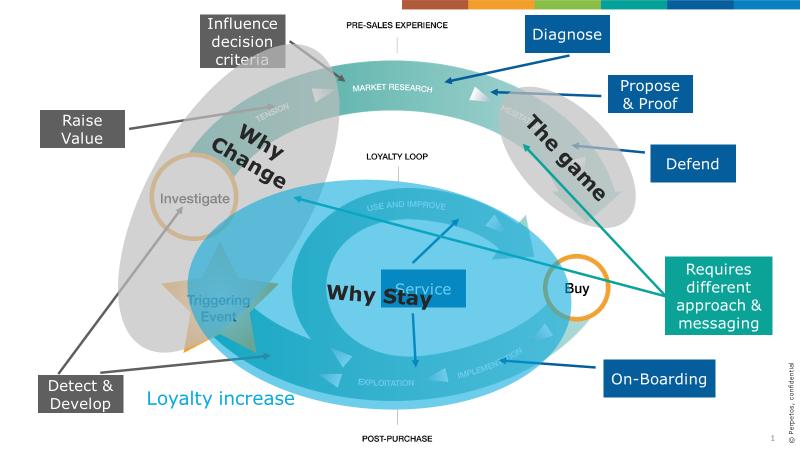
The most important insight to gaining rapid impact on upcoming negotiations is acknowledging that Negotiation is no more than a game with lot’s of activities before and after. In other words, detect and change selling tactics depending on being ‘in’ or ‘out’ of the game as shown on the customer journey image below.

Sellers spend way too little time in the Why Change phase which is the only time to sell value as explained in our blog “How to get started with value selling“

Negotiation, like the game of chess, is a matter of making a move and anticipating the next move of your customer.

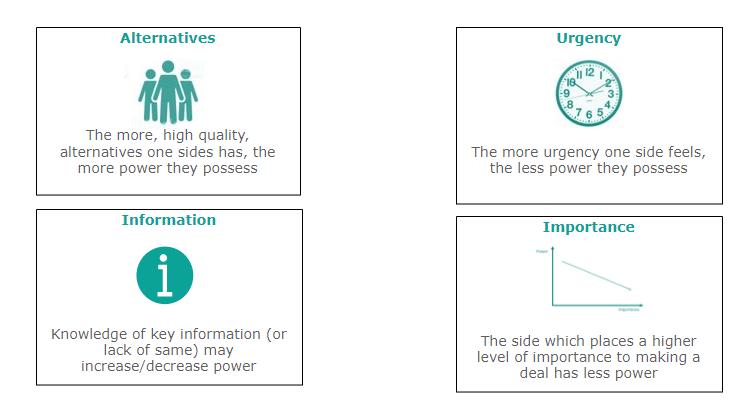
Most sellers believe the balance of power lies with the customer. As a consequence, they often make unnecessary price concessions to win the business. Recent research shows that less than 25% of professional buyers award contracts to the lowest bidders. Clearly price isn’t the only issue buyers are concerned about. Power is critical to any negotiation. Having the upper hand on the balance of power allows you to control the endgame

The balance of power in any negotiation is in the minds of both the buyer and the seller and comes from several sources:

Conducting an analysis of our strengths, and the risks the customer faces, may reveal we have more power than we think

Negotiation is the process of coming to an agreement. Remember the quote from Benjamin Franklin:

By failing to prepare, you are preparing to fail

Interested in improving your negotiation skills?

Book a meeting with one of our negotiation specialists


Agfa HealthCare: Where are you today and how is it still used?

Willy Rosé, Head Marketing IT Europe & International, explains how the Buying Clock®, buyer personas, master slide deck and interactive marketing materials, are still used today within Agfa HealthCare.

He mentions amongst others, how this is used during onboarding of new commercial employees, and how it enables them to get quicker up to speed with the vision and allows them to speak the same ‘commercial language’. He also talks about how every marketing initiative that is being launched starts with the same perspective, Agfa adopted recently.