
A key account had been buying from our client for years. But a new leadership team on the client side resulted in a decision to test the market.
Our client’s customer had received a competitive offer 12% below their own price. They were not opposed to a 3-year engagement but wanted to reduce costs by 5% and refused to be tied to any automatic price increases. They preferred to renegotiate annually and keep their options open.
Our client’s Key Account Manager obviously had to come prepared.
What he did differently
Of course this was not his first negotiation. But it was the first time he prepared for one using a structured game plan developed together with Perpetos. The approach gave him a clear framework to map scenarios, assess the balance of power, and decide on his positions before walking into the room. Rather than figuring it out under pressure.
Instead of walking in with a price defense, he started with that game plan. He mapped out all possible scenarios before the meeting. He assessed the balance of power and decided where he could influence it. He defined a starting position (a three-year contract with a fixed 16% price increase) and a clear Plan B (a three-year contract with a fixed 11% price increase and 1,5 M$ of new volume).
When the meeting started, his first question was: “What has changed since the last time we spoke?”
That single question brought him a lot of new information about the client’s priorities and on the broader scope of the RFP. Meaning: a clearer picture of what the client actually needed to justify a decision internally.
From there, the conversation moved away from price. He focused on the added value of the collaboration over the years: saved time, reduced waste, avoided production costs. He talked about the risk of switching suppliers and the value of supply certainty over three years. And he resolved every open issue live at the table, blocking off any leverage related to quality or service before price came up.
The outcome
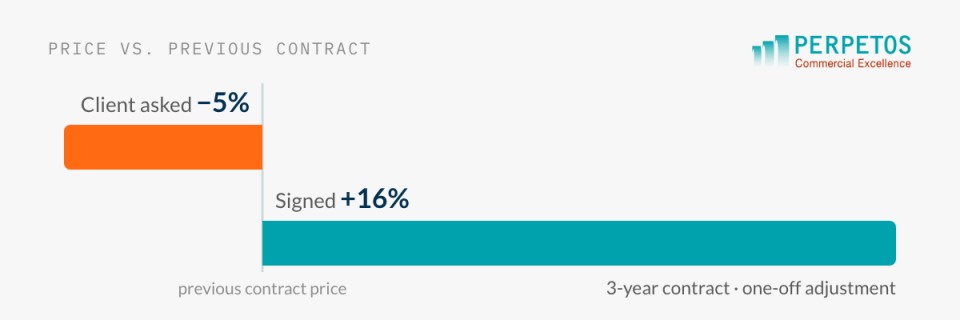
The key account expected a 5% decrease… instead they signed a three-year contract with a fixed one-time 16% price increase and a stable supply leading to other value.
That outcome didn’t happen because the Key Account Manager got lucky or because the client suddenly changed their mind. It happened because he was prepared differently. He knew his starting position and his walkaway. He understood what the client needed to say yes. And he had the tools and the mindset to steer the conversation rather than react to it.
What the team took away
The program didn’t stop at the negotiation table. The broader team worked with Perpetos to identify what they needed to keep doing, stop doing, and start doing.
Stop leading with product. Stop offering concessions before all objections are resolved. Stop asking self-serving questions like “when are you making a decision?” and start asking “by when would you like the first shipment?”
Start every meeting by asking what has changed. Reconfirm all agreed-upon points before moving into price discussions. Build a formal assessment of the balance of power before entering any significant negotiation.
Come (thoroughly) prepared.
Simple in writing but genuinely difficult in the room, especially under pressure, with a procurement team across the table that knows exactly which buttons to press. That gap between knowing and doing is exactly where Perpetos focuses its work.
Why Perpetos?
Sales leaders sometimes ask whether bringing in an external partner for negotiation training is worth the investment. In this case, a single deal covered the cost of the entire program. One contract, one price increase that would otherwise have been conceded.
That’s not the only measure of success. The bigger return comes from building a team that negotiates with more confidence, more structure, and better outcomes across every conversation, not just the exceptional ones. And that kind of shift rarely happens from the inside alone: it takes someone who has sat across from procurement teams in dozens of industries, knows the pressure tactics being used, and can translate that experience into tools a team can actually apply the next day. It’s been proven very useful for sales teams to be challenged upon their own methods and have a fresh pair of eyes look at them.
If your team is also preparing for tougher negotiations, we’d be glad to talk about what that preparation could look like and how Perpetos can make a difference.
Some examples of other feedback we received from participants:
Negotiation is truly a chess game. The buyers, not matter how close the relationship is, are not being completely truthful. Preparation is so important. Having confidence in our own value makes the difference in setting our own mindset.
It is ok to push back and ask for something in return when a customer requests for something.
I need to dig deeper and find the underlying request. Don’t assume!
Great session, it gave me the tools I need to take this to my customer.