



Scientific research has shown that every buying cycle is a sequence of the same mental processes; almost as certain as a law of nature. Our Buying Clock is an easy way to see the willingness to buy of everyone involved in a potential sale.

You can work out where the client is on Buying Clock by asking questions such as:

  • Are you 100% sure that the current situation has to change?
  • What will the impact be of the new solution?
  • Have you calculated the cost and ROI?
  • What criteria will you use to compare suppliers?
  • Are you trying to understand the differences and benefits of the various options?
  • How do you guarantee your future supplier won’t eventually fail on your expectations?
  • Have you checked whether the new solution won’t bring new problems?
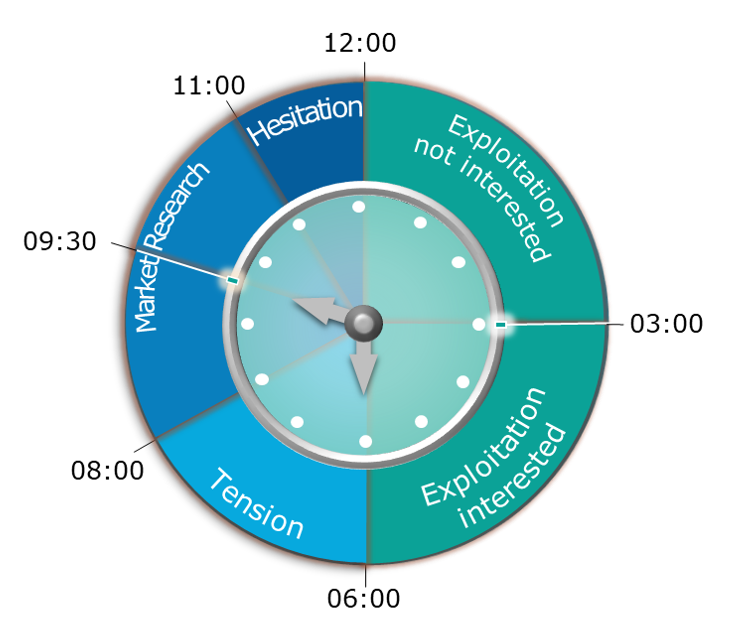
Perpetos Buying Clock

The buying cycles are far from always synchronized

You know ‘what time it is’ in the buying cycle when you’ve got answers from everyone who is influencing the decision. Everyone goes through the same mental processes in a purchase, and it’s very plausible that different people are in different stages.

The speed at which we go through the various stages of the buying cycle depends on various factors: experience of buying similar products or services, understanding the various options’ impacts, the decision’s importance and impact on us and our organization. A buying cycle can last from a few seconds to months or even years depending on these factors. Being able to detect and influence buying readiness and helping to synchronize the buying clocks will not only shorten the buying cycle. It will also improve conversion rates and decrease discounts.

Understanding the buying cycle leads to better results

Do your sales and marketing teams know what time it is on every client’s Buying Clock®? Wouldn’t it be great for your team to discover how ready your client is to buy, so they could approach them in the right way? Then sales would never start talking about product features before the client is ready to even consider buying that type of product. And marketing wouldn’t overload anyone with too much information about all the benefits. Clients will feel better understood, and make a decision faster, when approached with messages that match their buyer readiness.

When everyone in your organization can detect the client’s buying cycle, you can develop shared terminology to align your sales and marketing activities and increase your efficiency and effectiveness. To maximize your organization’s potential, make your client’s readiness to buy the reference point of your sales strategy and process. This can lead to the following impact:

  • Shared terminology for sharing experiences will improve the whole team’s performance
  • Precise timing of your actions, resulting in lower cost of sales
  • Higher conversion
  • Less margin erosion and discounts
  • Objective, predictable forecasts
  • In summary: more sales with higher margins at a lower cost

Curious how to prepare your commercial team for the empowered customer?


Does this sound familiar?

  • The customer is interested but the criteria for making decisions keep changing.
  • You sound out prospective customers for information – such as their current way of working and associated challenges – so that you can design your sales pitches accordingly, but they don’t bite.
  • You work with the same contact person throughout the entire sales process, and they are really interested, but suddenly replaced by a reluctant colleague in the final stage.
  • You have to send several quotes for the same sales opportunity
  • A deal gets called off just before it’s concluded. Subsequent inquiries show that the customer never even made a purchase order request.

Perhaps in all the above cases you are the victim of your own sales processes, which don’t take the customers’ readiness to buy into account. Too many companies fall into this trap, often lured by companies selling marketing techniques, training courses, CRM and marketing automation, consultants and software suppliers. They did a one-off analysis of a buying cycle, which was then converted into a sales process and uniformly applied to all customers and sales opportunities.

Navel-gazing leads you down a dead end

People who use sales processes as their guide instead of the customer’s buying cycle often find themselves down a dead end. This is just plain logic, because you are ignoring the customer’s reality in favour of your own reality. But it’s the customer who ultimately decides if and how much to buy.
You’re also asking your sales and marketing departments to convert all their external interactions into a linear and company-internal process. This never corresponds with the customer’s situation, by definition.

Briefly consider the following (and perhaps decide to get rid of the sales process):

  • There’s no such thing as one sales process for every sales opportunity. Each individual has their own dynamics and insights.
  • A sales process shifts the focus from the customer to the seller. A lack of focus on the customer leads to the right actions being taken, but at the wrong time.
  • Sales-oriented processes don’t offer any scope for sales to adapt their speed and communications to the customer, or to coach the customer according to their situation.
  • Someone who assumes their own processes can rarely make an accurate forecast: they only consider their own logic, and not the customer’s readiness to buy.

Copernican revolution

Another way is possible. There are models and tools that focus on the customer’s buying cycle rather than the sales cycle. Scientific research has shown that everyone goes through the same mental phases for every decision we make. It’s a mental phase that is not related to gender, age, job or nationality. Placing these mental phases in a model enables us to make this buying cycle predictable and so design a company’s actions to match it.

Sellers more important than ever

In this new model the role of the seller is more important than ever before. Every customer has their own way of indicating which phase they are currently in. The more important the purchase for the company, the longer the decision-making process can be expected to last. Only sellers who can correctly detect the buyer readiness of everyone in the buying cycle will conclude the majority of sales opportunities successfully. Because they are keeping their finger on the pulse, everything will run smoothly, as long as the customer allows. This doesn’t just improve your win ratio; it also keeps the buying cycle as short as possible.

Lower sales costs

So get rid of your sales process as quickly as possible and change your way of working, reporting and coaching to match the individual buyer readiness of all concerned. And sell more at a lower sales cost.


The advent of social media has given consumers a more powerful voice. Even though we’ve already known this for some time, it’s difficult to lose old habits, as Telenet discovered with its iPad campaign. The Facebook group criticizing this campaign now has 150,000 likes, which is much greater than the number of new customers Telenet will attract with a free iPad mini.

It proves that marketing communication has, despite everything, not been adapted sufficiently to suit the better informed and more involved customer of today. Telenet must now lie in the bed it has made for itself, but it could have happened to many others too. What three mistakes were made here?

Firstly, working with temporary campaigns is becoming less and less effective. In a saturated market with subscribers for an indefinite period, it comes down to the fact that your customer will also look at what’s on offer from your competitors, who are also trying to win regular customers with even stronger promotions. This results in smaller margins and there are no winners, except for the occasional individual who is happy with a new iPad.

Secondly, it appears that Telenet has too many latent unsatisfied customers who don’t fully realize their service provider’s added value. This is remarkable, particularly because the launch of King and Kong was otherwise a masterful success. The technical specs of what Telenet is offering are certainly not inferior, but customers apparently prefer an iPad mini to the ‘Internet 120’ from Telenet (because it’s easy to imagine what you can do with an iPad mini, but not why you’d need 120 mbps).

Finally, the customer is not central to the external communication. Otherwise you wouldn’t run campaigns that give new customers a very nice gift and existing customers simply nothing. Perhaps Telenet has to consider building up a community of customers and communicating in a language that a standard customer can understand (translate ‘Internet 120’ into the number of users that can surf simultaneously without experiencing any delay). Members of the community could also be tempted with gifts, of course: find a new quad-play customer and you receive credits for buying music online, or get two new customers for a smartphone, or three new customers for a tablet, for example.


The figure in your spreadsheet doesn’t lie: 13%. Your best salesperson accounts for about an eight of your sales, but you still have major doubts. His beliefs don’t fit in properly with your new business strategy, and even after lots of meetings, training and supervision, he’s still holding firm to his convictions.

He is still the technical salesperson who speaks most to your clients about how good your products are, but he doesn’t really listen, and is always boasting about his experience and skill. He still believes that selling to technical teams who can then defend their choices internally is the way forward. He doesn’t really help you think about the business as a whole or work out concrete ways your products can help clients move forward with their business strategy. But he’s still the best salesperson when it comes to sales and margins.

One of our clients struggled with this dilemma a few years ago. They ultimately decided – hesitantly and fearing a negative impact – to end the collaboration. And sales didn’t fall by 13%; indeed they didn’t fall at all. It seemed the salesperson was actually an obstacle when it came to capitalizing on the sales growth within the sector. In fact his departure even had a positive effect on short-term sales, and now – a few years later – it’s left no negative trace whatsoever. That’s the relative worth of your best salesperson. Other employees have noticed a positive impact on the internal operation too.

This mainly illustrates the importance of permeating company values and beliefs throughout all your business activities, including the HR policy. Every employee is an ambassador for your strategy. If this isn’t the case, there’s no getting round the fact that you’re better off without them. This might be a very unpleasant thing to do, but it’s essential for your department or company future.

1 3 4 5