

Value selling means selling a product or service while focusing on the added value you create for the customer. But how exactly do you do that? And how does value selling affect your experience with the customer?

Selling starts with understanding your customer’s end goal. The classic example that everyone knows by now is the story of the drill and the hole. Customers are not looking for products, they are looking for solutions, right? Okay, but what about the adhesive strip? Yes, there is that too, and this is where added value really comes into play.

Here’s what we mean. Your customer wants to hang a painting, so she needs a hole, not a drill. Right? Wrong: She wants to hang something, display something. But what does she want to hang? Is it something heavy? Does she want to change the content or place from time to time? If so, the adhesive strip is the right solution. After all, it leaves no marks and you can reposition your painting without damaging your wall. 3M understood this very well at the time.

Watch the video to learn more about the different phases in the customer journey and how to act in a successful way:

Do you understand your customer?

How often do you really know what your customer wants? How often do you know their end goal? Probably not always, maybe even rarely. Sales & marketing professionals don’t always dare to ask what they think they should have already known. So they remain silent.

Never assume, it makes an ASS out of U and ME. My boss used to tell me that, ad nauseam. But he was right, unfortunately.

If you understand the conceivable impact of your offering, if you understand its capabilities or competencies for the customer, then you can really add value to your conversation.

What is your value?

In a B2B context, you can reduce the impact of almost any product or service to one (or more) of these:

  • Time savings and thus cost savings
  • Increase in sales (i.e. by selling more or more expensive products)
  • Increase in margin

For many solutions you will have to make a considerable bridge between the strengths of your offering and its impact on your customer. Making that translation is value selling.

Now take a look at your website, sales presentations and other sales & marketing materials. How often do you talk about “we and us”? How often do you talk about “you and your company”? If you do mostly the former, then addressing your value proposition is an important first step.

3 important aspects of value selling

1. Know your customer and relevant stakeholders

Each stakeholder has their own experiences, intentions and goals. Understand the context in which your customer operates. Try to gain insight into their underlying motivations. This way you can later influence them to your own advantage. Engage in conversation and dare to ask the right questions.

2. Make a bridge between your solution and the (personal) impact for all stakeholders.

Make it concrete using examples, tangible evidence and/or customer testimonials. Calculate the return on investment (ROI) for the client so that the impact becomes even more tangible.

3. Understand your customer’s propensity to buy.

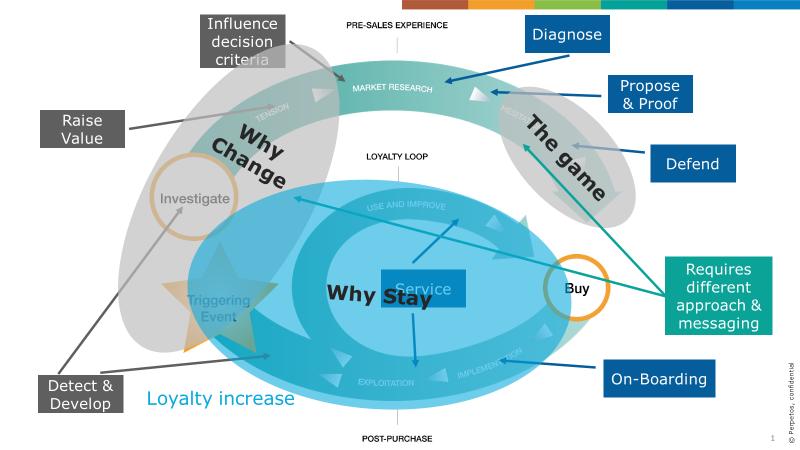
Before customers make a final buying decision, they go through several mental phases. Some customers go through those phases quickly, while others need a little more time. Depending on how prepared your customer is to buy, they will focus on different things. That in turn determines what your customer will actively listen to and what messages he is open to. Adjust your communication accordingly. Packaging your sales messages according to Why Change, Why Us, Why Stay will result in increased margin and win-rates.

Practical tips for value selling

  1. Share new insights or information that your customer does not have (easy) access to.
  2. Show new perspectives or suggest a new way of working that your client may not have considered.
  3. Navigate by providing knowledge. Help your customer make the right decisions.
  4. Help your client dodge the minefield by avoiding bad decisions.
  5. Help to sell to peers or upper management decision makers.
  6. Justify the purchase by quantifying the added value.

You can learn how to value-sell

Value selling means not being afraid to engage in conversation and ask the right questions. To my great surprise, in my experience with sales teams, therein lies the biggest challenge for sales professionals. It’s about conversation techniques, above and beyond questioning techniques. How do you formulate the right questions? How do you encourage the customer to tell you much more? How do you start a dialogue, instead of an interrogation?

The good news? Value selling can be learned. Even more, we can help you do it.

In our next blog post, we’ll take a closer look at why value selling is a good idea, and we’ll discuss the impact value selling has on your sales success.


We have never faced so many unpredictable parameters changing at the same time:

  • Market pivoting from avoiding supply chain risk to price decrease
  • Buyers are confronted with suppliers (having/still) passing on price increases
  • Some material indices are currently going down (eg. due to the oil price)
  • The supply chain starting to normalize but still volatile depending on region and business
  • Increased pressure from customers’ top management for procurement to “lower cost”
  • Increasing need to defend value which require moving from cost-plus to value-based pricing models

All of above leading to customer conversations being tougher than ever before.

The challenge for sales teams can be divided in 3 large buckets:

1. Doing the right things at the wrong time leading to poor impact

  • Trying to influence the customer perceived value during the negotiation
  • Accepting concessions while there are still unsolved obstacles
  • Lack of preparation needed to have a good A/B win strategy

2. Wrong or no assessment of the Balance of Power

  • Mis-reading the level of power you have over the customer
  • Not having access to key influencers and allow purchasing to keep you from talking to the business leaders
  • Lacking strong ‘why stay’ messaging to defend and increase the share of wallet

3. Taking negotiations tactics too seriously

  • Techniques such as good cop/bad cop, pencil sharpening, red herring and selective memory are no more than tactics to get discount
  • Discount does not exist. It should be an exchange of value
  • Lack of confidence in the offering, services and pricing as if the competitors don’t have their own problems. A reality easily forgotten during the negotiation game

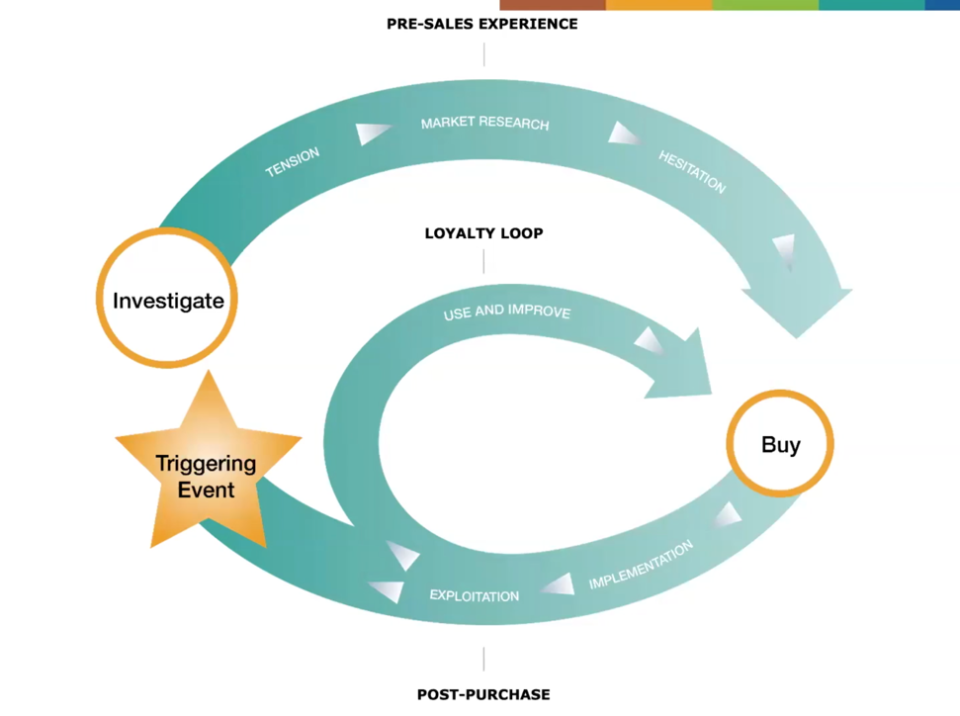
The most important insight to gaining rapid impact on upcoming negotiations is acknowledging that Negotiation is no more than a game with lot’s of activities before and after. In other words, detect and change selling tactics depending on being ‘in’ or ‘out’ of the game as shown on the customer journey image below.

Sellers spend way too little time in the Why Change phase which is the only time to sell value as explained in our blog “How to get started with value selling

Negotiation, like the game of chess, is a matter of making a move and anticipating the next move of your customer.

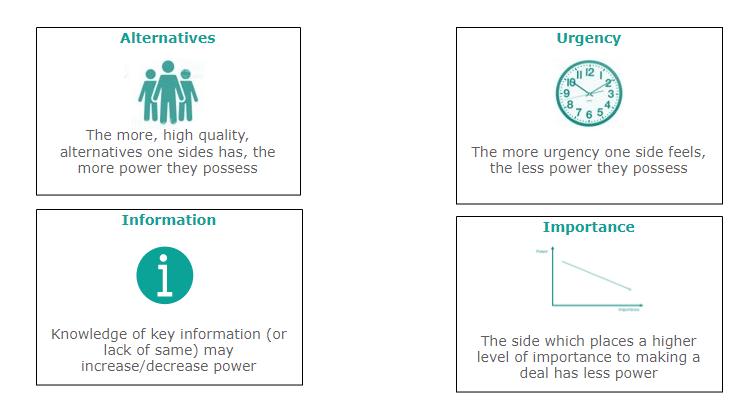
Most sellers believe the balance of power lies with the customer. As a consequence, they often make unnecessary price concessions to win the business. Recent research shows that less than 25% of professional buyers award contracts to the lowest bidders. Clearly price isn’t the only issue buyers are concerned about. Power is critical to any negotiation. Having the upper hand on the balance of power allows you to control the endgame

The balance of power in any negotiation is in the minds of both the buyer and the seller and comes from several sources:

Conducting an analysis of our strengths, and the risks the customer faces, may reveal we have more power than we think

Negotiation is the process of coming to an agreement. Remember the quote from Benjamin Franklin:

By failing to prepare, you are preparing to fail

Interested in improving your negotiation skills?

Book a meeting with one of our negotiation specialists


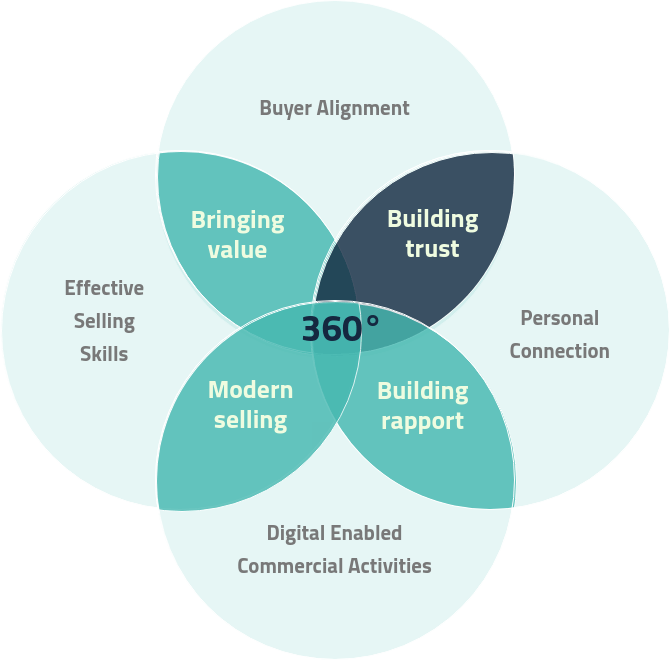
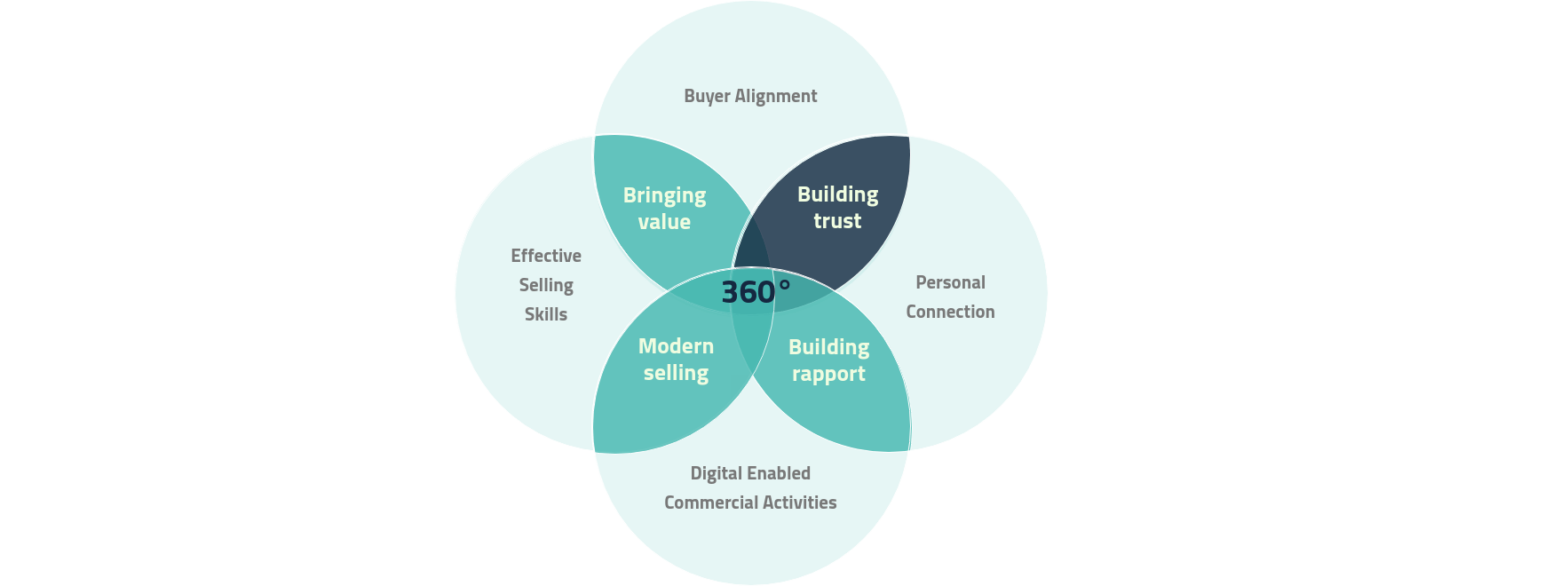
360° Buyer Alignment - Building Trust

Article 360° Buyer Alignment

Selling through building trust

How can you create and build trust, aligned to each step in the buying cycles of those involved?

The name of the game: provide relevant and value-adding messaging in every customer contact moment.

It almost sounds like a slogan but today, even more than before, it is the challenge for sales people.

How do you create trust during brief, and especially during digital, contact moments?

Building trust

You can approach trust from many angles. Trust that you deliver what you promise, trust in your competences, or in you as a person or the team, …

This quickly brings us to the personal connection one makes during (customer) interactions. Why do certain people manage to gain trust faster than others? Or why do you make a personal connection with certain people more easily or more quickly?

There are various models that provide a framework for gaining insights into someone’s (preferred) behavior and for adapting your behavior and communication to the people you are in contact with (Insights, Social Styles, MBTI, DISC,…). Maximizing trust in today’s market means combining authenticity with the right message at the right time, to accelerate the effect of a good personal connection.

Over the past decades, neuroscience has explored how to map the parts of the brain that play a role in decision making, which parts light up when different emotions are felt and what connections can be made with trust. It is a fascinating and still evolving scientific discipline.

One thing we know for sure is that the salesperson who works primarily on the relational aspect is coming under increasing pressure. Time pressure, conflicting priorities and more choice are creating a dynamic where the purely relational is no longer enough to ‘spend time with a salesperson’.

Sales people who can detect the willingness to buy of the various stakeholders during the buying cycle can add the right relevance and are able to build trust more quickly. They ask themselves questions such as:

  • How do I create trust among all those involved, taking into account the diversity of roles, expectations, personalities, buying cycle phases, etc.?
  • How do I align my interactions, tailor my sales messages and bring value so that stakeholders recognize me as the first person to contact for genuine and relevant answers to their questions.

Building trust with each stakeholder in a buying cycle is only possible if you can add the right relevance and adapt this to the different personalities and the willingness to buy.

Reading Tip
Stephen M.R. Covey’s book “The speed of Trust” is a great book to deepen your understanding of how to build trust quickly.

Buyer alignment – buyer center coverage

In the previous sections, we talked about building trust through personal connection and relevance, tailored to the people involved. One of the challenges that every sales person experiences, regardless of whether you work in project-based sales or more recurring sales, is broadening your network with your customers.

A lot of opportunities are lost or stagnate because of lack of contact with and insight into all the parties involved who influence the decision. Because people now inform themselves more and more via digital means, a large part of the influencing of decisions happens outside the reach of the sales person. This is a major risk if the sales person continues to sell via a ‘sponsor’ instead of managing and developing as many relationships as possible in parallel.

Let’s take a side step:

LinkedIn published an article at the end of October 2021: “The Great Reshuffle is Making Selling Hard. Here’s How to Best Adjust.”

The article indicates that we are in the midst of the “Great Reshuffle” of talent. Globally, job rotations have increased by 28% in the last three months. Corporate director-level job turnover – i.e. the mass of B2B buyers – has risen by 31% globally over the last three months.

No wonder a recent survey found that 80% of salespeople have delayed or lost a deal because of a change in function within an account. It is difficult to sell to a moving target.

The blog also rightly highlights the positive side of function or job changes of buyers: this can also be your entry point into a new customer if you had built up a good relationship with the buyer in question.

When a new buyer comes in, LinkedIn states that the salesperson must align the solution with the customers’ strategic initiatives and demonstrate its value.

The following paragraphs from the blog reinforce this:

If you are doing this well, then you can be an asset to a new executive sponsor and help them get up to speed on the critical initiatives your solution supports.

In this environment, the gap between strategic partners and expendable vendors is growing. The difference is value delivered at the right level and time.

It also means giving them the tools and training to be effective in virtual selling. After all, nothing builds morale quicker than success. And the right tools and training play a big part in that.

The LinkedIn article nicely illustrates how job rotation can have a huge impact on the buying process both within sales teams and with buyers. In addition, the blog points to the importance of broadening relationships within a customer to accommodate this and why you can be successful when the right value is delivered at the right time.


To improve your sales chances and engage customers, it’s important to identify where your customer is in their buyer journey. Do they need to change supplier? And if so, why should they choose you? Or are you already their supplier, and you need to convince them to stay? These different situations call for different messages, so you need to gain insights into your customer’s roles and challenges, create targeted messaging, and train your salespeople to deliver it correctly. 

Driven by insights, Marketing must build targeted communications and content. This should drive action and conversion, both before and after sales engages with customers.  

Engage customers with deep buyer empathy 

Your sales force needs to adapt its messaging to the particular situation so it can communicate your added value efficiently and effectively. But sales pitches often focus too much on internal issues, causing commercial professionals to simply act as talking brochures and lose sight of the messages and skills they need to convince your customers. 

So instead of talking about what you do and why you think you can do it better, you need to create a buying vision that defines a new set of challenges that align with your particular strengths. For example, the key question that new prospects need to answer – to break their status quo and initiate their buying journey – is: why should I change?  

Follow these three steps below to identify where your customers are on their buying journey, work out what specific messaging you need to use, and deliver it correctly… 

Step 1: Gain insights into roles and challenges 

Wherever the customer is in their buying cycle, to build a compelling case, you first need to find out more about their situation. 

  • Start by talking to the decision-makers to gain an understanding of their KPIs, challenging projects, and any blocking issues;  
  • Use contextual interviewing techniques to build trust, create credibility, and gain valuable insights into their specific challenges – and find out what capabilities they envisage will solve them; 
  • This will help you collect, organize, and build messages for your salespeople to create empathy and demonstrate business acumen; 
  • Salespeople who understand their prospects’ and customers’ roles and challenges can adjust accordingly, so they’re better placed to influence the buying criteria and improve the returns on their sales efforts. 

Step 2: Create three types of messaging 

To improve your sales chances, salespeople need to articulate value messages that resonate with customers’ specific challenges and have access to decision-makers who are much better placed to convert leads into deals. But they still need to know how to have successful conversations which promote a shared vision early enough in the decision-making process. It is therefore essential to understand buyers’ roles and relevant business challenges when creating this vision. 

For example, staying the same is safe and comfortable, whereas change is associated with threat and risk. If too many deals in your pipeline are being lost to ‘no decision’, rather than to your competitors, your real threat is the status quo – because buyers are deciding they prefer to do nothing instead of change. This means you need tell a story that explains why they should change and leave their current situation, and why they should do it now.  

Acquiring new customers and developing new accounts therefore requires messaging and an approach to customer conversations that is distinct from those used for existing customers. So marketing needs to equip your commercial people with three different types of sales messages and tools: ‘why change’, ‘why choose us’, and ‘why stay with us’.  

These three messages need to align with each member of the decision-making unit’s journey, which increases the number of conversations, and unfortunately this complexity can undermine sales performance.  

But whatever the customer’s situation, you need to explain why their current approach is putting their business at risk. To do this, you need to demonstrate that you know and understand their business, and can deliver insights into what they’re missing that will improve their performance. So, to address your buyer’s situation, you need to equip your salespeople with the right messaging to take advantage of any opportunities at early an early stage – to gain and keep control of the buying cycle right up until the deal is sealed. 

Step 3: Train your salespeople to deliver the right message to the right people at the right time 

Prospective customers are a different proposal to existing customers – customer acquisition is all about challenging the status quo to highlight the benefits of switching to your solution, whereas customer retention and expansion requires you to reinforce your position as their status quo: ‘why change’ and ‘why us’ messages will resonate with prospects, but ‘why stay’ is designed to foster customer loyalty. Make sure your marketing tells the right story for the right customer. Bearing this in mind, you need to: 

  • Help your salespeople gain access to executive buyers early in their decision-making process, and work consultatively with those buyers to shape a vision for their solution; 
  • Build a messaging kit that covers what to say to whom, and when, in order to ensure engaging conversations; 
  • Train your commercial force, use role play exercises to practice typical scenarios and conversations, share best pitches through the use of videos, promote ‘intervision techniques, and provide constructive feedforward from the customer perspective. 

How can messaging kits help? 

Developing messaging kits can help marketing help salespeople gain access to executive buyers early in the decision-making process, and work consultatively to shape the vision of the solution they can provide. These messaging kits offer insight-driven content so your salespeople can engage more deeply with buyer empathy. This can enable sales through having a messaging repository and customer-centric presentations, impacting customer stories, and organizing training sessions for salespeople to learn how to sell certain solutions. 


Probably you have seen this quote passing by several times on your LinkedIn feed: 

“CFO says: What happens if we invest in developing people & they leave us? 

CEO responds: What happens if we don’t & they stay?” 

Now I ask you: How do you make sure your investments in learning & development are effective and pay off? Simply put: How do you make it stick?  

The major pitfalls of sales trainings are the following

  • Lack of reinforcement  
  • Lack of engagement  
  • Lack of business relevance  

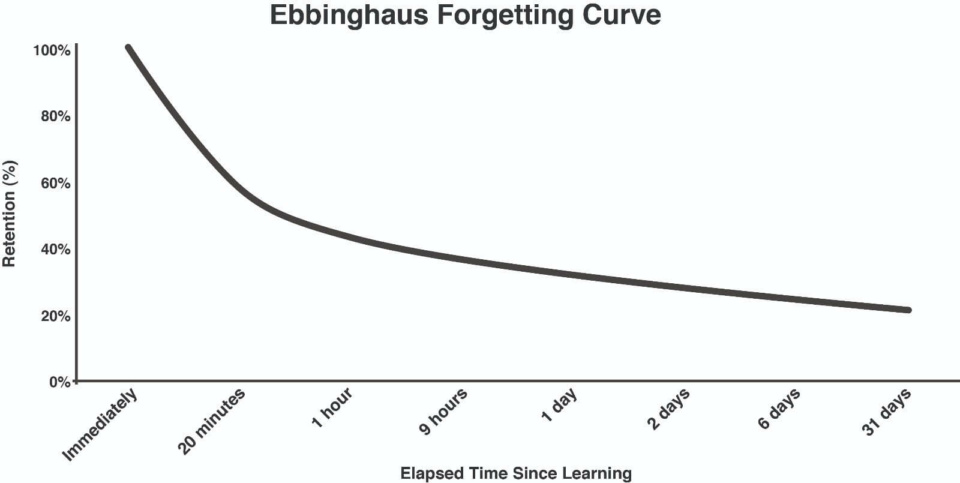
Competency does not come from periodic, one-time training. According to Ebbinghaus’ Forgetting Curve, learners forget 90% of what they learn from an event-based approach within 30 days, with most of the new material being forgotten within the first few hours after the training.  

Ebbinghaus’ Forgetting Curve

True though; there is not a single, absolute learning curve. Several factors contribute to learning retention, like individual ability and prior knowledge. But the risk of forgetting fast is real for most of us.

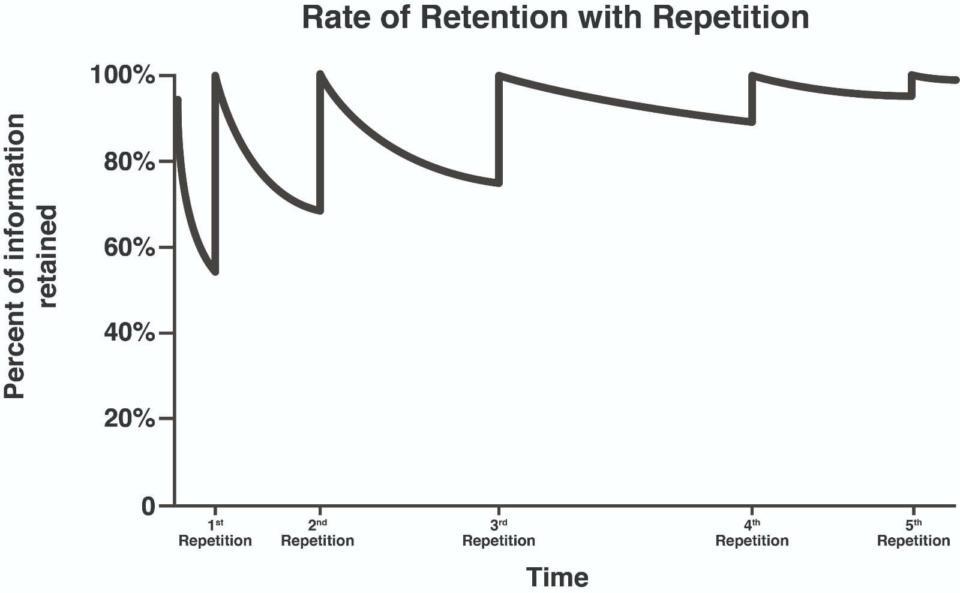
A first solution to promote knowledge retention is spaced learning (1). In short, i.e. multiple training opportunities. Many figures like this one show how less is forgotten after each review.

Rate of Retention with Repetition

Repetition is indeed the mother of learning. We also notice great results by combining spaced learning with micro-learning (2)! Micro-learning breaks down complex courses into smaller manageable learning content. Not only do we enhance retention rates through repetition, but we also speed up the learning process because trainees avoid the phenomenon of mental fatigue.

Of course, transfer to the job (3) is equally as important. In the end you are aiming for measurable business results, are you not? Knowledge of concepts is one thing, the capability of applying them another. So, if you want to see impact on your sales results and implement lasting positive change, you will want to change habits and behaviors. 

That is where the design of the training matters and on-the-job learning and coaching come into play. Think about group coaching, peer learning, in the field coaching done right (i.e. where the coach does not intervene) and using mobile technology with scenario-based challenges. 

By genuinely including your team in continuous training opportunities, you can make lasting changes in sales behaviors and positively impact performance. 

Next, make sure trainings are relevant to the business and your team’s objectives (4).

Do you remember those compulsory courses you had to follow in school which were nowhere close to your field of interest? Probably not your absolute best. It is the same with business training. Making it business relevant and aligned to individual and team objectives will generate higher engagement, increase on the job practice, and generate tangible results.

A good way to gauge this, is whether people within your sales team take ownership of their day to day activities and proactively ask for feedback about their successes and challenges, encountered while consciously trying to apply what they have learned.

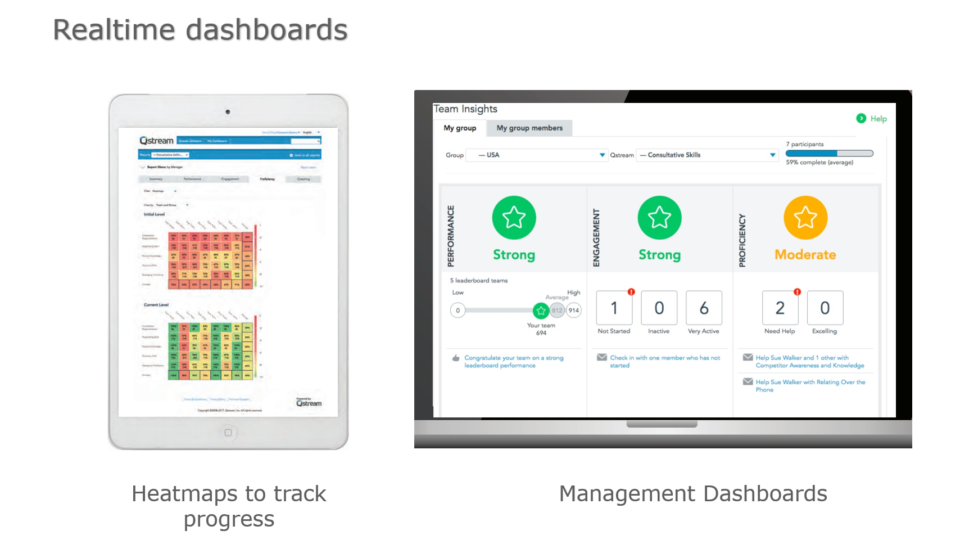
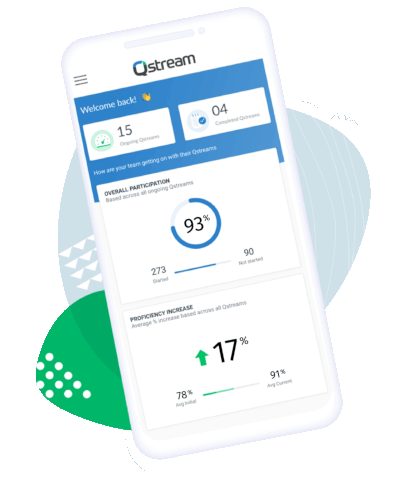
Finally, think about building a performance dashboard (5) measuring proficiency, adoption, and the link to commercial performance. It will enable you to do two things:

  • See how competency levels are evolving within the group in order to put your time and effort where it matters most
  • See the direct link between your investments in L&D and business results.

Want to read more about this topic?

Related Content


Collective intelligence makes your sales team smarter. Empower your entire team to help one salesperson solve a problem by using intervision techniques to leverage collective intelligence. 

Collective intelligence 

Put simply: ‘two heads are better than one’. Intervision techniques therefore help you harness every member of a team’s own thoughts and ideas to promote group intelligence – investing in each member and increasing the potential of overcoming one salesperson’s specific challenge. 

Intervision techniques call on collective intelligence 

Intervision, also known as ‘group coaching’, ‘peer coaching’ or ‘co-development’, refers to an activity with a small group of professionals who have a professional context in common. It emphasizes the multilateral contribution between colleagues – as opposed to supervision – because collective intelligence is a kind of wisdom and knowledge that grows out of a group. 

The intervision technique provides sales managers with a different way to interact with their team and team members. Similar to group coaching, it relies on questioning and active listening, but also employs brainstorming techniques and makes it possible to tackle both technical and conceptual problems. The main difference, however, is that intervision covers topics that will benefit the entire sales team and make it more effective, whereas individual coaching aims to solve a problem specific to the salesperson. 

What sales problems can intervision techniques help to resolve? 

Team meetings are too often laborious and ineffective, and this is where collective intelligence can help. Intervision techniques relate to sales team coaching. They develop sales efficiency, strengthen team spirit, and increase corporate identity. They can be used to generate new ideas, discover new ways to analyze situations, and find new possible solutions. 

There are a couple of conditions for its effective use, however: the presented case must be real, and it must relate to a real blocked sales opportunity, for example in a situation where a salesperson experiences repetitive failure or a persistent communication issue. 

The exposed situation very often reveals a common problem – something that sounds familiar to all salespeople, which they might have been exposed to in the past or are still facing today. This is why the intervision session can benefit the whole team. 

How to moderate an intervision session 

The session can be done with or without a facilitator, but it’s always crucial to stick to the allocated time for the exercise to be effective and stop the group from dwelling on details. It is recommended to spend 45-90 minutes on each issue as a group, depending on the group size and complexity of the topic.  

  • During an intervision session, a participant raises one issue, which could be a new challenge or a problem that they have encountered. It’s essential that it’s an ongoing issue.  
  • The other participants then act as consultants and commit to share ideas, collaborate, and help the salesperson who wants to overcome a difficult situation. Group members ask questions to find out more about the topic and clarify particular points. It’s important not to start discussing solutions at this stage, but simply to focus on clarifying the issue. 
  • The next stage is for the group to start brainstorming possible ways of approaching the problem and suggesting possible solutions. The issue owner is invited to listen and to take in the proposals without joining the discussion.  
  • Following the brainstorming session, the group makes a number of recommendations and suggestions to the issue owner, who can then provide feedback on what he/she has heard from the group: how it helps or not, what they can take away from the exercise, etc.  

Selling in uncertain times 

This technique is particularly relevant in today’s market – with fierce competition and rapid change. Sales organizations need collective intelligence to be more agile and adaptive without burning talent.

Talk to our experts to find out more. 


To stimulate improved sales performance, it’s important to understand and practice digital behaviors that promote a sense of psychological safety. You can encourage this psychological safety in your commercial team by: 

  • Framing the work as a learning process,  
  • Acknowledging your own fallibility; 
  • Modeling curiosity and asking lots of questions. 

Remote working and digital communications 

Psychological safety and trust in leadership are more important than ever before as sales forces are increasingly working remotely and communicating digitally.  

Leverage psychological safety 

Amy Edmondson, Professor of Leadership and Management at the Harvard Business School, defined the notion of psychological safety as a shared belief that the team is safe for interpersonal risk-taking and being vulnerable in front of each other. In other words: team members feel accepted and respected in psychologically safe teams. 

This means that members of effective teams feel comfortable asking questions or bringing up new ideas – without worrying about being judged – and are confident they won’t be embarrassed or punished for making mistakes.  

The whole is greater than the sum of its parts 

In line with this phrase first coined by the philosopher Aristotle, we also believe that members of efficient sales teams can achieve more by working together than working alone. An efficient commercial team is therefore more than the sum of its individuals – so even though getting these individuals to all work together can be tough, it’s critical for team effectiveness. They need to plan, solve problems, make decisions, and review progress. And they need each other – and efficient leadership – to get this work done successfully. 

3 behaviors that increase team efficiency 

A Google study reported in The New York Times Magazine highlighted several factors that boost team efficiency, and psychological safety came top in the order of importance. The most effective leaders are therefore those that create a safe and open ‘digital dialogue’ with their team members.  

There are three specific behaviors that strongly correlate with high-performing managers: 

  1. Expressing doubts: Do you feel safe saying ‘I don’t know’, or are you worried about seeming ignorant or incompetent? Managers who admit not knowing the answer to a question – and who create the same sense of security in their direct contacts  – are more effective than those who do not.
  2. Requesting feedback: Asking for and providing feedback increases effectiveness and engagement. Digital interactions through video conferences, chats, or email are good opportunities for providing constructive feedback – and constructive feedforward.
  3. Sharing opinions: It’s important for team members to feel confident that nobody else in the team will embarrass or punish them for offering ideas or questioning the status quo.

Our 9 tips for building psychological safety 

  1. Create a forum to discuss issues and concerns
  2. Establish a common language
  3. Ask for input and opinions, stimulate feedback, and provide feedforward 
  4. Share your communications and personal preferences, and encourage others to do the same
  5. Clarify team member roles and responsibilities
  6. Communicate team objectives and determine how each member can contribute to the team and broader company objectives
  7. Explain what work you are doing and the impact it will have on customers and the company
  8. Adopt a customer-centric evaluation method
  9. Seek continuous improvement  

During periods characterised by insecurity the general attitude towards salespeople changes. In addition, customers’ focus shifts to short-term solutions and the reduction of risk. Both constitute an opportunity for enterprises and salespeople who manage to adapt to this situation quickly. Adding value while responding to this situation and at the same time focussing on enhancing customer confidence.  

There are four elements that play a role in creating value for the customer:  

  • How can we improve our insight into the customer’s situation?  
  • What are the techniques we can use?  
  • How can we keep all conversations relevant?  
  • How can we ensure that customers are prepared to pay for it?  

In this respect it’s important to have a good insight into the customers’ “Buyer Journey”.  

Waarde creëren in tijden van grote onzekerheid

A few important things to take into account:  

  • A late entry in the buying cycle does not provide much room for value creation, as the customer already knows what he wants and has a preferred supplier with whom he compares other suppliers 
  • If you enter the cycle before the trigger moment, your chances of success are much better.  Nevertheless, your focus should be on messages that increase the willingness to change, i.e. messages that break through the status quo and the “loyalty loop”.  
  • As a salesperson, you must be able to guide the customer through his buying cycle by aligning the activities and messages to what is important to him.  

When you have contact with a customer, you can find out where he is in the buying cycle by asking a few questions. It’s not possible to reverse the cycle. If the customer is already at the end of the cycle, you need very strong conversation techniques to create an opening. Unfortunately, the consequence is that the price is a very important factor, unless you are lucky enough that others before you have made a significant mistake.  

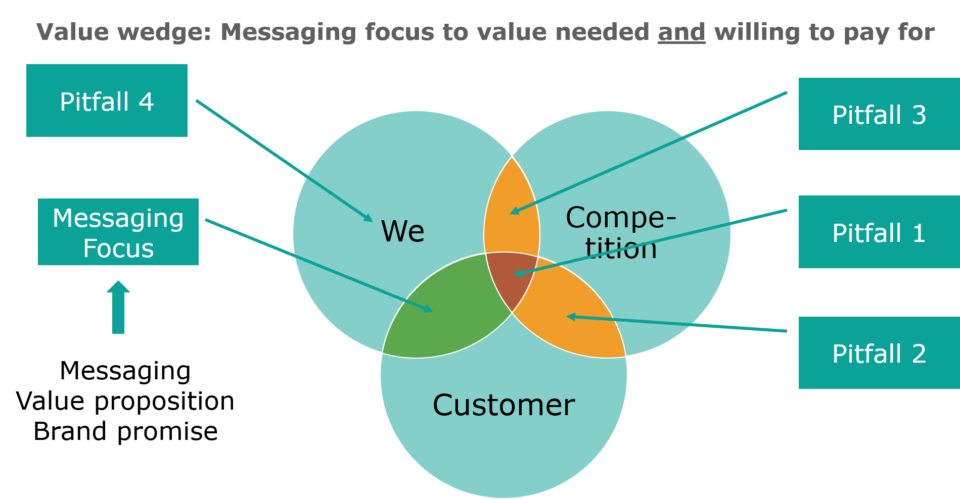
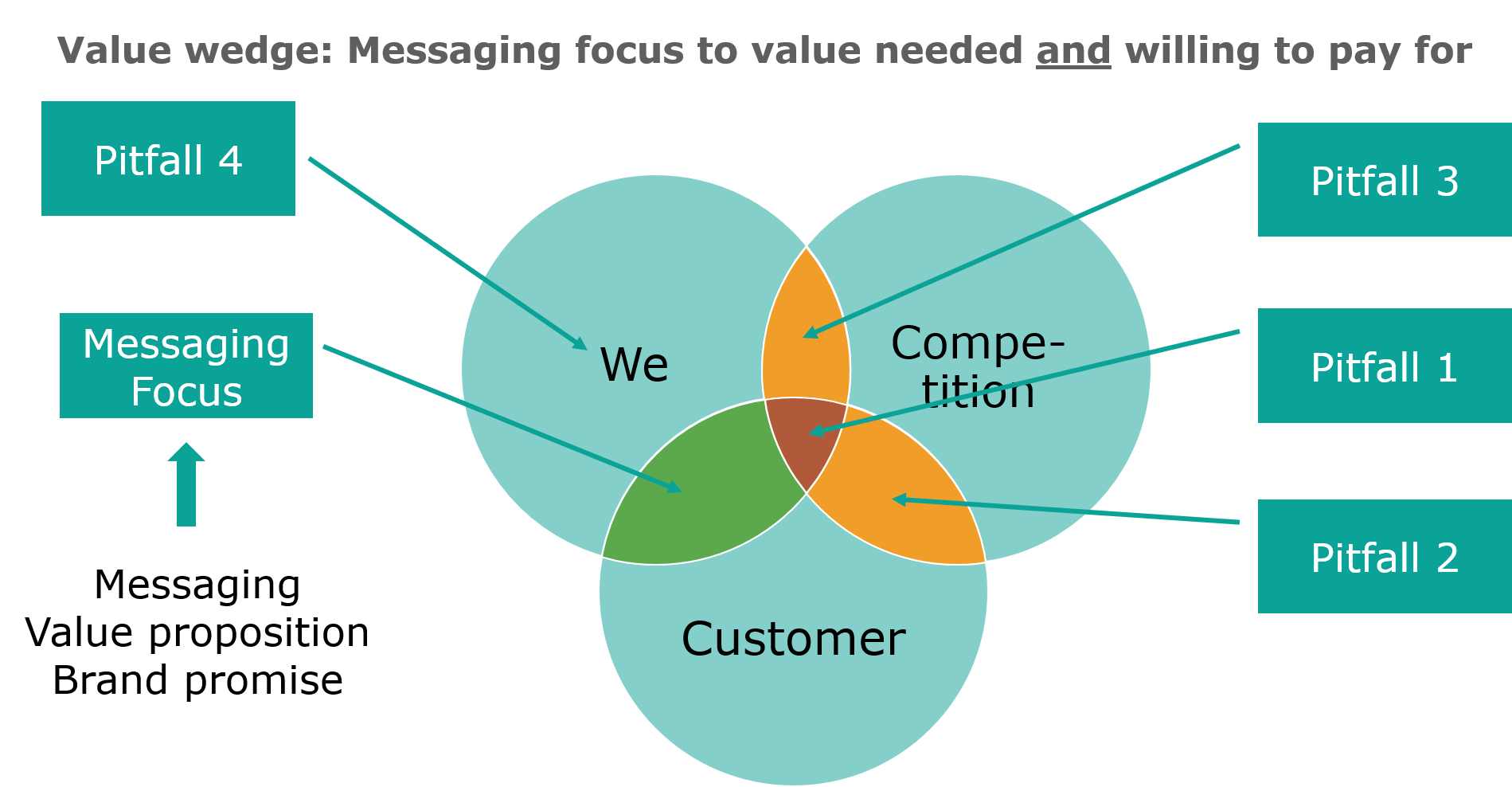
The value wedge combined with the phase in the buying cycle indicate how the added value can be created.  

value wedge

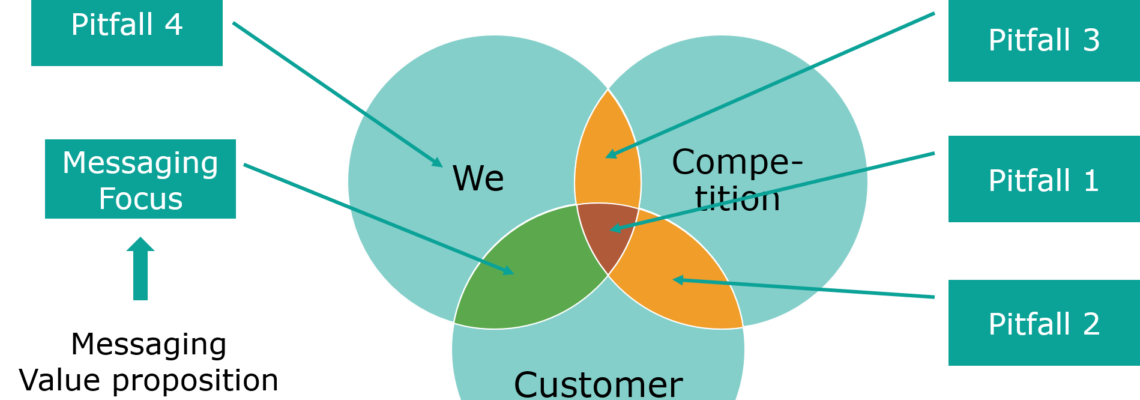
First let’s discuss the typical pitfalls and mistakes that are made on the basis of the value wedge.  The salesperson:  

  1. doesn’t distinguish himself from the competition, just tells the same story 
  1. tries to convince the customer with strong points of the competition that are not at all strong points of his own offer, as it is clear how important they are to the customer.  
  1. is too focused on outdoing the competition by focusing on strong points they both have but that are not relevant for the customer 
  1. fails completely by presenting entirely irrelevant advantages and messages on the basis of his own convictions or non-identical situations, causing irreparable damage to customer confidence.  

If the right conversations take place in line with the specific phase in the buying cycle, the essential confidence will be built quickly, and the critical insights will be acquired that enable the salesperson to focus on the messages that are important to the customer and that the competition overlooked.  

A few “must-do’s” during conversations:  

  • Tell a clear story about similar situations and thus quickly build confidence for the next steps.  
  • Use the right interview and conversation techniques to not only have full knowledge of the situation but also to quantify. This will have a major impact on the price the customer is willing to pay.  
  • Once preparations are complete, your first contact in the active sales cycle is preferably the person who is exposed to the most disadvantages and at the same time has the highest decision-making power. This way you structurally increase your chances of quickly breaking through the status quo.  
  • Ask closed questions to validate your assumptions and monitor your rapport with the person concerned.  
  • Provide a solid underpinning for a possible change, so as to make it easier to minimise discounts and therefore to sell at a higher price than the competition. 

Do you want to know more about these essential elements? Contact us


Customers’ buying behaviour has changed considerably in the past few years. How can companies respond to this challenge? How do you organise sales in a digital world? Are you still sending your salespeople out like talking brochures, or will you take action? And how? A diagnosis.  

Time for a sales reboot 

Since 2012, the results of a multitude of studies about the changing buying behaviour of customers have been published. However, many companies only take action when the impact really becomes painful. And it’s often too late by then. It is therefore advisable to take action proactively. But can you motivate people and organise your sales in such a manner that the transition can take place in a timely and painless manner?  

Avoid a reaction that is either too soft or too hard 

There are two ways to react to the reality of changing buying behaviour.  

  •  (Too) many companies continue to assure their clients that with some adjustments, the existing commercial solutions are immune to the changes. Unfortunately, the sales pipeline is like the arteries in our body. If we do not adopt a healthy lifestyle, they slowly get clogged up. The consequences in the long term are disastrous. Holding on to old habits is not the solution.  
  • Others call for a revolution. The world is no longer the same, which is why a drastic transformation of sales is required. We have to start over! That means completely redesigning the processes and systems and preparing for the future! That may be so, but… intrusive action often triggers a shock effect, which in turn has serious consequences.  

Opt for the human approach!  

How can you react to the constantly changing world? Doing nothing is not an option. Starting all over again is not the right solution, either. Actually, the answer is simple: we have to evolve together with our customers. Selling is and will always be a people business, even online. The impact we are noticing with our customers and prospects shows that the changes are real. It is therefore necessary to develop a change process as soon as possible. This way, the changes can be implemented gradually and on a human scale. Without disruptions or all too radical actions.  

Toward a new role for salespeople  

All change processes are based on insights. Customers are still overwhelmed by salespeople who are sent out by their employers like some sort of talking brochures, although they don’t care about salespeople bombarding them with arguments and the benefits of the products they try to sell. Some consultants take advantage of this fact by stating that salespeople will disappear altogether. Nothing could be further from the truth, but it is true that the role of salespeople is changing drastically.  

60% of the sales opportunities come to nothing because the customer does not buy or does not change suppliers.  

The sales cycles have become 22% longer since 2012 and your biggest competitor is no longer your direct competitor, but customers who do “nothing”.  Recent research has shown that up to 60% of the opportunities are simply closed in CRM because the customer doesn’t buy anything or is not willing to change suppliers. You can imagine the impact on the sales cost.  

Sales are needed as long as you:  

  • … incorporate the right mix of digital and human touchpoints in the entire buying cycle of the customer. This depends on the complexity of the product or service you offer, but mainly on the impact on the customer.  
  • … use an interpersonal approach focused on supporting customers and creating added value. This requires the salespeople to have contact with an increasing number of different persons with the customer and at other moments during the buying cycle.  
  • … adjust the sales pitches to every moment during the buying cycle and to the profile of the persons with whom the salespeople are to engage in dialogue.  

Do you want to find out how you can prepare your commercial staff for the future without having to take all too radical actions? Contact us or read more in our eBook:

7 Criteria your sales process has to meet

Are you looking for a new Sales process to find a (new) way to reduce your cost of sales, stop margin erosion or better align your approach with the customer’s buying cycle? Learn how to make sure that the selected process is right for your business.


Why sales coaching?

Research by CSO Insights has shown that sales coaching enables sellers to substantially improve their sales skills and so win more deals. The second benefit is that it allows sales managers to shift their focus from simply helping people to do their work to actually developing their skills. Which is surely an advantage, isn’t it?

But how?

Sales managers need to use coaching techniques, tips and tools. Even though some may have a talent for coaching, many don’t know how best to go about it. Sales management coaching programs help them gain the skills and self-confidence they need to integrate coaching as part of their daily routine. Fortunately, there’s technology available to help them. Sales coaching software doesn’t just make it possible to personalise the coaching, but also to measure it by looking at the sellers’ individual actions, monitoring their progress and providing a visual representation to make things clearer, rather than simply using their own perception, gut instinct and experience.

Sales coaching tools

Coaching isn’t the same thing as providing solutions or giving everyone the same advice. A good sales coaching tool can chart progress and zoom in on the lowest level of knowledge, and combine this with the extent to which this knowledge is actually applied.

Sales coaching tools

It differs from eLearning or other content offered by Learning Management Systems (LMS) in this sense, because a sales coaching tool combines software for teaching sellers and ensuring they retain this information, stimulating behavioural change, making everything measurable, and providing suggestions for the management to reach the right conclusions and implement the right actions. Altogether, it forms an integrated solution that provides content exactly when it’s needed.

Enabling just-in-time coaching

This flexible (agile) method for developing sellers’ skills is called ‘Coaching Enablement’. It allows you to organise, manage and individualise coaching while ensuring sellers retain the information they’re given. It also provides dashboards for sales managers, higher management and HR. This means HR can now measure, support and adapt each employee’s development and the impact they have. Peer-to-peer learning is also provided.

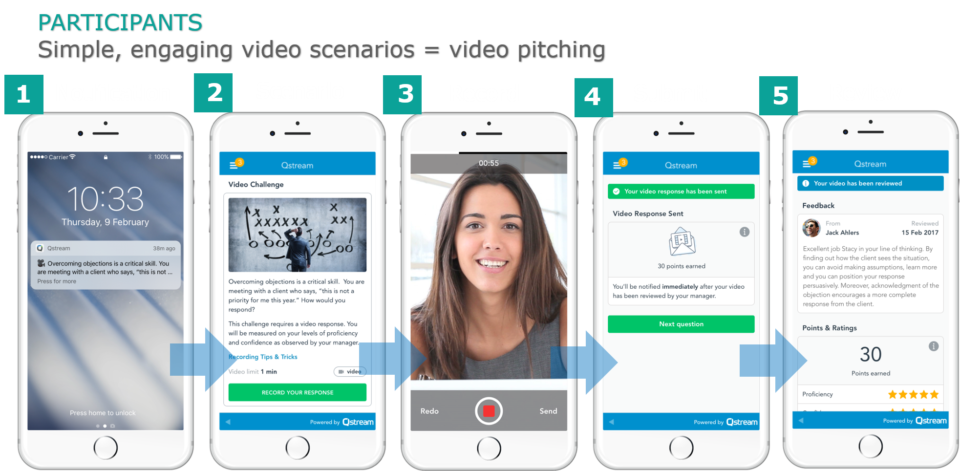
A good example of this is ‘video pitching’, where the seller records an answer to a client situation using their smartphone, which can then be used as coaching input for the sales manager, and good examples can be shared with other team members. This enhances the performance of the whole team, contributes to continuous development and improves team spirit.

Enabling just-in-time coaching

The main advantages of just-in-time coaching are:

  1. Identifying possibilities for personal development
  2. Building self-confidence
  3. Strengthening desired behaviour, knowledge and skills
  4. Installing a culture that stimulates continuous improvement for each individual and the team
  5. Measuring the impact on sales results

Read more about agile learning, knowledge retention and just-in-time coaching

Qstream app

Perpetos Improves Customer Sales Proficiency from 53% to 80%

Qstream’s mobile microlearning application was selected by Perpetos as a continuous sales training reinforcement solution for their sales performance programs which help their customers improve conversion rates and lower the cost of sales.

Want to see a demo ? Contact us at inquiry@perpetos.com


Commercial excellence means you know your customers so well, that you fully understand them as well as their context. This allows your company to anticipate their needs and expectations. And via sales and marketing to communicate the right thing at the right time, and to show the impact and value of what you have to offer.

To achieve commercial success, it no longer suffices to promote your company. Nor to merely listen and ask questions. Buyers increasingly expect the right information at the right time. And a number of elements are important in this regard.

Commercial Excellence: really know your customer

We need to align activities to the customer’s expectations. Any contact with your company, personal or online, needs to contain the right message aligned to the customer’s readiness to buy. You can accelerate the sales process considerably by meeting their expectations with every contact.

In terms of results

It’s not about what your service or product can do, but about its value to the customer. How does it impact their organisation? What specific results can they expect?

Highest market price

A customer-oriented organisation strives for the highest market price for its products and services. But at the lowest cost from the customer’s perspective. Commercial excellence has a positive impact on your cost of sales and enables you to get results twice as fast.

How can you achieve this? You may ask yourself the following questions:

  • Do your product developers and officers understand the importance of your products and services to the customer?
  • Do they know how the customer will work differently? And what improvements he will accomplish?
  • Are all persons involved aware of how your strengths will contribute to a better result?
  • Can you say whether your products or services will give a better result than those of your competitors?
  • Do your customers recognise the link between your strengths and their accomplishments?

Becoming a customer-oriented organisation

Not every industry has noticed crucial changes in customer behaviour yet. Determine to what extent your customer target groups are already part of the experience economy. To what extent do they use the Internet and social media to inform themselves? If this is the case, follow these four steps to achieve a more customer-oriented approach:

  • Ensure that your market is segmented on the basis of equal needs and reasons to buy. So that your sales messages can be used on a wider scale and are at the same time aligned in detail to each segment’s unique character
  • Map the obstacles preventing your employees from embracing new ways of working. Also map possible motivating factors to change work patterns
  • What current processes and KPIs obstruct a more customer-oriented approach?
  • Develop and implement a change project taking into account all of the above. Take special care to implement the required changes on a human scale. And clearly communicate the benefits for each person involved so as to stimulate willingness to change.

Reach your full potential and create commercial excellence: benchmark your company against ‘Best in Class’ with our Sales Performance Benchmark