

 Els Costers
The commercial lever is often sitting right next to you, or one desk over. Did you know that?
There is a curious comfort that lives in a lot of commercial teams.
Marketing delivers leads and sales frowns. Not big enough. Not ripe enough. Not immediately sellable. Meanwhile, elsewhere in the customer base, there are relationships that already trust you, already buy, already pay and already have experience with your people. And still, a huge amount of potential there stays untouched.
As if we secretly believe customers will ask, all by themselves, for everything we could help them with.
Yes, but we do have account plans, I can hear you thinking.
Great. But is that enough? A nice plan. What about the execution, and who is involved in it?
Because in the meantime the competition is dropping by your customer too. They ask plenty of questions, get to know the customer far better, and put an offer on the table that suddenly looks very relevant.
What customers know, and what they don’t
Do all of your customers know the full picture of what your organization can mean for them? Probably not. They mostly know the slice they once became a customer for. The solution it started with. The contact they trust. The routine that formed. And routines are handy, until they lull growth to sleep.
That is exactly why the complexity of account development is so often overestimated in theory, while the potential of cross- and upselling is underestimated in practice.
Upselling is, in essence, selling more of what a customer already buys today: more volume, a broader application, a richer scope. Cross-selling is about other products or services, sometimes to the same person, but often through other stakeholders. In both cases, growth does not start with the offer. It starts with the question of how much of the customer’s context you actually see. And so it starts with what you know and what you ask.
Anyone who keeps having the same conversation with the same contact rarely builds real account growth.
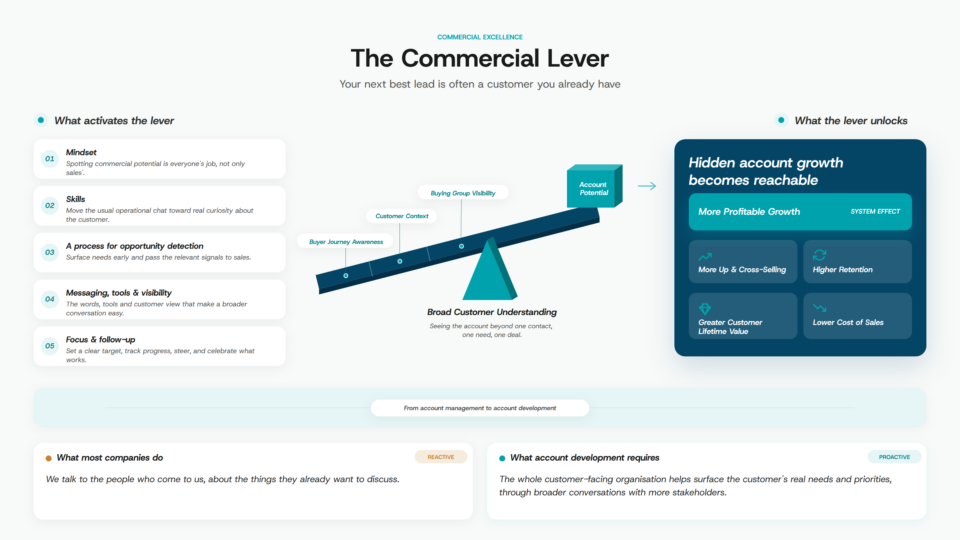
The unused lever
A lot of companies feel this more and more. They just run into their own organization and its division of roles.
Service experts deliver excellent service. Customer care resolves questions. Internal sales processes orders. Account management guards the commercial relationship. Marketing feeds campaigns. Everyone touches the customer, but not necessarily with a shared picture of what is still possible.
So signals get left lying around. Small frustrations are not picked up and new ambitions stay under the radar. Other needs in other departments at the customer never come into view at all.
And then we call it a difficult market. But often it is simply, and unintentionally, not getting everything out of your customer because of a lack of… what, exactly?
In a customer-driven context, commercial impact grows when teams learn to do the right thing, at the right moment, with the right stakeholders. That takes more than good intentions. It takes alignment around the customer journey, buying readiness and the dynamics in the buying group, but above all, knowing what is going on at the customer. Trust is not built only by being nice, but mostly by being relevant in the context of each stakeholder.
Account development, then, is not an isolated sales exercise. It is a team effort.
How do you activate that lever?
It starts with focus. Which customers deserve priority? Where is the biggest growth potential in terms of share of wallet, lifetime value and retention?
In recurring business, that lever often lies in systematically widening relationship breadth and loyalty. In project environments, a first project can be exactly what opens the door to services, expansion or new applications elsewhere in the organization. The commercial model determines where the growth sits, but almost always there is a lever hidden somewhere that can genuinely open doors.
So the question is: who is talking to the customer today? What could that person find out? And how could they be more relevant by having a different conversation?
Mindset: the step everyone skips
As long as people believe that spotting commercial potential is not their role, growth stays stuck in job descriptions. As long as service, support or delivery think they are not allowed to open the conversation or move smoothly into another topic, value stays invisible. And as long as account managers would rather protect their customer from colleagues than connect them with colleagues, caution wins out over growth.
The forward-looking account manager is not a classic salesperson. They are an orchestrator of customer experience and business impact.
Team selling, stakeholder alignment and synchronizing perspectives are essential to genuinely move customers forward.
But mindset alone is not enough.
People also have to learn which other conversations are needed. Not only operational check-ins, but conversations that help clarify problems, make ambitions tangible and bring latent needs into view. Sometimes with the same contact. Sometimes through buying group extension toward other people involved. Not by bluntly kicking in new doors, but by broadening the relationship organically through existing trust.
That takes skills, messaging, a process and practical support. Which signals should someone recognize? Which questions help to look more broadly? And once a need is detected, how do you make sure sales takes it further? Capabilities are not built with training alone, but in context: with methodology, processes, enablement and coaching.
Follow-up: the most underrated part
Not only measuring whether extra leads, and ultimately business, came in, but also whether the desired behavior becomes visible.
Are more leads and concrete customer information being shared? Are other stakeholders being reached, and do we therefore see our contact database at existing customers growing? Are successes celebrated internally when the number of opportunities rises? Is there coaching on what works, and does anything change about what does not?
Lasting growth takes a rhythm of feedback, feed forward and reinforcement in the flow of the work. That is also why durable change always goes beyond a commercial initiative on its own. It touches culture, collaboration and daily habits.
The real question
The real question is not whether your customers still have potential.
The real question is whether your organization is set up so that it can see, discuss and activate that potential.
Because up- and cross-selling do not start with the offer, but with the breadth of your understanding of the customer.
And maybe even more confronting: sometimes your next best lead has been sitting in your customer base for months, waiting for someone to finally dare to have a different conversation.
Usually that starts with appetite, a healthy dose of curiosity and the nerve to open up the conversation. And that, by the way, is best done not over email or chat.