


Frédéric had his team enrolled for an international corporate change program of the sales organization and participated too. He talked us through the experience of the entire program and the impact on the team and himself as a sales leader.
Frédéric, how did you experience the sales program? What feedback did you receive from your team?
The overarching program dealt with enabling growth. When Perpetos rolled out the first part of the program, that was directly linked to our go-to-market approach, we realized that this sales program was more than just providing a sales approach.
For example, the sessions were organized with mixed groups, meaning employees from different business units in one group. During the training, it became clear that those initial perceived segment differences, weren’t so different when approaching it from the customers perspective. Even more, because the teams saw the sales methodology worked independent of segments, a bond between the participants was created.
The workshops with role-play and realistic client cases, created an excellent opportunity to adopt a uniform and new way of working, which meanwhile all teams had bought into. Group learnings were brought to an individual level by individual coaching and it allowed further progress.
When did you see behavioral changes, signs of adoption and changes of habits?
Let me state clearly, that adopting new ways of working requires focus and effort. Applying the methodology demands people to take a step back and question themselves. Throughout the learning, the importance of an open mindset and the willingness to adopt, are stimulated by the approach of the training and the learner engagement support by Perpetos.
The Perpetos’ methodology was perceived as refreshing and just what sales teams need in today’s market. Our sales team was already a highly experienced team, so that was very important for the buy-in right from the start. Perpetos implemented a common vocabulary focusing on the customer buying cycle instead of traditional linear steps of sales. The use of the terminology across the different teams and departments became part of our day to day allowing everybody to know what to do when. The customer verifiable outcomes in combination with the common language heavily improved both the efficiency and effectiveness.
How did this methodology impact your teams and success?
Throughout the process, there were two important recurring elements.
First, the methodology and approach assured our teams which actions to take and gave them the necessary structure, avoiding too much tension at important moments.
Second, there are no bad actions, but you must know what to do at what time.
The combination of both these elements provided a structure to our teams and ensured we moved in the same direction. We learned to do less, with more focus. When we apply the methodology well, it significantly increases our chances of winning. During the 18-month period we were able to win all our ‘must-win’ targets, with involvement of our Perpetos’ coach.
Final observations?
The program brought not only a changed way of working, but also created a mental and culture shift. We no longer push our activities but align our activities with the customer’s decision cycle. Even in another business context, a similar program can help to install a more efficient structure amongst sales teams. It plays a bonding role in the context of restructurings and adapting sales teams to the new reality in the field.
Frédéric, big thanks!
Create value in times of uncertainty
 Pascal Persyn | Customer Journey, Remote Selling, Sales Performance
During periods characterised by insecurity the general attitude towards salespeople changes. In addition, customers’ focus shifts to short-term solutions and the reduction of risk. Both constitute an opportunity for enterprises and salespeople who manage to adapt to this situation quickly. Adding value while responding to this situation and at the same time focussing on enhancing customer confidence.
There are four elements that play a role in creating value for the customer:
- How can we improve our insight into the customer’s situation?
- What are the techniques we can use?
- How can we keep all conversations relevant?
- How can we ensure that customers are prepared to pay for it?
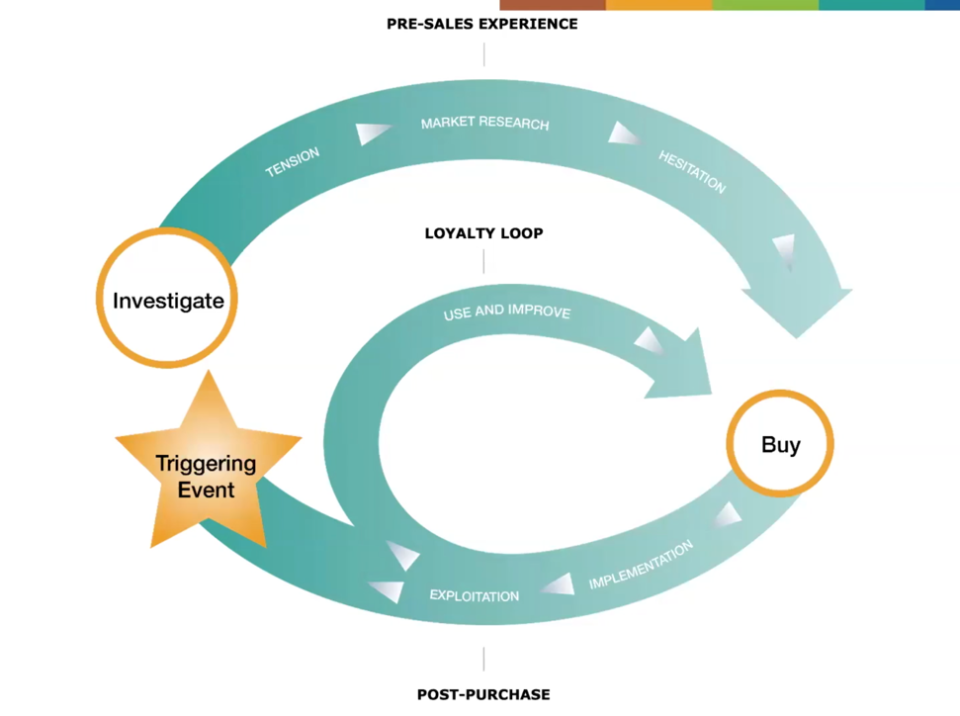
In this respect it’s important to have a good insight into the customers’ “Buyer Journey”.
A few important things to take into account:
- A late entry in the buying cycle does not provide much room for value creation, as the customer already knows what he wants and has a preferred supplier with whom he compares other suppliers
- If you enter the cycle before the trigger moment, your chances of success are much better. Nevertheless, your focus should be on messages that increase the willingness to change, i.e. messages that break through the status quo and the “loyalty loop”.
- As a salesperson, you must be able to guide the customer through his buying cycle by aligning the activities and messages to what is important to him.
When you have contact with a customer, you can find out where he is in the buying cycle by asking a few questions. It’s not possible to reverse the cycle. If the customer is already at the end of the cycle, you need very strong conversation techniques to create an opening. Unfortunately, the consequence is that the price is a very important factor, unless you are lucky enough that others before you have made a significant mistake.
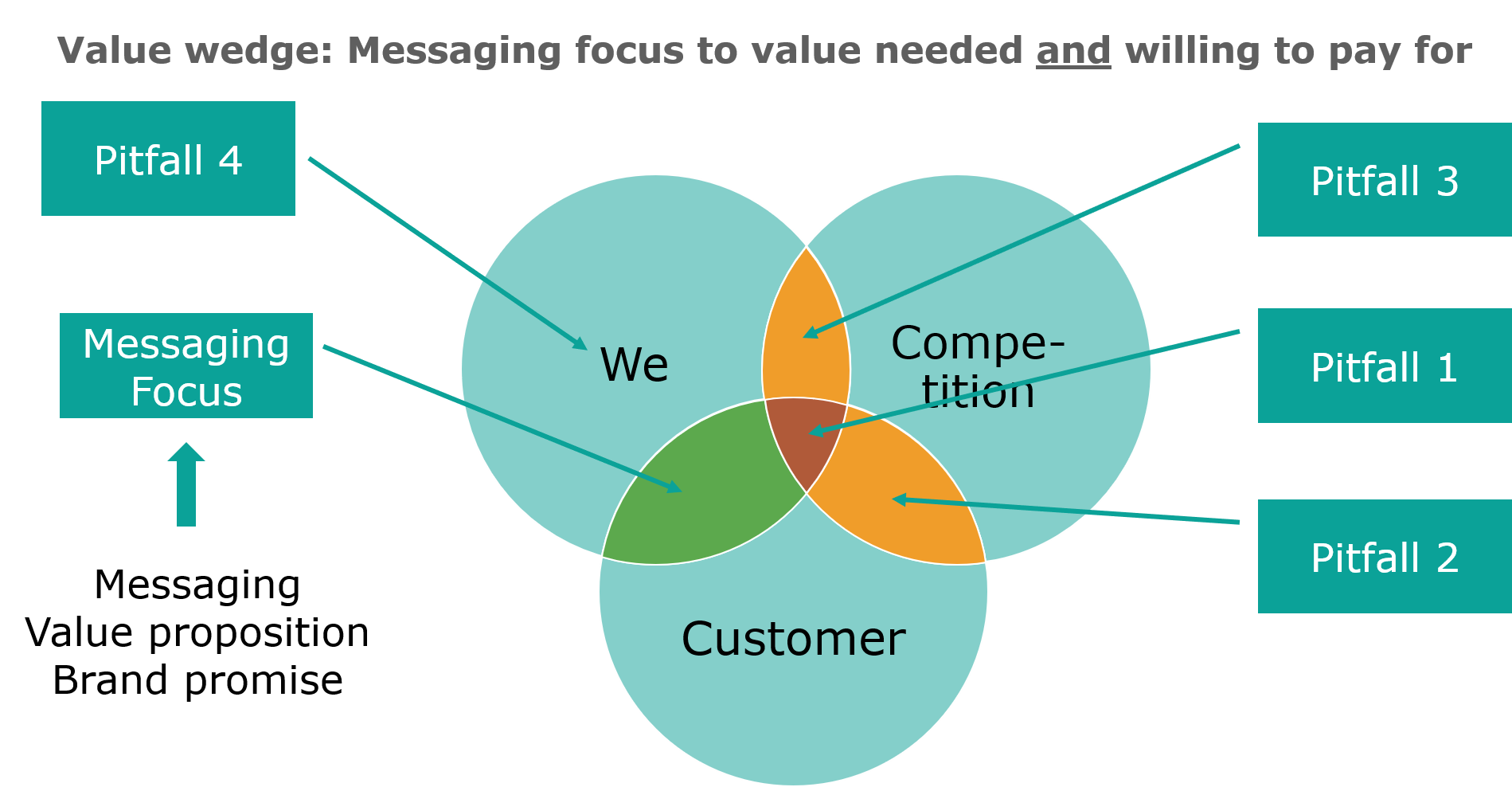
The value wedge combined with the phase in the buying cycle indicate how the added value can be created.
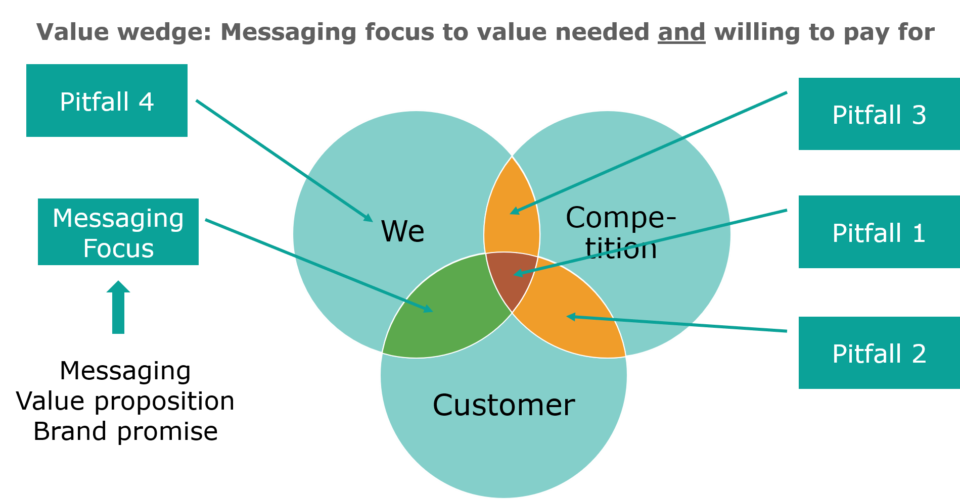
First let’s discuss the typical pitfalls and mistakes that are made on the basis of the value wedge. The salesperson:
- doesn’t distinguish himself from the competition, just tells the same story
- tries to convince the customer with strong points of the competition that are not at all strong points of his own offer, as it is clear how important they are to the customer.
- is too focused on outdoing the competition by focusing on strong points they both have but that are not relevant for the customer
- fails completely by presenting entirely irrelevant advantages and messages on the basis of his own convictions or non-identical situations, causing irreparable damage to customer confidence.
If the right conversations take place in line with the specific phase in the buying cycle, the essential confidence will be built quickly, and the critical insights will be acquired that enable the salesperson to focus on the messages that are important to the customer and that the competition overlooked.
A few “must-do’s” during conversations:
- Tell a clear story about similar situations and thus quickly build confidence for the next steps.
- Use the right interview and conversation techniques to not only have full knowledge of the situation but also to quantify. This will have a major impact on the price the customer is willing to pay.
- Once preparations are complete, your first contact in the active sales cycle is preferably the person who is exposed to the most disadvantages and at the same time has the highest decision-making power. This way you structurally increase your chances of quickly breaking through the status quo.
- Ask closed questions to validate your assumptions and monitor your rapport with the person concerned.
- Provide a solid underpinning for a possible change, so as to make it easier to minimise discounts and therefore to sell at a higher price than the competition.
Do you want to know more about these essential elements? Contact us

Are your salespeople like talking brochures?
Pascal Persyn | Competence Development, Sales Performance
Customers’ buying behaviour has changed considerably in the past few years. How can companies respond to this challenge? How do you organise sales in a digital world? Are you still sending your salespeople out like talking brochures, or will you take action? And how? A diagnosis.
Time for a sales reboot
Since 2012, the results of a multitude of studies about the changing buying behaviour of customers have been published. However, many companies only take action when the impact really becomes painful. And it’s often too late by then. It is therefore advisable to take action proactively. But can you motivate people and organise your sales in such a manner that the transition can take place in a timely and painless manner?
Avoid a reaction that is either too soft or too hard
There are two ways to react to the reality of changing buying behaviour.
- (Too) many companies continue to assure their clients that with some adjustments, the existing commercial solutions are immune to the changes. Unfortunately, the sales pipeline is like the arteries in our body. If we do not adopt a healthy lifestyle, they slowly get clogged up. The consequences in the long term are disastrous. Holding on to old habits is not the solution.
- Others call for a revolution. The world is no longer the same, which is why a drastic transformation of sales is required. We have to start over! That means completely redesigning the processes and systems and preparing for the future! That may be so, but… intrusive action often triggers a shock effect, which in turn has serious consequences.
Opt for the human approach!
How can you react to the constantly changing world? Doing nothing is not an option. Starting all over again is not the right solution, either. Actually, the answer is simple: we have to evolve together with our customers. Selling is and will always be a people business, even online. The impact we are noticing with our customers and prospects shows that the changes are real. It is therefore necessary to develop a change process as soon as possible. This way, the changes can be implemented gradually and on a human scale. Without disruptions or all too radical actions.
Toward a new role for salespeople
All change processes are based on insights. Customers are still overwhelmed by salespeople who are sent out by their employers like some sort of talking brochures, although they don’t care about salespeople bombarding them with arguments and the benefits of the products they try to sell. Some consultants take advantage of this fact by stating that salespeople will disappear altogether. Nothing could be further from the truth, but it is true that the role of salespeople is changing drastically.
60% of the sales opportunities come to nothing because the customer does not buy or does not change suppliers.
The sales cycles have become 22% longer since 2012 and your biggest competitor is no longer your direct competitor, but customers who do “nothing”. Recent research has shown that up to 60% of the opportunities are simply closed in CRM because the customer doesn’t buy anything or is not willing to change suppliers. You can imagine the impact on the sales cost.
Sales are needed as long as you:
- … incorporate the right mix of digital and human touchpoints in the entire buying cycle of the customer. This depends on the complexity of the product or service you offer, but mainly on the impact on the customer.
- … use an interpersonal approach focused on supporting customers and creating added value. This requires the salespeople to have contact with an increasing number of different persons with the customer and at other moments during the buying cycle.
- … adjust the sales pitches to every moment during the buying cycle and to the profile of the persons with whom the salespeople are to engage in dialogue.
Do you want to find out how you can prepare your commercial staff for the future without having to take all too radical actions? Contact us or read more in our eBook:
 7 Criteria your sales process has to meet
Are you looking for a new Sales process to find a (new) way to reduce your cost of sales, stop margin erosion or better align your approach with the customer’s buying cycle? Learn how to make sure that the selected process is right for your business.

Every day we’re being confronted with increasing sales costs and margins under greater and greater pressure. In this blog, we explain why this is happening and look at the solution in detail.
Increasing sales costs and greater pressure on margins are usually the result of inadequate or non-existent internal sales training and supervision. There are also a few die-hard habits that many companies and sales reps cling on to which can cause even bigger problems for sales performance.
Directors will already be familiar with the changed buying behaviour and understand the impact it has on their sales and marketing organisation. The fact that up to 75% of decision-making criteria are influenced online means it’s important for us to allow sales to start a dialogue with customers at different times and with different messages.
If sales is forced to wait until customers are ‘ready-to-buy’ or in the quotation stage before they spring into action, it’s impossible to sell customer value, so:
- Margins continue to fall
- Products and services are experienced as commodities
This habit comes from:
- Managers being mainly interested in the time frame that deals are agreed in
- Sales who think it’s a waste of time to enter into a buying process early, and prefer to wait for ready-to-buy leads from marketing
- Sales who are willing to start the buying process early and influence the customer, but don’t have the necessary skills and messages to appeal to customers in this early stage
The solution: do the right thing at the right time with the right person
Management behaviour and how to direct sales teams is crucial here, although that’s a separate topic just in itself. But how can we arm sales to face these new challenges?
- Train sales to detect and facilitate the entire buying process
- Implement a sales process that allows your team to document opportunities based on the customer’s willingness to buy (buying process) – and embed this in the CRM. Read our eBook “7 criteria for a Sales Process Your Sales Team will actually use”
- Document messages for each product-market combination, and teach sales to use these messages at the right time in their comfort zone using ‘how to sell’ training with role plays

The buying process in figure 1 shows the complete customer journey. Whether it’s for existing or new customers determines how sales deals with it.
For existing customers, sales mainly need to convey ‘why customers need to stay’
Combined with behaviour that we label as ‘account development’ rather than ‘account management’. With existing relationships, detailed knowledge of the customer and their environment provides a great opportunity for increasing the value perception, and so embedding the relationship more deeply.
For non-customers, the first question is: ‘Has the customer already decided to change?’
Has the customer not decided to change yet? Then it’s best to base your messages and interactions on breaking the status quo, and so increasing the willingness to change. Customers aren’t usually aware of what improvements are possible. Or the customer thinks the risks that come with the change look too big. Or they’re not familiar enough with exactly what’s required.
These ‘why change’ messages assume the customer’s point of view and are the best way of developing prospects. And this is where the biggest challenge is identified in terms of sales performance. Various studies and analyses of our customers show that up to 60% of opportunities simply disappear from the forecast without any decision being made by the customer. The biggest competitor isn’t another supplier, but the customers themselves simply not deciding to buy anything. So messages about how good your company and its solutions are, or the extra benefits that you can offer, won’t help stimulate the buying process.
Has the customer already decided to buy?
Then the next question is of course: who should I buy what from, and how much for? Sales responds to this with messages that underline why the customer should choose them. These ‘why us’ messages are most effective at this point in time. Most companies and a large proportion of sales reps score quite to very highly in this area.
Video shows when these three types of messages are most effective from a sales perspective
In summary, we therefore need to enable sales to convey three different types of messages convincingly according to the situation and depending on the product-market combination:
- Why change
- Why choose us
- Why stay with us

Sales Performance Benchmark
How much do your sales convey these three sets of messages?
And to what extent can they discuss them with the customer at the right time?
Compare your sales performance and customer orientation with best in class companies.

Lead generation: how to align sales and marketing
Pascal Persyn | Sales and Marketing Alignment, Sales Performance
On a recent lead generation training course, I was very surprised to find a large majority of salespeople among the participants. It turned out that these sales reps were attending because their marketing wasn’t delivering leads that made sense from a sales perspective. Some of them had KPIs for cold calling, and results were reportedly getting worse and worse.
This situation again illustrates that the majority of businesses in Europe haven’t yet realised we’ve arrived in the ‘age of the customer’. Not that the customer has changed, but thanks to the internet, social media and new mobile possibilities, buyers have changed the way they interact with us. Organisations that want to secure or grow their business shouldn’t wait any longer to start looking at ways of meeting the empowered customer’s needs.
A well-oiled sales and marketing machine is essential

Buyers today can find loads of information about your products, and your competitors’, in just a few clicks. If you want to do business with leads who are looking for a solution like yours, it’s the marketing department’s job to provide the right information in the right form, at the right time in your lead’s buying cycle.
Cost efficiency and volume are key: marketing generates leads in a one-to-many digital approach. Only leads that meet specific marketing criteria (MQL) are being handed over to sales, who then take over from there. Sales qualifies both the contact and the buyer readiness (SQL), and leads rejected by sales are recycled by marketing into campaigns that can be made very specific thanks to the new insights gained by sales.
One marketing activity that is often forgotten is demand generation: besides capturing ready-to-buy leads, marketing can also create demand through inbound marketing. Leads from these campaigns can be nurtured to hopefully become sales-ready one day. Without demand generation, sales will keep on complaining about the quantity and quality of leads provided by marketing.
So has your machine been oiled to meet new customer demands?
How to get the machine running
If your machine’s a bit sluggish, it’s probably time to stop the ongoing battle between sales and marketing. Take a new look at activities and responsibilities, and create a value chain that helps your customers buy from you.
Here are a few tips to get sales and marketing collaboration on track.
- Share common goals
Across departments, increase awareness that we’re all trying hard to achieve the same company targets. Collaboration is key! - Share a common vocabulary
In the age of the customer, replace your sales process with a buying process, and make sure both sales and marketing are speaking the same language. Introduce a clear demand-generation process with milestones based on commonly agreed definitions to make it work - Co-development and best practice
Work together as one team. Both sales and marketing can add lots of value, insights and messaging to improve traction, conversion and ROI on marketing activities. Sales meetings are an ideal platform to keep marketing up-to-date with what’s happening in the market; marketing can take the stage to inform sales about ongoing results and planned activities in line with the sales organisation’s needs, again reinforcing the importance of common goals - Marketing: messaging should allows the building of customised content
Research has shown that that up to 90% of content created by marketing goes unused by sales. Implement a content strategy that enables the building, sharing, measurement and improvement of messaging quality. Messaging should allow the building of content that is customised for different roles, their individual buyer readiness, and context - Marketing: ‘why change’ content
The majority of content aims to convince us why we should choose company X or product Y. But research shows that 60% of opportunities are neither won nor lost; they simply disappear without a sale. The content that explains why customers should change is therefore crucial for creating demand and increasing conversion
Want to find out more and see the whole picture? Watch the webinar ‘How to Align Sales and Marketing’ with guest speaker Pascal Persyn, CEO at Perpetos, and moderator Deva Rangarajan, Associate Professor at Vlerick.


[ON-DEMAND WEBINAR]
How to Move Stalled Sales Opportunities?
Procrastination comes in different guises. 3 steps to avoid procrastination
Dealing with Late Cycle Concerns


Buyers today want less risk
Pascal Persyn | Customer Journey, Sales and Marketing Alignment, Sales Performance
Buying behaviour has fundamentally changed over the past ten years. But there are still lots of companies approaching buyers of today with outdated best practices and mindsets, or continuing to advocate the old way of selling.
Until recently, it was still possible to achieve reasonable B2B sales results by simply highlighting solution benefits. Clients had no alternative but to take the sales person’s advice when making their buying decisions. People who still have this mindset should beware: buyers have taken over the sales process, and now they have the power. And they want to avoid risk as much as possible.
How can we adapt to today’s buyer?
A lot has already been said about the switch from product sales to solution sales, or from transactional into consultative selling. But we still see that neither has delivered on its full potential, and results remain far below expectations. This is why:
- Both aim to implement a repeatable, linear and mechanical step-by-step process (not a ‘real’ sales environment!)
- The sales support environment is not upgraded simultaneously; bonuses, product training and literature, events, CRM and even reporting remain largely unchanged
- Management tries to resolve this with sales skills training and there is no change programme
You can fix this by focusing on the buyer, and learning about your clients and their markets.It’s also important to factor in risk mitigation. The ‘customer trust equation’ by David Maister, one of the world’s leading authorities on the management of professional service companies, is an excellent formula for clarifying the idea of risk mitigation:
T = (C+R+I) / S
T: trustworthiness (or perceived risk of working with you)
C: credibility = words (I can trust what he says)
R: reliability = actions (I can trust him to …)
I: intimacy = emotions (I feel comfortable discussing the subject)
S: self-orientation (I can trust that he cares)
The denominator of this fraction is (of course) what has the biggest impact here. You have to convince your clients that you really understand their requirements and objectives. The conversion rate will be lower if the client thinks the seller is focussing on themselves, regardless of the quality of your products or your sales person’s knowledge. In this case the seller is not being driven by the client but by a bonus that depends on the deal being struck, the internal pressure of a forecast, the special offer they want to sell, management’s desire to sell more of these solutions, or the belief that they’re an expert and want to prove it to you.
So consider risk management and look at all the conditions that can have an impact on sales when deciding how to improve your sales performance.

Improve your sales with a better understanding of the buying cycle
Pascal Persyn | Sales and Marketing Alignment, Sales Performance
Scientific research has shown that every buying cycle is a sequence of the same mental processes; almost as certain as a law of nature. Our Buying Clock is an easy way to see the willingness to buy of everyone involved in a potential sale.
You can work out where the client is on Buying Clock by asking questions such as:
- Are you 100% sure that the current situation has to change?
- What will the impact be of the new solution?
- Have you calculated the cost and ROI?
- What criteria will you use to compare suppliers?
- Are you trying to understand the differences and benefits of the various options?
- How do you guarantee your future supplier won’t eventually fail on your expectations?
- Have you checked whether the new solution won’t bring new problems?
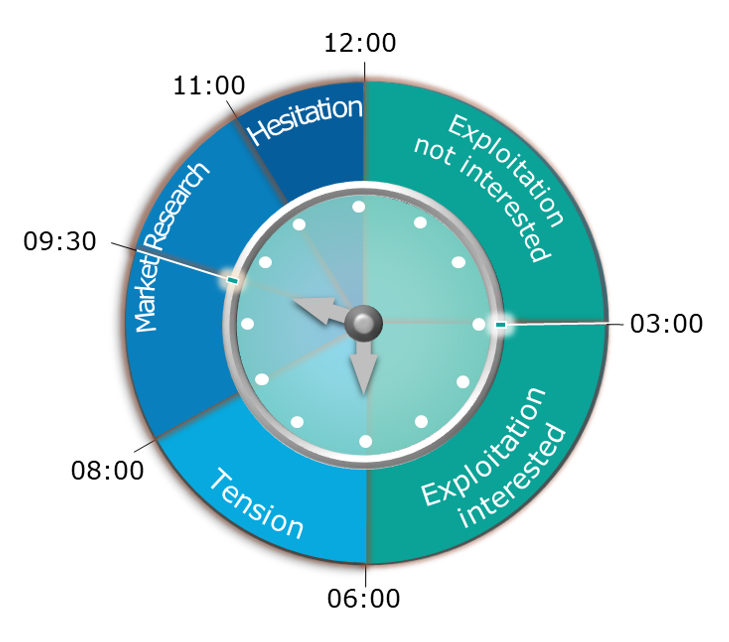
The buying cycles are far from always synchronized
You know ‘what time it is’ in the buying cycle when you’ve got answers from everyone who is influencing the decision. Everyone goes through the same mental processes in a purchase, and it’s very plausible that different people are in different stages.
The speed at which we go through the various stages of the buying cycle depends on various factors: experience of buying similar products or services, understanding the various options’ impacts, the decision’s importance and impact on us and our organization. A buying cycle can last from a few seconds to months or even years depending on these factors. Being able to detect and influence buying readiness and helping to synchronize the buying clocks will not only shorten the buying cycle. It will also improve conversion rates and decrease discounts.
Understanding the buying cycle leads to better results
Do your sales and marketing teams know what time it is on every client’s Buying Clock®? Wouldn’t it be great for your team to discover how ready your client is to buy, so they could approach them in the right way? Then sales would never start talking about product features before the client is ready to even consider buying that type of product. And marketing wouldn’t overload anyone with too much information about all the benefits. Clients will feel better understood, and make a decision faster, when approached with messages that match their buyer readiness.
When everyone in your organization can detect the client’s buying cycle, you can develop shared terminology to align your sales and marketing activities and increase your efficiency and effectiveness. To maximize your organization’s potential, make your client’s readiness to buy the reference point of your sales strategy and process. This can lead to the following impact:
- Shared terminology for sharing experiences will improve the whole team’s performance
- Precise timing of your actions, resulting in lower cost of sales
- Higher conversion
- Less margin erosion and discounts
- Objective, predictable forecasts
- In summary: more sales with higher margins at a lower cost