

During periods characterised by insecurity the general attitude towards salespeople changes. In addition, customers’ focus shifts to short-term solutions and the reduction of risk. Both constitute an opportunity for enterprises and salespeople who manage to adapt to this situation quickly. Adding value while responding to this situation and at the same time focussing on enhancing customer confidence.  

There are four elements that play a role in creating value for the customer:  

  • How can we improve our insight into the customer’s situation?  
  • What are the techniques we can use?  
  • How can we keep all conversations relevant?  
  • How can we ensure that customers are prepared to pay for it?  

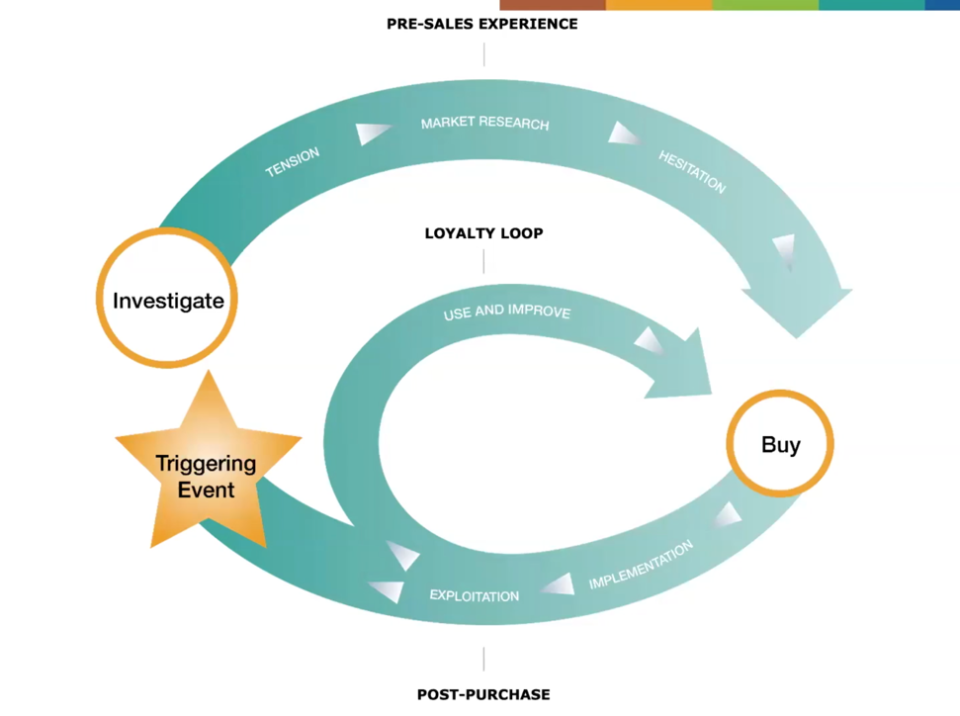
In this respect it’s important to have a good insight into the customers’ “Buyer Journey”.  
Waarde creëren in tijden van grote onzekerheid

A few important things to take into account:  

  • A late entry in the buying cycle does not provide much room for value creation, as the customer already knows what he wants and has a preferred supplier with whom he compares other suppliers 
  • If you enter the cycle before the trigger moment, your chances of success are much better.  Nevertheless, your focus should be on messages that increase the willingness to change, i.e. messages that break through the status quo and the “loyalty loop”.  
  • As a salesperson, you must be able to guide the customer through his buying cycle by aligning the activities and messages to what is important to him.  

When you have contact with a customer, you can find out where he is in the buying cycle by asking a few questions. It’s not possible to reverse the cycle. If the customer is already at the end of the cycle, you need very strong conversation techniques to create an opening. Unfortunately, the consequence is that the price is a very important factor, unless you are lucky enough that others before you have made a significant mistake.  

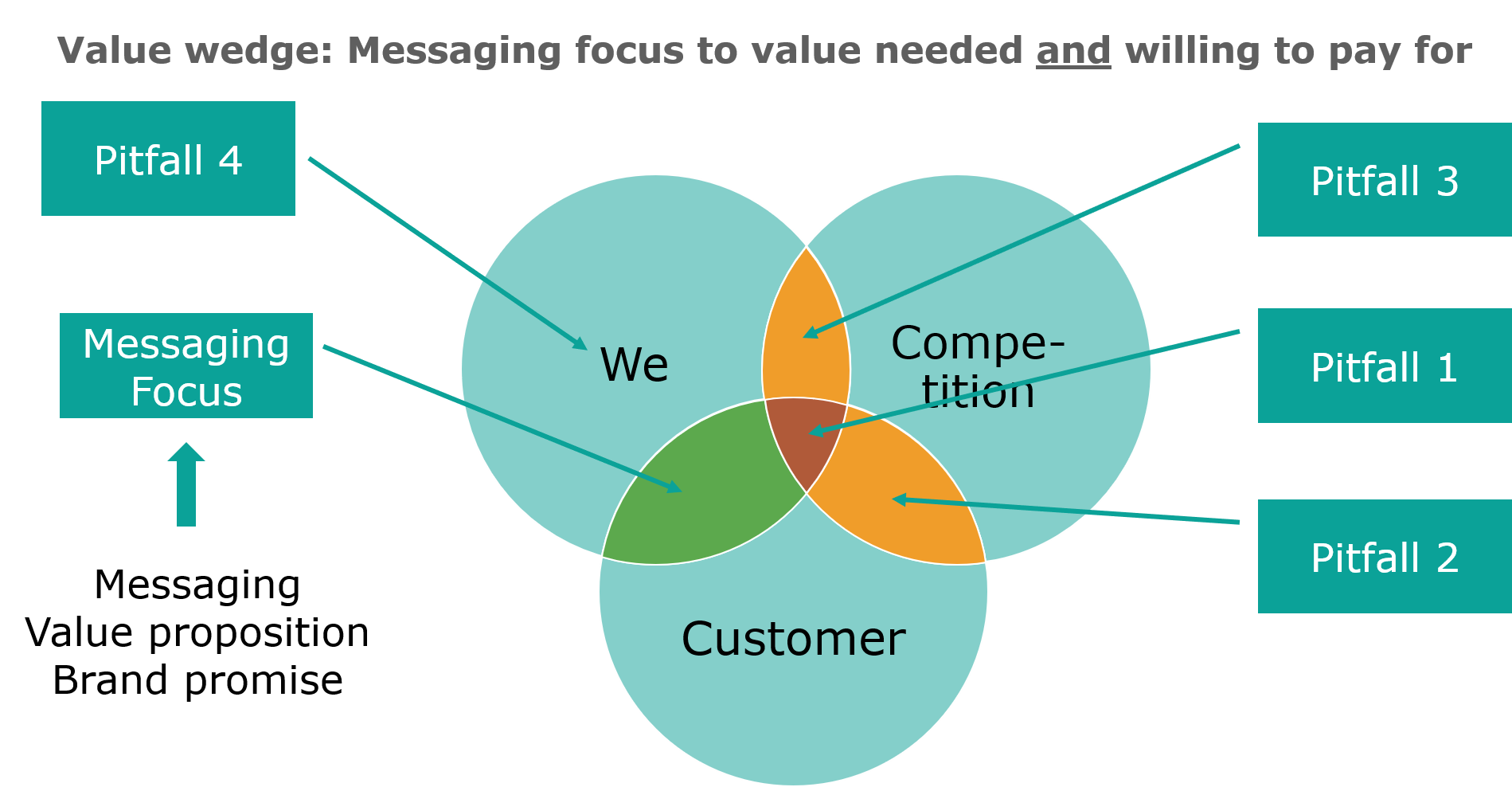
The value wedge combined with the phase in the buying cycle indicate how the added value can be created.  
value wedge

First let’s discuss the typical pitfalls and mistakes that are made on the basis of the value wedge.  The salesperson:  

  1. doesn’t distinguish himself from the competition, just tells the same story 
  1. tries to convince the customer with strong points of the competition that are not at all strong points of his own offer, as it is clear how important they are to the customer.  
  1. is too focused on outdoing the competition by focusing on strong points they both have but that are not relevant for the customer 
  1. fails completely by presenting entirely irrelevant advantages and messages on the basis of his own convictions or non-identical situations, causing irreparable damage to customer confidence.  

If the right conversations take place in line with the specific phase in the buying cycle, the essential confidence will be built quickly, and the critical insights will be acquired that enable the salesperson to focus on the messages that are important to the customer and that the competition overlooked.  

A few “must-do’s” during conversations:  

  • Tell a clear story about similar situations and thus quickly build confidence for the next steps.  
  • Use the right interview and conversation techniques to not only have full knowledge of the situation but also to quantify. This will have a major impact on the price the customer is willing to pay.  
  • Once preparations are complete, your first contact in the active sales cycle is preferably the person who is exposed to the most disadvantages and at the same time has the highest decision-making power. This way you structurally increase your chances of quickly breaking through the status quo.  
  • Ask closed questions to validate your assumptions and monitor your rapport with the person concerned.  
  • Provide a solid underpinning for a possible change, so as to make it easier to minimise discounts and therefore to sell at a higher price than the competition. 

Do you want to know more about these essential elements? Contact us


Customers’ buying behaviour has changed considerably in the past few years. How can companies respond to this challenge? How do you organise sales in a digital world? Are you still sending your salespeople out like talking brochures, or will you take action? And how? A diagnosis.  

Time for a sales reboot 

Since 2012, the results of a multitude of studies about the changing buying behaviour of customers have been published. However, many companies only take action when the impact really becomes painful. And it’s often too late by then. It is therefore advisable to take action proactively. But can you motivate people and organise your sales in such a manner that the transition can take place in a timely and painless manner?  

Avoid a reaction that is either too soft or too hard 

There are two ways to react to the reality of changing buying behaviour.  

  •  (Too) many companies continue to assure their clients that with some adjustments, the existing commercial solutions are immune to the changes. Unfortunately, the sales pipeline is like the arteries in our body. If we do not adopt a healthy lifestyle, they slowly get clogged up. The consequences in the long term are disastrous. Holding on to old habits is not the solution.  
  • Others call for a revolution. The world is no longer the same, which is why a drastic transformation of sales is required. We have to start over! That means completely redesigning the processes and systems and preparing for the future! That may be so, but… intrusive action often triggers a shock effect, which in turn has serious consequences.  

Opt for the human approach!  

How can you react to the constantly changing world? Doing nothing is not an option. Starting all over again is not the right solution, either. Actually, the answer is simple: we have to evolve together with our customers. Selling is and will always be a people business, even online. The impact we are noticing with our customers and prospects shows that the changes are real. It is therefore necessary to develop a change process as soon as possible. This way, the changes can be implemented gradually and on a human scale. Without disruptions or all too radical actions.  

Toward a new role for salespeople  

All change processes are based on insights. Customers are still overwhelmed by salespeople who are sent out by their employers like some sort of talking brochures, although they don’t care about salespeople bombarding them with arguments and the benefits of the products they try to sell. Some consultants take advantage of this fact by stating that salespeople will disappear altogether. Nothing could be further from the truth, but it is true that the role of salespeople is changing drastically.  

60% of the sales opportunities come to nothing because the customer does not buy or does not change suppliers.  

The sales cycles have become 22% longer since 2012 and your biggest competitor is no longer your direct competitor, but customers who do “nothing”.  Recent research has shown that up to 60% of the opportunities are simply closed in CRM because the customer doesn’t buy anything or is not willing to change suppliers. You can imagine the impact on the sales cost.  

Sales are needed as long as you:  

  • … incorporate the right mix of digital and human touchpoints in the entire buying cycle of the customer. This depends on the complexity of the product or service you offer, but mainly on the impact on the customer.  
  • … use an interpersonal approach focused on supporting customers and creating added value. This requires the salespeople to have contact with an increasing number of different persons with the customer and at other moments during the buying cycle.  
  • … adjust the sales pitches to every moment during the buying cycle and to the profile of the persons with whom the salespeople are to engage in dialogue.  

Do you want to find out how you can prepare your commercial staff for the future without having to take all too radical actions? Contact us or read more in our eBook:

7 Criteria your sales process has to meet

Are you looking for a new Sales process to find a (new) way to reduce your cost of sales, stop margin erosion or better align your approach with the customer’s buying cycle? Learn how to make sure that the selected process is right for your business.