Many of today’s interactions take place via automated, CRM or CX management tools, which often don’t tap into the full customer potential. There’s still immense value to be had from our ‘human touchpoints’ – our moments of personal contact, which are often the only way to clearly see if your offer matches customer expectations. But it goes further than this. These moments can actively influence the customer vision and develop new potential. Customer-centric conversations are also the topic of one of our ongoing client programs, in which we’re teaching these techniques to 30 teams throughout EMEA. Over the space of three months, we’re preparing our client’s in-house and external sales teams for these challenges.
Human interaction is still incredibly valuable for assessing your customer’s potential and influencing their decisions – something we sometimes forget in today’s hectic world with so much focus on data. Conversations with your customer are the ideal opportunity to find out whether they can clearly see the benefits of your solution and how they will help their organization. After all, what you think you can give doesn’t always match up to what the customer is trying to buy.
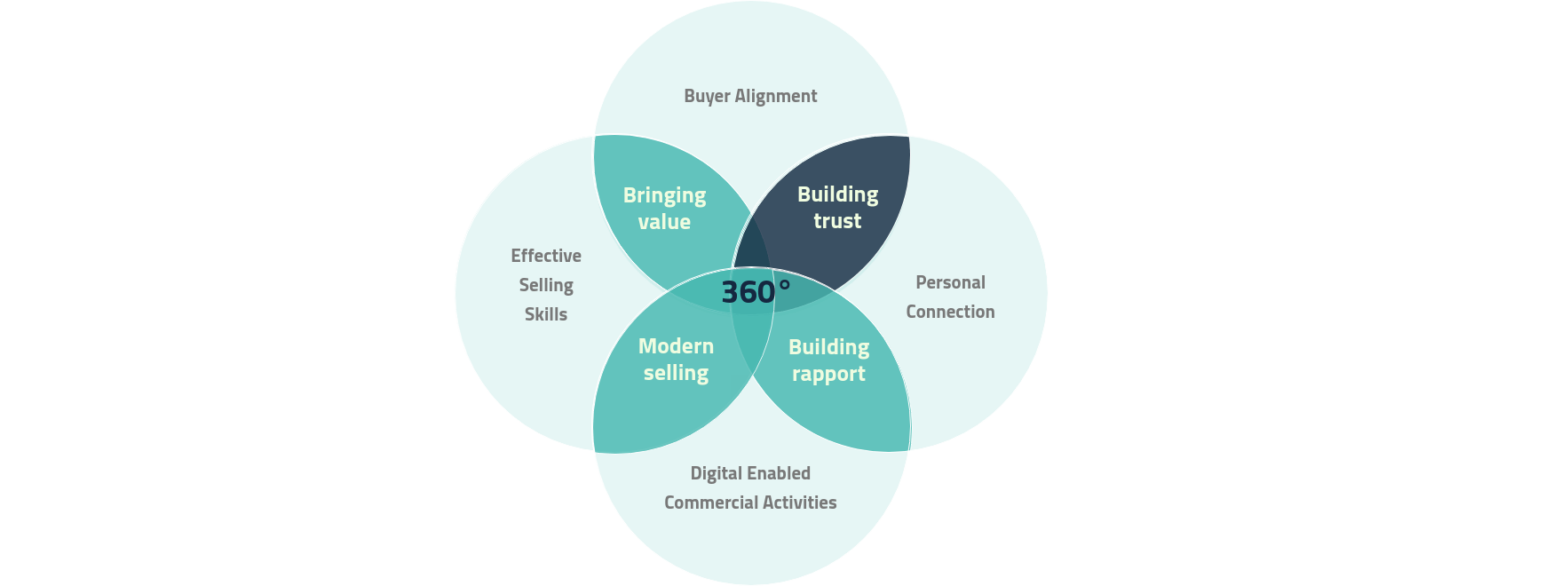
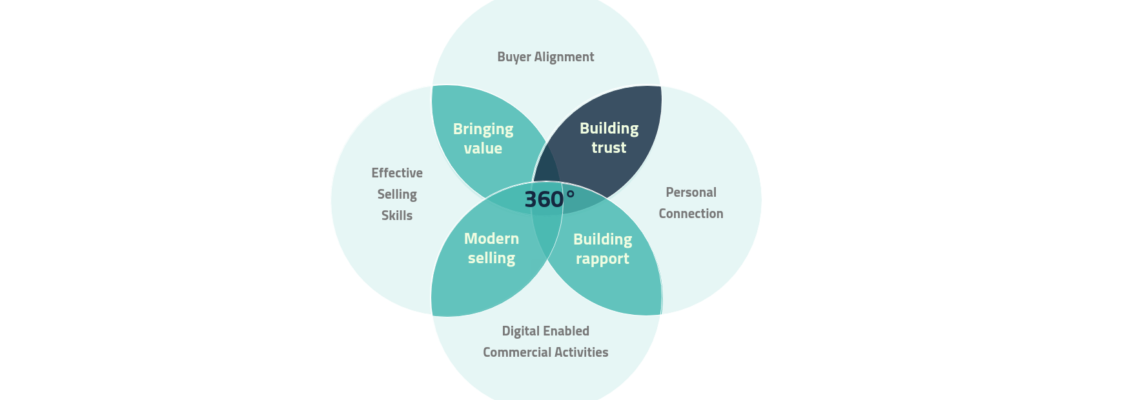
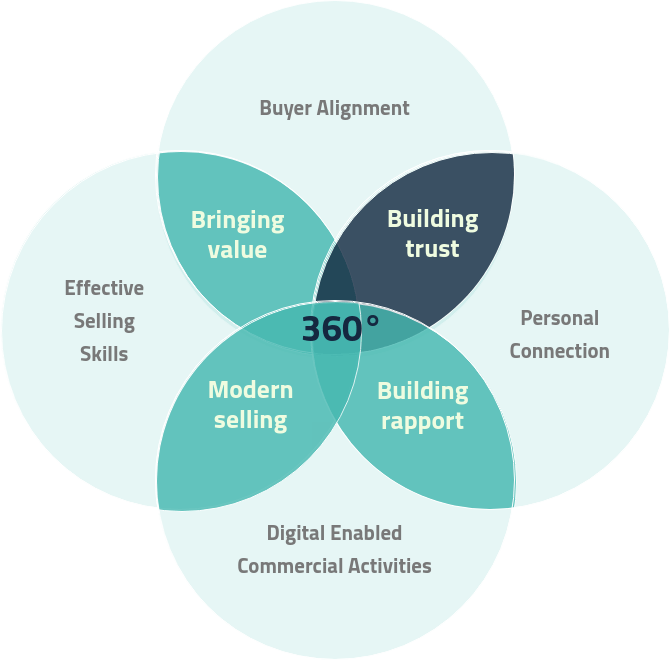
Exposing this value to the customer at the right time and influencing their potential are critical for continued growth. So ask yourself whether the customer can see the value you bring, and if you can use it to accelerate their sales cycle – the intersection between buyer alignment (where your sales process aligns with the buyer journey) and sales effectiveness. Successfully combining these two aspects creates real value.
Value selling
It’s also the exact combination that we’re working on in our upskilling process for 30 teams, where value selling is still a critical component. And that’s why we – together with our client – are developing this further on a new messaging framework, and helping to convert this value and messaging in the workplace. Ready to use and available for their teams.
We’ve talked about value selling before, but we’d like to give you three more important tips:
Detect and develop value as early as possible in the process to ensure your customer is more receptive to your message.
Figure out all the buying cycle stakeholders’ drivers for change – which are the keys for differentiation.
Be aware that value perception is different both for all stakeholders in the buying cycle and in every buying cycle.
In the beginning of February, we launched a successful kick-off event for an EMEA program deployment with 30 teams. Our aim: to bring the customer to the heart of the organization.
During the event, we worked with the customer to get up to speed with proactive selling. 6 Perpetos people on stage, a high-energy event, and an exceptionally motivated audience. We’re grateful for having realized another success.
Implementation & results
Since COVID, Perpetos has proven to be a global boutique for implementing commercial excellence. Yet, we are humble and grateful for being able to co-pilot critical programs for international and global organizations. Our boutique size, our proven methodology, and our team of field experts formed the winning combination of this event.
Implementation is key in everything we do. Supported by tools and technology, we implement change at a speed that allows our participants to pick up the message fast and make it their second nature. On top of that, we value authenticity, and respect cultural differences, while still ensuring our one way of selling.
Pascal Persyn, CEO of Perpetos comments:
We always want to bridge the gap between our advisory position – providing knowledge – and the practicalities of implementation. In other words: we want to see results too.
Motivation is key
According to Pascal Persyn, the willingness to change and the motivation to overcome the inevitable hurdles are critical.
The question is not whether we can prevent these hurdles, but whether we are ready to deal with them when they occur. That’s one of the reasons why experience in the field is a must.
Stay tuned for more!
All together, we experienced a vibrant kick-off event and we are ready to meet more teams all over EMEA. No doubt, sales and implementing commercial excellence are team sports.
In our next blog post, we will go more in depth on how we brought 30 teams up to speed with the art of proactive selling.
Today, investing in learning and development is a must. But does it actually pay off? Far too often, training is just a box-ticking exercise and knowledge is quickly forgotten. So, how do you build an effective learning journey, one that embeds knowledge into your organization, and that drives a change in behavior and mindset?
2 rules of thumb before you start
When we map out an effective learning journey, we always consider the following rules of thumb:
The Ebbinghaus Forgetting Curve: up to 90% of new tools and concepts get forgotten after a workshop or training.
The 70-20-10 rule, or the balance between the different modes of learning:
70% = on-the-job learning
20% = social learning by working together, coaching and mentoring
10% = learning from courses and workshops
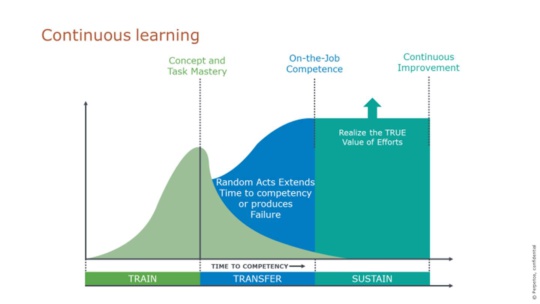
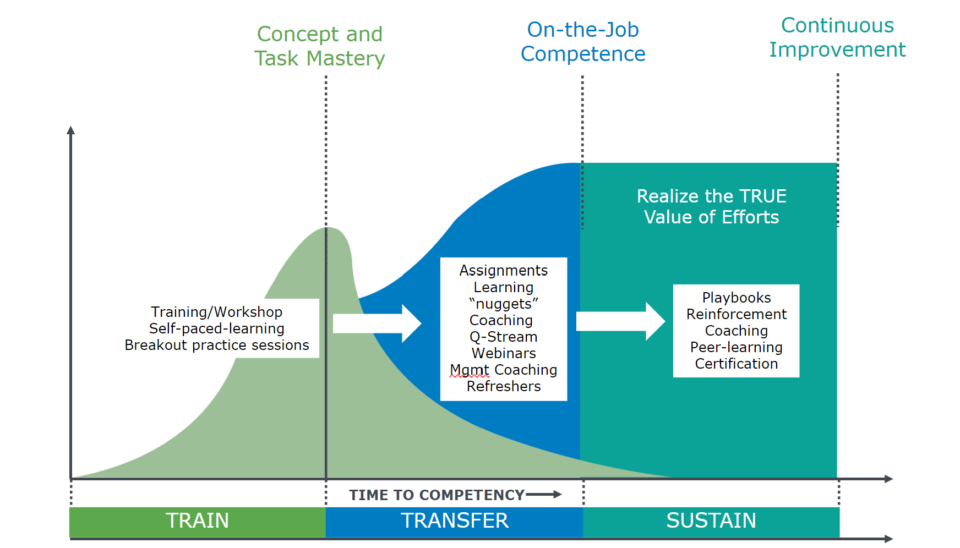
3 stages in a learning journey
1. Train
Trainings and workshops are only one stage of the learning journey. For optimal effect, we work with various techniques in this stage, such as breakout sessions, self-paced learning and role-playing. These techniques make knowledge more digestible.
2. Transfer
In the next stage, we apply that knowledge to the workplace. Again, we deploy a mix of techniques and formats, such as working with assignments or incorporating learning nuggets.
3. Sustain
The most important thing, of course, is that learning not only leads to one-time knowledge accumulation, but also to long-term impact. Through coaching or peer-learning, for example, you not only embed knowledge, but you can also achieve a change in behavior and mindset.
From our experience in designing learning journeys that really pay off, we’d like to offer some tips & tricks:
5 tips for an effective learning journey
Make room for spaced learning. This is learning over a longer period of time combined with repetition. Very useful tools are assignments, interactive short refresher videos (like our learning nuggets) and webinars.
Make knowledge digestible with micro-learning. Split up complex material into digestible pieces. This not only ensures that knowledge will stick because of repetition, but it also prevents mental fatigue.
Translate knowledge to the work context. Applying abstract concepts in their own work environment enables people to change habits and behaviors. We often link this to group coaching, peer coaching or mobile applications, such as Qstream (= targeted individual coaching of sales managers based on data insights).
Provide content that is relevant to your business and your team goals. This seems obvious, but it requires an accurate analysis of the challenges within your business and team. Relevant content increases engagement, enhances applicability on the job and leads to tangible results.
Build a performance dashboard. This enables you to officially embed the tools and concepts within your organization and to measure growth, results and engagement.
This quickly brings us to the personal connection one makes during (customer) interactions. Why do certain people manage to gain trust faster than others? Or why do you make a personal connection with certain people more easily or more quickly?
There are various models that provide a framework for gaining insights into someone’s (preferred) behavior and for adapting your behavior and communication to the people you are in contact with (Insights, Social Styles, MBTI, DISC,…). Maximizing trust in today’s market means combining authenticity with the right message at the right time, to accelerate the effect of a good personal connection.
Over the past decades, neuroscience has explored how to map the parts of the brain that play a role in decision making, which parts light up when different emotions are felt and what connections can be made with trust. It is a fascinating and still evolving scientific discipline.
One thing we know for sure is that the salesperson who works primarily on the relational aspect is coming under increasing pressure. Time pressure, conflicting priorities and more choice are creating a dynamic where the purely relational is no longer enough to ‘spend time with a salesperson’.
Sales people who can detect the willingness to buy of the various stakeholders during the buying cycle can add the right relevance and areable to build trust more quickly. They ask themselves questions such as:
How do I create trust among all those involved, taking into account the diversity of roles, expectations, personalities, buying cycle phases, etc.?
How do I align my interactions, tailor my sales messages and bring value so that stakeholders recognize me as the first person to contact for genuine and relevant answers to their questions.
Building trust with each stakeholder in a buying cycle is only possible if you can add the right relevanceandadapt this to the different personalities and the willingness to buy.
Reading Tip Stephen M.R. Covey’s book “The speed of Trust” is a great book to deepen your understanding of how to build trust quickly.
Buyer alignment – buyer center coverage
In the previous sections, we talked about building trust through personal connection and relevance, tailored to the people involved. One of the challenges that every sales person experiences, regardless of whether you work in project-based sales or more recurring sales, is broadening your network with your customers.
A lot of opportunities are lost or stagnate because of lack of contact with and insight into all the parties involved who influence the decision. Because people now inform themselves more and more via digital means, a large part of the influencing of decisions happens outside the reach of the sales person. This is a major risk if the sales person continues to sell via a ‘sponsor’ instead of managing and developing as many relationships as possible in parallel.
The article indicates that we are in the midst of the “Great Reshuffle” of talent. Globally, job rotations have increased by 28% in the last three months. Corporate director-level job turnover – i.e. the mass of B2B buyers – has risen by 31% globally over the last three months.
No wonder a recent survey found that 80% of salespeople have delayed or lost a deal because of a change in function within an account. It is difficult to sell to a moving target.
The blog also rightly highlights the positive side of function or job changes of buyers: this can also be your entry point into a new customer if you had built up a good relationship with the buyer in question.
When a new buyer comes in, LinkedIn states that the salesperson must align the solution with the customers’ strategic initiatives and demonstrate its value.
The following paragraphs from the blog reinforce this:
If you are doing this well, then you can be an asset to a new executive sponsor and help them get up to speed on the critical initiatives your solution supports.
In this environment, the gap between strategic partners and expendable vendors is growing. The difference is value delivered at the right level and time.
It also means giving them the tools and training to be effective in virtual selling. After all, nothing builds morale quicker than success. And the right tools and training play a big part in that.
The LinkedIn article nicely illustrates how job rotation can have a huge impact on the buying process both within sales teams and with buyers. In addition, the blog points to the importance of broadening relationships within a customer to accommodate this and why you can be successful when the right value is delivered at the right time.
The 3 must do’s for who wants to sell with confidence
Broaden your network with the right relevant contact moments and messaging.
Take into account the different personalities and, when applicable, the possibility that buying cycles may be (evolving) different for each person.
Rotation in your team and with the customer can be a danger. Those who tackle this proactively can turn it into an advantage.
In these times, professional salespeople are witnessing an unprecedented change in all aspects of the business world that will echo for years to come. Being an active part of this shift is crucial to the success of your business and the individuals that keep it running. What the sales function is confronted with is an unavoidable shift to remote learning in support of the demand to master the skills of remote selling.
In this blogpost, we discuss strategies to remotely train salespeople with new skills, refreshing their existing skill sets, and how to keep them motivated and engaged along the way in today’s hybrid selling world.
Sales teams face the need to immediately master remote selling
Today, selling has never been more difficult and requires salespeople to be very agile when selling virtually and connecting with their customers on a personal level. Now more than ever before, sales learning and development is extremely important for enabling salespeople to upskill and reskill to meet the new demands of your business and the needs of your customers all while selling from home. Normal methods of learning won’t cut it in these difficult times, a new training approach is required to help your salespeople go through their own digital transformation.
Turning in-person training and delivering via the web is not a solution
It is not just about turning your in-person training and delivering it through a video conference tool like Zoom or Teams. Nor is it effective to resort to traditional e-learning through a learning management system. Content that’s in your learning management systems is most likely not relevant to the new sales models that have been put into place because of all the changes businesses are making regarding the effects of COVID-19. Also, every moment an impatient sales professional spends sitting through time-consuming LMS courses is time away from selling. We must find better ways to reinforce topics throughout the normal workday without disrupting anyone’s workflow.
Step-by-step training
Many learning programs deliver so much information in short periods that it can be unreasonable to expect employees to pick everything up immediately. They are human, and humans have a natural tendency to forget. A more effective and lasting approach is to introduce new skills to employees while continually reinforcing what was previously taught to improve long-term knowledge retention. Once they show proficiency with a particular skill, you can move on to the next one. The key, however, is making sure that employees don’t forget what they initially learned. One way to ensure sales professionals retain what they learn is to embed micro-learninginto your Learning & Development strategy.
Snackable and mobile learning to reinforce learnings
Research has proven that a great way to avoid disrupting sales people workflow is by pushing “bite-sized” chunks – no longer than 2 minutes per topic – so they can stay focused on their work and implement teachings into their day-to-day with ease. Mobile-firstremote learning is essential in this effort. Even with more people at home, the “device of first attention” for most people is their mobile phone (Fig. 1).
Additionally, these reinforced training sessions can be done in pockets of free time rather than salespeople having to carve time out of their day to get it done. This way, everyone gets constant refreshers and reinforcement without any of the inconvenience.
Fig. 1: Bite-sized chunks of mobile learning through Qstream
Personalized learning paths that support corporate objectives
Your salespeople all come from different backgrounds and have different experiences, some may have already sold remotely before, so you need to take into consideration the different variations of knowledge sets by analyzing the knowledge gaps and using personalized learning that will meet the needs of each salesperson. Personalized learning paths can only be routed by understanding the proficiency and knowledge gaps of each individual.
We see 2 ways to personalize learning paths while supporting corporate objectives:
Through popular microlearning applications like Qstream that allow to identify proficiency gaps and guide personalized development programs
By means of qualitative and quantitative interviews, investigating common areas that affect sales performance. This deep dive into audiences’ learning needs will surface blockers and boosters of commercial performance and will allow to go directly into implementation mode with tailored content within a coherent corporate development program.
Interested in microlearning? Qstream is the only microlearning platform scientifically proven to increase knowledge, develop skills, and change behaviors.
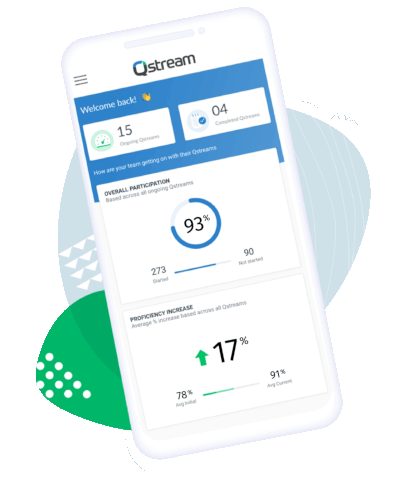
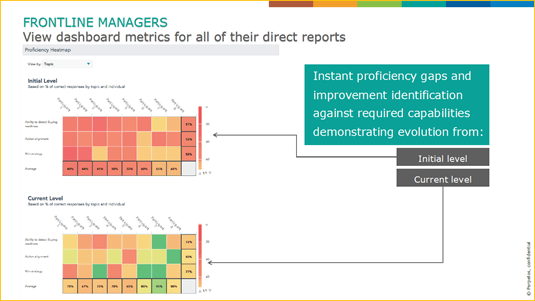
Analytics from an LMS is historically insufficient for sales managers or trainers in determining if their salespeople are understanding what’s being taught. Microlearning platforms enable you to track and compare the evolution of sales engagement, proficiency and performance. The insights gained from these can help to leverage each individual’s strengths for the benefit of the other team members. Real-time dashboards and proficiency heat maps (Fig. 2) show initial and current proficiency, allowing you to assess progress and offer personalized coaching for each team member.
Fig. 2: Qstream dashboards with heat maps
Real-world scenarios
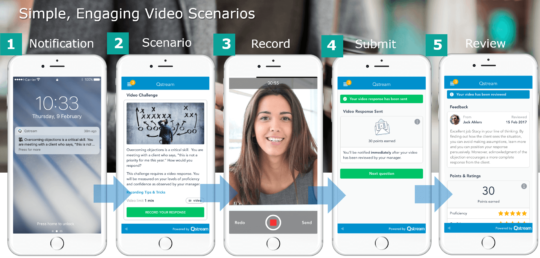
The key to keeping reps engaged is to feed them information that is relevant to what they are experiencing every day. Microlearning platforms like Qstream provide an easy method for learning by utilizing spaced repetition, cases and testing (Fig. 3). This way instant learning is obtained, and salespeople are able to incorporate the lessons into their daily routines and use that knowledge in real-time.
Fig. 3: Microlearning with roleplay on Qstream
Precise coaching
Mobile platform tools can paraphrase classroom content into 12-15 yes/no, multiple choice or scenario-based questions, helping your team to jog their memories and repeat what they have picked up during training. The system thus reinforces knowledge, not only by testing but continuous retraining at the same time.
Ambition, engagement and improving proficiency are encouraged through competition and gamification – with extra points for both speed and accuracy and real-time leaderboard. Managers receive suggested topics for coaching their team members as well as overview of how much progress individuals have made compared to earlier tests. Data-driven matrixes evaluate the impact of training, offering customized coaching opportunities for the team’s manager, based on individual and team results.
Making Sales training Stick
Competency does not come from periodic, one-time training. According to Ebbinghaus’ Forgetting Curve, learners forget 90% of what they learn from an event-based approach within 30 days, with most of the new material being forgotten within the first few hours after the training. A solution to promote knowledge retention is spaced learning.
Spaced learning implies multiple training opportunities. Repetition is indeed the mother of learning. We also notice great results by combining spaced learning with microlearning.
A systemic approach to learning
Key components of a systemic approach to learning for the mobile workforce will typically include a mix of learning strategies:
Virtual training sessions that relate to the day-to-day operations and will equip salespeople with the confidence and capability to perform at their highest potential
Experience-sharing sessions that will leverage peer-based support to unlock current difficult customer situations
Individual coaching sessions to follow up on field implementation of newly acquired knowledge and skills
Supplemental online training that will put the learner in contextually rich scenarios that are cognitively challenging.
Spaced microlearning to break up complex or detailed job-specific learning content into scenarios and delivering this repetitively over time through a learning experience that fits into the daily flow of sales work
Combining these learning strategies will ensure that your upskilling becomes ingrained in individual habits, thereby making sales people better performers and more likely to have a positive impact on organizational goals.
Conclusion
The digital age requires an agile learning environment, supporting continuous learning. Hence the need to integrate spaced and mobile learning for continuous knowledge reinforcement and proficiency measurement. Creating the capacity to objectively measure the impact of improvement initiatives, and even measure proficiency, enables you to create individual learning paths on the one hand and encourage the implementation of effective sales strategies on the other.
Having questions on how to implement effective commercial improvement initiatives?
To improve your sales chances and engage customers, it’s important to identify where your customer is in their buyer journey. Do they need to change supplier? And if so, why should they choose you? Or are you already their supplier, and you need to convince them to stay? These different situations call for different messages, so you need to gain insights into your customer’s roles and challenges, create targeted messaging, and train your salespeople to deliver it correctly.
Driven by insights, Marketing must build targeted communications and content. This should drive action and conversion, both before and after sales engages with customers.
Engage customers with deep buyer empathy
Your sales force needs to adapt its messaging to the particular situation so it can communicate your added value efficiently and effectively. But sales pitches often focus too much on internal issues, causing commercial professionals to simply act as talking brochures and lose sight of the messages and skills they need to convince your customers.
So instead of talking about what you do and why you think you can do it better, you need to create a buying vision that defines a new set of challenges that align with your particular strengths. For example, the key question that new prospects need to answer – to break their status quo and initiate their buying journey – is: why should I change?
Follow these three steps below to identify where your customers are on their buying journey, work out what specific messaging you need to use, and deliver it correctly…
Step 1: Gain insights into roles and challenges
Wherever the customer is in their buying cycle, to build a compelling case, you first need to find out more about their situation.
Start by talking to the decision-makers to gain an understanding of their KPIs, challenging projects, and any blocking issues;
Use contextual interviewing techniques to build trust, create credibility, and gain valuable insights into their specific challenges – and find out what capabilities they envisage will solve them;
This will help you collect, organize, and build messages for your salespeople to create empathy and demonstrate business acumen;
To improve your sales chances, salespeople need to articulate value messages that resonate with customers’ specific challenges and have access to decision-makers who are much better placed to convert leads into deals. But they still need to know how to have successful conversations which promote a shared vision early enough in the decision-making process. It is therefore essential to understand buyers’ roles and relevant business challenges when creating this vision.
For example, staying the same is safe and comfortable, whereas change is associated with threat and risk. If too many deals in your pipeline are being lost to ‘no decision’, rather than to your competitors, your real threat is the status quo – because buyers are deciding they prefer to do nothing instead of change. This means you need tell a story that explains why they should change and leave their current situation, and why they should do it now.
Acquiring new customers and developing new accounts therefore requires messaging and an approach to customer conversations that is distinct from those used for existing customers. So marketing needs to equip your commercial people with three different types of sales messages and tools: ‘why change’, ‘why choose us’, and ‘why stay with us’.
These three messages need to align with each member of the decision-making unit’s journey, which increases the number of conversations, and unfortunately this complexity can undermine sales performance.
But whatever the customer’s situation, you need to explain why their current approach is putting their business at risk. To do this, you need to demonstrate that you know and understand their business, and can deliver insights into what they’re missing that will improve their performance. So, to address your buyer’s situation, you need to equip your salespeople with the right messaging to take advantage of any opportunities at early an early stage – to gain and keep control of the buying cycle right up until the deal is sealed.
Step 3: Train your salespeople to deliver the right message to the right people at the right time
Prospective customers are a different proposal to existing customers – customer acquisition is all about challenging the status quo to highlight the benefits of switching to your solution, whereas customer retention and expansion requires you to reinforce your position as their status quo: ‘why change’ and ‘why us’ messages will resonate with prospects, but ‘why stay’ is designed to foster customer loyalty. Make sure your marketing tells the right story for the right customer. Bearing this in mind, you need to:
Help your salespeople gain access to executive buyers early in their decision-making process, and work consultatively with those buyers to shape a vision for their solution;
Build a messaging kit that covers what to say to whom, and when, in order to ensure engaging conversations;
Train your commercial force, use role play exercises to practice typical scenarios and conversations, share best pitches through the use of videos, promote ‘intervision techniques’, and provide constructive feedforward from the customer perspective.
How can messaging kits help?
Developing messaging kits can help marketing help salespeople gain access to executive buyers early in the decision-making process, and work consultatively to shape the vision of the solution they can provide. These messaging kits offer insight-driven content so your salespeople can engage more deeply with buyer empathy. This can enable sales through having a messaging repository and customer-centric presentations, impacting customer stories, and organizing training sessions for salespeople to learn how to sell certain solutions.
Last week, I had another meeting with a Head of Sales in order to determine improvement opportunities within his sales team. Once again, the Head of Sales expressed to me the closing skills of his account managers should better.
While this might be true for some, the reality is that this is mostly the symptom of another problem.
While conducting several assessments to determine skill and proficiency levels within and across sales teams in several organisations, we noticed a recurring pattern: sales professionals induce the difficulty of closing themselves.
How? They often go for the kill too soon in the selling process.
Let me explain. We all know buyers go through their own buying journey. After being triggered by something, their interest is raised, they become aware something should change, start exploring,… to finally end up deciding what specific solution they need and whom shall be the best provider of this solution.
If, as a sales rep, you start proposing a specific solution while the buyer just became aware something in his current situation should change, or worse, if you start telling him why he should collaborate with you, you will create a lot of friction.
When you think of it, it is no rocket science. It all has to do with the mental phases we all go through in our decision process towards change. This mental journey is illustrated by buyer journeys. This is something your sales reps should be aware of so they can determine what they should and should not do, and when to do it.
So, what about your sales reps’ closing skills? It is quite simple, really. If you want them to be efficient in applying their closing skills, first ask yourself if your selling process is aligned to the buyer journey. If so, your sales reps are able to identify the buying readiness of prospects, know what to do accordingly, and when to close.
Want to know if your selling processes is truly buyer aligned?
Collective intelligence makes your sales team smarter. Empower your entire team to help one salesperson solve a problem by using intervision techniques to leverage collective intelligence.
Collective intelligence
Put simply: ‘two heads are better than one’. Intervision techniques therefore help you harness every member of a team’s own thoughts and ideas to promote group intelligence – investing in each member and increasing the potential of overcoming one salesperson’s specific challenge.
Intervision techniques call on collective intelligence
Intervision, also known as ‘group coaching’, ‘peer coaching’ or ‘co-development’, refers to an activity with a small group of professionals who have a professional context in common. It emphasizes the multilateral contribution between colleagues – as opposed to supervision – because collective intelligence is a kind of wisdom and knowledge that grows out of a group.
The intervision technique provides sales managers with a different way to interact with their team and team members. Similar to group coaching, it relies on questioning and active listening, but also employs brainstorming techniques and makes it possible to tackle both technical and conceptual problems. The main difference, however, is that intervision covers topics that will benefit the entire sales team and make it more effective, whereas individual coaching aims to solve a problem specific to the salesperson.
What sales problems can intervision techniques help to resolve?
Team meetings are too often laborious and ineffective, and this is where collective intelligence can help. Intervision techniques relate to sales team coaching. They develop sales efficiency, strengthen team spirit, and increase corporate identity. They can be used to generate new ideas, discover new ways to analyze situations, and find new possible solutions.
There are a couple of conditions for its effective use, however: the presented case must be real, and it must relate to a real blocked sales opportunity, for example in a situation where a salesperson experiences repetitive failure or a persistent communication issue.
The exposed situation very often reveals a common problem – something that sounds familiar to all salespeople, which they might have been exposed to in the past or are still facing today. This is why the intervision session can benefit the whole team.
How to moderate an intervision session
The session can be done with or without a facilitator, but it’s always crucial to stick to the allocated time for the exercise to be effective and stop the group from dwelling on details. It is recommended to spend 45-90 minutes on each issue as a group, depending on the group size and complexity of the topic.
During an intervision session, aparticipant raises one issue, which could be a new challenge or a problem that they have encountered. It’s essential that it’s an ongoing issue.
The other participants then act as consultants and commit to share ideas, collaborate, and help the salesperson who wants to overcome a difficult situation. Group members ask questions to find out more about the topic and clarify particular points. It’s important not to start discussing solutions at this stage, but simply to focus on clarifying the issue.
The next stage is for the group to start brainstorming possible ways of approaching the problem and suggesting possible solutions. The issue owner is invited to listen and to take in the proposals without joining the discussion.
Following the brainstorming session, the group makes a number of recommendations and suggestions to the issue owner, who can then provide feedback on what he/she has heard from the group: how it helps or not, what they can take away from the exercise, etc.
Selling in uncertain times
This technique is particularly relevant in today’s market – with fierce competition and rapid change. Sales organizations need collective intelligence to be more agile and adaptive without burning talent.
To stimulate improved sales performance, it’s important to understand and practice digital behaviors that promote a sense of psychological safety. You can encourage this psychological safety in your commercial team by:
Framing the work as a learning process,
Acknowledging your own fallibility;
Modeling curiosity and asking lots of questions.
Remote working and digital communications
Psychological safety and trust in leadership are more important than ever before as sales forces are increasingly working remotely and communicating digitally.
Leverage psychological safety
Amy Edmondson, Professor of Leadership and Management at the Harvard Business School, defined the notion of psychological safety as a shared belief that the team is safe for interpersonal risk-taking and being vulnerable in front of each other. In other words: team members feel accepted and respected in psychologically safe teams.
This means that members of effective teams feel comfortable asking questions or bringing up new ideas – without worrying about being judged – and are confident they won’t be embarrassed or punished for making mistakes.
The whole is greater than the sum of its parts
In line with this phrase first coined by the philosopher Aristotle, we also believe that members of efficient sales teams can achieve more by working together than working alone. An efficient commercial team is therefore more than the sum of its individuals – so even though getting these individuals to all work together can be tough, it’s critical for team effectiveness. They need to plan, solve problems, make decisions, and review progress. And they need each other – and efficient leadership – to get this work done successfully.
3 behaviors that increase team efficiency
A Google study reported in The New York Times Magazine highlighted several factors that boost team efficiency, and psychological safety came top in the order of importance. The most effective leaders are therefore those that create a safe and open ‘digital dialogue’ with their team members.
There are three specific behaviors that strongly correlate with high-performing managers:
Expressing doubts: Do you feel safe saying ‘I don’t know’, or are you worried about seeming ignorant or incompetent? Managers who admit not knowing the answer to a question – and who create the same sense of security in their direct contacts – are more effective than those who do not.
Requesting feedback: Asking for and providing feedback increases effectiveness and engagement. Digital interactions through video conferences, chats, or email are good opportunities for providing constructive feedback – and constructive feedforward.
Sharing opinions: It’s important for team members to feel confident that nobody else in the team will embarrass or punish them for offering ideas or questioning the status quo.
Customers’ buying behaviour has changed considerably in the past few years. How can companies respond to this challenge? How do you organise sales in a digital world? Are you still sending your salespeople out like talking brochures, or will you take action? And how? A diagnosis.
Time for a sales reboot
Since 2012, the results of a multitude of studies about the changing buying behaviour of customers have been published. However, many companies only take action when the impact really becomes painful. And it’s often too late by then. It is therefore advisable to take action proactively. But can you motivate people and organise your sales in such a manner that the transition can take place in a timely and painless manner?
Avoid a reaction that is either too soft or too hard
There are two ways to react to the reality of changing buying behaviour.
(Too) many companies continue to assure their clients that with some adjustments, the existing commercial solutions
are immune to the changes. Unfortunately, the sales pipeline is like
the arteries in our body. If we do not adopt a healthy lifestyle, they
slowly get clogged up. The consequences in the long term are disastrous. Holding on to old habits is not the solution.
Others call for a revolution. The world is no longer the same, which is why a drastic transformation of sales is required. We have to
start over! That means completely redesigning the processes and systems
and preparing for the future! That may be so, but… intrusive action
often triggers a shock effect, which in turn has serious consequences.
Opt for the human approach!
How can you react to the constantly changing world? Doing nothing is not an option. Starting all over again is not the right solution, either. Actually, the answer is simple: we have to evolve together with our customers. Selling is and will always be a people business,
even online. The impact we are noticing with our customers and
prospects shows that the changes are real. It is therefore necessary to develop a change process as soon as possible. This way, the changes can be implemented gradually and on a human scale. Without disruptions or all too radical actions.
Toward a new role for salespeople
All change processes are based on insights.
Customers are still overwhelmed by salespeople who are sent out by
their employers like some sort of talking brochures, although they don’t
care about salespeople bombarding them with arguments and the benefits
of the products they try to sell. Some consultants take advantage
of this fact by stating that salespeople will disappear altogether.
Nothing could be further from the truth, but it is true that the role of
salespeople is changing drastically.
60% of the sales opportunities come to nothing because the customer does not buy or does not change suppliers.
The sales cycles have become 22% longer since 2012 and your biggest competitor is no longer your direct competitor, but customers who do “nothing”. Recent research has shown that up to 60% of the opportunities are simply closed in CRM because the customer doesn’t buy anything or is not willing to change suppliers. You can imagine the impact on the sales cost.
Sales are needed as long as you:
… incorporate the right mix of digital and human touchpoints in the entire buying cycle of the customer. This depends on the complexity of the product or service you offer, but mainly on the impact on the customer.
… use an interpersonal approach focused on supporting customers and creating added value. This requires the salespeople to have contact with an increasing number of different persons with the customer and at other moments during the buying cycle.
… adjust the sales pitches to every moment during the buying cycle and to the profile of the persons with whom the salespeople are to engage in dialogue.
Do you want to find out how you can prepare your commercial staff for the future without having to take all too radical actions? Contact us or read more in our eBook:
7 Criteria your sales process has to meet
Are you looking for a new Sales process to find a (new) way to reduce your cost of sales, stop margin erosion or better align your approach with the customer’s buying cycle? Learn how to make sure that the selected process is right for your business.
When it comes to training, businesses generally prefer to leave it to HR. And the same goes for training evaluation. So there’s a good opportunity for HR to increase their impact on business operations. This typically takes place in the form of evaluations, when determining training requirements. And the other way around: evaluating if trainings are achieving their goals with employees performing better.
Pitfalls of conventional evaluation after training
Unfortunately, this latter form of evaluation is all too rare. Many HR professionals are happy to evaluate the training itself, usually by measuring participant satisfaction. Now the trainer and the content do – of course – still need to be evaluated by participants. But this isn’t the most important thing.
Real evaluation can only take place weeks and sometimes even months later. Have the salespeople permanently changed the way they work? Can they put newly-acquired competencies into practice? Are they actually performing better?
Get more from your training budget: measuring ROI
Not measuring the impact of training on the business puts training budgets under pressure. Businesses rightly need to question the usefulness of training. Especially when salespeople are taken out of the field and so have less time to actually make deals. But the benefit of training is sometimes limited to briefly boosting employee motivation, which then ebbs away again just as quickly. The impact of training isn’t just the responsibility of HR and the training course itself, however.
Turning training into a continuous learning process – integrated in the work environment – enables your people to learn skills and behaviour that they benefit from permanently. A number of techniques include:
The 70-20-10 rule, where only 10% of time invested is for training, with 20% specifically linked to coaching that accompanies the training, and 70% for support in the workplace
Allow direct managers to follow the training too. So they’re also familiar with all the content and can provide better coaching. Depending on the training content and corporate culture, they can either join the employee session or organise a separate one
Snackable learning – not to be confused with e-learning. This involves short, interactive sessions (nuggets) that are made available to salespeople via their smartphone or tablet. They can help reinforce and embed the training content. And they always remain available as a refresher when specific situations arise. Think of it as an interactive ‘How do I …?’ YouTube clip
Convert customer expectations and business objectives into specific behaviour and competencies that can form the basis personal development plans
A culture of continuous improvement
The above enables you to get a culture of continuous improvement on track, together with the business. Actively supporting direct managers in the 90% non-training time, means HR can help influence the impact. You can then implement any necessary changes depending on the progress made and any obstacles encountered. Research by CSO Insights shows that continuous learning can increase sales performance by 50%.
Customer expectations are changing fast as a result of digitisation. Customers today are better informed than ever before. So they don’t need salespeople to come and inform them about their company or products.
We use cookies to ensure that we give you the best experience on our website. If you continue to use this site we will assume that you are happy with it.



 Pascal Persyn




 Eliseo Manfron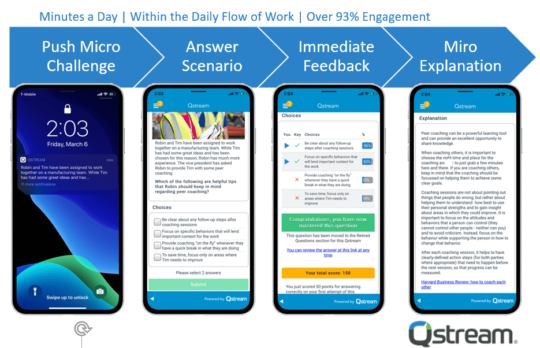


 Nicolas Dejehansart