

In our conversations with CEOs and sales and marketing directors, we keep hearing the same comment – that fewer and fewer salespeople are meeting their targets. And further investigation has made the reason for this very clear: salespeople have insufficient knowledge of their customers and the market, and are lacking some of the specific competencies required in today’s marketplace. 

Various research has shown that revenue and sales quotas are becoming increasingly difficult to achieve. For example, one study by Sales Insights Lab in 2021 demonstrated that only 24.3% of salespeople were managing to exceed their sales quota. So is there a problem with salespeople’s productivity?  

Much depends on how we present sales productivity, because the concept is very often seen as a combination of efficiency and effectiveness.  

Sales Productivity

And this presentation is a good reflection of traditional sales training, where the main aim is to clone top salespeople’s behaviour into the DNA for other salespeople. According to figures from the Association for Talent Development, the US alone spends $24 billion per year on this.  

But this approach has a disappointing outcome. Fewer and fewer salespeople are achieving their quotas, and fewer and fewer companies are achieving their revenue targets. So the main challenge is no longer effectiveness, but a lack of knowledge about the customer and an inability to link any available knowledge to products and services.  

What has changed? 

Almost everyone agrees that customers are much better informed nowadays. And one consequence of this is that customers prefer it when we are less active in trying to sell. They don’t want us to try to convince them, and instead like to make their own minds up. So traditional methods of talking about the company, products and services simply don’t work anymore because customers can find all the information they need on the internet. They used to accept the information we gave them and were happy with that because there was no alternative, but now they can find all the information they need about products and services without any help or intervention from salespeople. 

The fact that customers can now serve themselves with this information also has a significant downside, however. How do they deal with conflicting information and advice? How do they know what is correct or relevant?  

And this is where the opportunity now lies for customer-facing professionals: providing added value, offering useful content, and having meaningful conversations. These are now the most important reasons for customers wanting to engage in dialogue with a salesperson. They expect the salesperson to know their environment and responsibilities, and don’t want to have to bring them up to speed themselves. But they do expect the salesperson to engage in dialogue, share their experiences from other companies, and enhance the buyer’s perspective.  

What has not changed? 

All of this has led to a steep rise in content production over recent years because we want to ensure customers can inform themselves. Some suppliers and analysts even claim that content marketing is taking over from sales. Unfortunately, however, it’s not quite that simple.  

Customers may well be informing themselves more, but content marketing has not solved the problem of declining sales quotas and salespeople productivity. In B2B, digital interactions are just as necessary as personal interactions with sales – as a recent study by Forrester confirms (Sales Enablement: Planning Assumptions 2022, Forrester Research Inc., September 2021). Interactions with customers have only increased recently, e.g. from 16 to 17 between 2017 and 2019, and from 17 to 27 during the pandemic. Customers are seeking out information for themselves, but they still need answers. And this is where the salesperson comes in – because they are still seen as a partner here.

Furthermore: the type of interaction (digital versus personal with the salesperson) is independent of the phase in the buying process. It’s not the case that a salesperson is only forced to join in at the end of the buying cycle. So we need to make sure we interpret the almost mythical figure – that 57% of the buying cycle is completed before a salesperson is involved – from research firm CEB (now Gartner), correctly. As mentioned above, the customer is better informed these days. So their decision criteria have typically already become more influenced.  

A salesperson with the right knowledge can therefore engage in dialogue with the customer and avoid this pitfall. It’s all about having meaningful conversations. And it’s not relevant whether these conversations take place through personal interaction or indirect communications – as long as the buyer finds answers in every phase of the buying cycle. Again: content marketing is essential, just like sales. And one cannot do without the other in complex B2B environments. 

And what about training?  

Traditional sales training has become outdated, just like the focus on quotas based on efficiency and effectiveness. What we need today, more than ever before, is more focus on sharing knowledge and experiences (see graph). 

Our advice to sales managers is therefore to enable salespeople to share useful information with customers during sales conversations, and to introduce a common language in your training that encourages team selling and experience sharing. Customer-facing professionals want to be able to have meaningful conversations that are relevant to the context and the customer’s phase in the buying cycle. ‘Just in time’ is the key phrase here. We are therefore seeing increased benefits in training that teaches competencies which allow salespeople to introduce contextually relevant cases, from themselves or at least from their environment. 

Increasing sales productivity again 

Our analyses consistently show that salespeople who possess the right knowledge, skills and tools are more likely to meet their quotas. This clearly falls under the realm of sales enablement, a continuous process of giving your customer-facing employees the knowledge, skills and tools they need. 

Figures from Miller Heiman Group from 2019 support this claim (see graph below), and they show the impact of sales enablement in their 5th Annual Sales Enablement Study. Organizations without sales enablement achieve a win rate of 42.5%, 3.9% lower than the average (46.4%). Organizations with sales enablement achieve an average win rate of 49.0%, a huge 15.3% increase. 

Win Rates for Forecast Deals

Win Rates for Forecast Deals

Creating an environment like this in your organization can therefore significantly improve your sales results. But how do you do that? First and foremost, you need a company culture that encourages continuous learning and improvement. Additionally, it’s also best to make relevant content available in bite-sized pieces, easily accessible, and with clear instructions on when and with whom to use it.  

In other words, the solution lies in continuously sharing knowledge and experiences to improve the productivity of salespeople and the entire sales team.  

To find out more, get in touch with one of our experts who will be happy to provide you with specifically tailored and actionable input. Book your appointment today. 

Want to learn more? Download our eBook:


Who are the hunters and farmers in your sales team? Or do other characteristics determine the DNA of your salespeople? If you want to improve your team’s sales performance, you need to know their DNA. 

The classic way to look at salespeople is the dichotomy between hunters and farmers. In a nutshell, this is the difference between salespeople who acquire customers and who maintain customer relationships. 

Unfortunately, this dichotomy is a bit outdated, and no longer useful for maximizing your team’s sales potential. Further in this article, I explain why. But let me start by stating how we may look at this in a better way. 

Three important sales competencies  

Research has shown that every sales profile is, to a greater or lesser extent, a combination of three components or competencies. And one such competence is a mix of knowledge, skills, attitudes and convictions.  

These components are:  

  • Account Management: This competency focuses on supporting the customer in the best way. This translates into customer support and taking responsibility to resolve problems quickly and appropriately. Account Management also means coordinating and connecting the right people within the company and the customer. Everything is about service and maintaining existing relationships. 
     
  • Account Development: This competency includes actively seeking up-sell and cross-sell opportunities. Important attributes here are proactivity and thinking with the customer to cover their needs with the available range of products and services as much as possible. Account Development requires that you can extend relationships to colleagues of your relations who may also benefit from a partnership. This allows you to sell other products and services and maximize the share of wallet. 
  • Business Development: The three main characteristics here are building new relationships, empathy for the customer’s business and influencing from trust. This competency is necessary to develop new opportunities within the same company, but also to activate and bring in new customers. 
Sales Profile by team example:
Sales profile by team

Healthy mix  

Every salesperson has a unique blend of the three competencies listed above. Some of the underlying skills can be learned, at least up to the point where the salesperson steps outside their comfort zone too far or when personal beliefs become too much of an obstacle in a business environment. In that respect, it is not strange to speak of the salesperson’s DNA. An obvious example is that you would teach someone who scores very high on account management and has virtually no business development competency skills, to market a new product or focus on new customer acquisition.  

Based on the unique mix of competencies, you can better distribute roles and responsibilities in your team. A balanced distribution ensures a consistent and positive customer experience across all touch points. 

For example, someone with strong account management competencies and little affinity for business development will function best in a commercial support function. Customer Success and inside sales are two typical job titles for such a profile. Someone with strong business development competencies and little affinity for account management will thrive on bringing in new customers, and preferably non-recurring customers. 

Why the hunter – farmer model is no longer adequate 

The dichotomy between hunters and farmers may have been useful as a shortcut, but today’s more complex sales practice requires a much more nuanced view. Today we see sales profiles more as a unique blend of three competencies that every salesperson possesses to a greater or lesser degree. 

Today’s reality brings forth new challenges: 

  • The Internet and social media often lead to better informed customers, but just as often to misinformed customers.  
  • The number of people involved in B2B decisions has increased to an average of 6.8 people and can be as high as 20.  
  • Products and services have become more comprehensive and complex. 
  • Market volatility has never been greater. 
  • The speed of change and evolution continues to increase. 

The best way to deal with this new complexity is to organize sales as a team sport. Make sure all competencies are present in the right dosage so you can offer your customers a consistently positive experience throughout the entire customer journey. 

Better performance based on your team DNA   

The distribution of the three sales profiles across your team is what we call your team DNA. That DNA will have an impact on: 

  • How and who you are hiring, and which competencies you need to reinforce  
  • Which roles you assign to the different people in your team  
  • Which skills and knowledge areas need to be developed  
  • How you compose your customer portfolios. For example, you want to avoid having pure acquisition customers in the same portfolio as retention customers. 
  • How you manage and coach each team member in line with what they like to do and what they want to improve in quickly.

Do you want to maximize the performance and mental fitness of your sales team? Then, first and foremost, you need a certain balance in the available profiles adapted to your goals. An efficient, flexible and balanced team with the right DNA consists of motivated employees who each individually do the right things at the right time, together with the right stakeholders, both internally and with the customer. 

Discover your team DNA  

Do you want to map the DNA of your sales team and use this to improve their performance? You can. At Perpetos, we use a sophisticated audit that we can also link to sales performance. 

For example, in this audit we examine: 

  • The preferences and spontaneous reactions of team members when handling a range of customer situations  
  • Time spent on each type of sales activity
  • Time lost on activities that should not be the responsibility of a sales person 
  • What energizes your sales reps and keeps them mentally fit 
  • To what extent they are satisfied with support from other departments 
  • In some cases, to what extent compensation is perceived as “fair” and in line with expected performance 

We call this our Account Development Audit™. The audit is most effective for companies that derive a significant portion of their revenue from recurring customers and sales. For companies that sell investment goods for example, we have a different audit that is more suited to that typical environment. 

An audit of your sales team is an important step towards making better use of the people available to realize your goals.

Do you want to know more about the possible impact of a DNA analysis of your team?

The war for talent is raging. On top of that, B2B buying behavior is changing dramatically. Commercial teams have a hard time finding answers to these ongoing challenges. The changing environment has a serious impact on sales functions, responsibilities and competencies. What your sales team needs now is new skills. Even more than that, it needs a program that enables your team to continuously develop and hone its competencies, through an effective learning method. At Perpetos, we call this your Sales Academy.  

We can think of at least five reasons why your team needs its own Sales Academy: 

  1. Consistent training: A Sales Academy will provide your team with consistent commercial training, ensuring that everyone is on the same page and working towards the same goals. This will help to deliver a consistent and positive customer experience in all the touch points with your organization. In turn, this will lead to improved sales effectiveness and better results. 
     
  1. Customized training: By developing your own Sales Academy, you can customize learning according to the specific needs and performance priorities of your company. This requires a company-specific integration between individual competence gaps, business performance gaps, team interactions, effective messaging that engages customers, and new ways of working. This can include messaging about specific products and services, that are most effective and translated into your sales teams’ reality. 
     
  1. Increased sales: Sales is not that different from athletics. Training and mental fitness are key for a top performance. By providing your commercial team with the tools they need to succeed, you can improve their ability to close deals, improve customer loyalty and maximize revenue for your business. 
     
  1. Improved customer experience: Well-trained people in today’s reality understand how people buy and are also better equipped to do their job. By understanding the different phases of the customer journey and knowing how to adjust messaging accordingly, your sales team will be able to influence buyers more successfully and build stronger relationships. 
     
  1. Increased employee retention: Providing continuous learning opportunities will help to improve employee satisfaction and retention. But just as important is a commercial academy to groom sales talent and facilitate internal job mobility, from a technical role into sales and moving on to key account management. All this requires is a well thought out training strategy with competencies linked to learning modules, which allow people to grow in their career and be guided with Just In Time learning.  

Signing up for a Sales Academy in your B2B organization means that you are serious about installing a culture of continuous improvement, and that you want to stimulate peer-to-peer learning.

People uplift each other when they are challenged. They acquire new competencies and are being reminded about the things they know but no longer apply. After all, the hardest thing to achieve is closing the gap between knowing and doing. 


The digital landscape has profoundly changed the buyer journey. Today, customers go online to find answers. But does this mean that the salesperson is no longer necessary? Not at all. The magic word here is relevance. In addition, sales reps need to find the right balance between digital and personal touch points throughout the customer journey. 

We’ve all read it before. According to one study, customers have already completed 57% of their customer journey before the first appointment with a salesperson. According to another study, even 70% of that customer journey has already been completed. No wonder it’s so hard to get an appointment, you might think. 

Relevant touch points

And yet, many of those so-called studies on the customer journey draw the wrong conclusion. Not surprisingly so, if you look at who publishes or sponsors the research. Very often they are providers of marketing automation solutions who would love to have all those salespeople replaced by their content marketing platform. If only it were that simple.  

What those studies do expose are symptoms of another phenomenon, namely that customers no longer accept being bombarded with irrelevant company presentations or product pitches. What customers do expect however, are relevant touch points tailored to the buying phase the customer is in. This applies to both digital and physical interactions. 

An earlier study by SiriusDecisions, now part of Forrester, proves this statement. Their figures show that prospects are willing to interact with salespeople at any stage of the customer journey, regardless of the complexity of the product. The prerequisite is that the salesperson can detect the right buying stage and align the conversation accordingly. 

Providing value

This obviously requires a different approach. Now, the focus is increasingly shifting from push to pull communication. In other words, sales reps will need to put less effort into arguing and persuading, but focus more on dialogue and bringing new insights.  

In addition, as a sales professional, you are expected to know your customer’s background. Asking about your customer’s challenges is therefore pointless. After all, the customer doesn’t have time to train salespeople on the challenges of their job and their industry.   

A relevant contact does not necessarily imply knowing the customer’s exact priorities. What is important here is to deliver a message that is recognizable to the customer’s industry. That is enough to start a dialogue. Once your client feels that there is value in it for him, those priorities will come forward naturally.

Tools that help you stay in touch  

Based on dialogue, the customer and salesperson can decide together whether a follow-up action or further contact is needed. That doesn’t necessarily have to be a physical appointment. As a salesperson, you can also keep the relationship warm by offering valuable, relevant content. That’s why a good collaboration with the marketing team is recommended. They can offer you the tools you need to keep the contact with the customer going.  

Some examples where the marketing team can help you: 

    • Background information and descriptions that help you empathize with the different roles and markets where you want to build and maintain relationships 
    • Clear value propositions that demonstrate the link between customer challenges and aspirations and the products and services you offer  
    • Relevant content, such as case studies, ebooks or research results, which allows you to communicate digitally in a relevant way in between your face-to-face contacts with customers  
    • A digital preference center, where you can link content to customer profiles and topics, and which is customizable by the customer  
    • A CRM where you can easily start linking relevant content to a contact that has not been added to the system 

    Don’t believe the hype  

    No appointment? No panic. There are ways other than physical contact to keep the relationship with the customer warm. Despite what many ominous studies tell you, the salesperson remains relevant, and at every stage of the buying cycle. So, don’t believe the hype. Do try to stay relevant and engage with the customer. With the right marketing tools, that task will become much easier. Good luck!


    Today’s buying cycles are more like nonlinear, networked journeys. As a sales professional, it’s almost impossible to handle this complex fuzzy logic process on your own. That’s why selling is a team sport. It needs multiple people with different roles who need to work together to achieve a common goal: solving customer challenges and aspirations.

    5 reasons why sales is a team sport

    1. Selling is a complex process that requires different competencies.

    Selling includes building relationships, qualifying, gathering insights, enriching the vision of the customer, influencing based on your strengths, negotiating and closing. Each phase of the buying cycle requires different skills and knowledge. Developing sales talent to prepare them for all these competencies takes too much time. It is too risky and it prevents companies from reaching their full potential. Collaboration between team members is the name of the game.

    2. Selling is a competitive process that requires differentiation and mental strength.

    In today’s crowded, noisy market, customers have many options and alternatives. The abundance of available information makes it hard to distinguish what is relevant. A salesperson can help customers by pointing out what is relevant to their business and challenges. Sales can help by visualizing what the impact will be when they use their products and services. This can help the customer to break the status quo and actively seek a solution. Only then is it the right time to talk about products and services and link those to the solution the customer has in mind. To drive the buyer towards a favorable decision, a commercial organization needs to make use of the strengths and resources of its team. This includes seeking assistance from marketing, product development, product marketing, technical experts, application engineers, and customer service.

    3. Selling is a relational process that requires trust.

    Customers always buy from salespeople they like, know and trust. Yet, the number of people involved in B2B buying cycles has increased to at least 5, even up to 20 people, depending on the complexity of the offering and the size of the customer’s organization. How can one person build rapport and credibility with so many people in different roles? How can one person have relevant conversations to establish long-term relationships that go beyond the transaction?

    Commercial organizations have to enable a team to build relationships in parallel. Sales can be the orchestrator in this to ensure a consistent and positive customer experience throughout the buyer’s journey. That is a big change for traditional sellers, because it means they no longer own the relationship. Many people and digital touchpoints are now in play in parallel.

    4. Selling is a dynamic process that requires adaptation.

    Customer needs, preferences and expectations change over time. The offering evolves, the competition is changing, new competitors enter the market, sometimes with a totally new perspective. A salesperson needs to stay on top of market trends and customer feedback. This requires the team to adjust its strategy and tactics accordingly. That’s why they need to learn and grow with their team, and continuously build ‘next’ practices instead of ‘best practices’ based on these insights and lessons learned.

    5. Selling is a rewarding process that requires recognition.

    Salespeople work hard to achieve their goals and overcome challenges. They need to feel appreciated and valued for their efforts and contributions. The new context has a huge impact, because they no longer are the hero. It’s the team who is realizing success and failure together. That’s why they need to learn to celebrate success as a team and acknowledge their achievements, express gratitude and enjoy the fruits of the collaboration. It’s an important role for sales leaders to facilitate this, while keeping the mental resilience of the salesperson high. At the end of the day, the salesperson is like a deep striker in soccer. If they don’t score enough, the team can’t win.

    5 tips on how to organize sales as a team sport

    1. Define clear roles

    Define clear roles and responsibilities for each team member involved in the customer journey. Make sure everyone knows what they are expected to do, when they are expected to do it and how they are expected to do it. They all need to understand how they contribute and what others in the team are expecting from them.

    2. Foster communication

    Establish regular communication channels and feedback mechanisms for all involved. Make sure everyone is informed, aligned and engaged with the sales goals, strategies and activities.

    3. Stimulate collaboration

    Create a culture of collaboration and continuous improvement. Make sure everyone respects, supports and helps each other to achieve the common goal.

    4. Keep learning

    Stimulate a culture of learning and development. Make sure everyone seeks, shares and applies new knowledge, skills and ideas to improve their performance.

    5. Celebrate success as a team.

    Cultivate a culture of recognition and appreciation among team members involved in the sales process. Make sure everyone acknowledges, praises and rewards each other for their efforts and results.

    With today’s complex buying cycles, we need to have everyone on board to make the sale. Everyone is in sales and can contribute to ensure a consistent and positive customer experience in every touchpoint.


    In our previous post, we explained that a complex business negotiation is much like a chess game. It’s about making a move and anticipating your customer’s next moves. One of our customers, a packaging company, recently learned this by following our Complex Negotiations Implementation Track, an intense training & development program for sales teams and management professionals. Throughout the process, our customer started to have a pretty good idea of what they were doing right and should do more of, what they needed to stop doing, and what they needed to start doing. We packed all the valuable lessons in a practical overview.  
     

    What they need to CONTINUE doing 

    Have strategic conversations

    Before going into the negotiation and even quotation phase, start by exploring the customer’s challenges and priorities for improvement. During preparations, also talk to technical teams or people on the work floor. 

    Sell the value, not the product  

    Sales reps like to see their customer relationship as a partnership, where they jointly work on Total Cost of Ownership. This is a much better choice than just defending the value or margin on your product. To do this successfully, you need to be able to prove the value you are offering, whether it’s a cost reduction, cost avoidance, increased revenue, or decreased risk.  

    You need to make clear that taking your company out of the equation would have a negative impact, one that outweighs the potential price gain from working with a cheaper vendor. The value you offer, including the specialty services on top of your product, is something unique.  

    Prepare, prepare, and then prepare some more 

    Hamlet knew: readiness is all. Preparation does make a difference. Prepare your meetings and calls by inputting data and insights from the customer in a structured way and always determine a next objective before starting any new customer interaction.   

    What they need to STOP doing 

    Give discounts  

    Discounts don’t exist. Concessions are always a value transfer. Giving a discount without getting something in return will undermine your integrity and credibility. You are always offering the best price as part of your partnership. That is why you need something in return when your customer needs a lower price.  

    Enter price negotiations before issues are solved  

    Before going into the negotiation endgame (where you discuss what to give and take), you should reconfirm all actions that have been agreed upon and that have led to resolving all objections and concerns. It makes no sense to start your endgame discussion when some issues are still on the table.  

    Oversell 

    Don’t talk about features or benefits before you are sure that your customer will perceive these as valuable. You need clear confirmation from your customer about the relevance of your features and benefits.  

    Ask self-serving questions  

    Questions like ‘when are you taking a decision?’ do not help the customer. Instead, ask things like ‘by when would you like to see the first shipment or implementation?’ 

    Assume things  

    It’s dangerous to assume things. What happened yesterday or today, will not necessarily happen tomorrow. Don’t assume something to be true even if it is true 99% of the time. Instead discuss it with your customer and get confirmation. Remember: one mistake with one customer is 100% failure. 

     “Give” before preparing a give and take list 

    You should always have a list of “gives and takes” before entering a negotiation. You need to know what concessions the customer is willing to do in exchange for your give list. Remember, it’s not wise to start giving before the Middlegame (all non-price related matters) has ended.  

    What they need to START doing 

    Ask the magic opening question 

    ‘What has changed since the last time we spoke’ is a great opening question. You don’t always know what has happened since you last spoke with your customer, so you should ask this question every time before going into the meeting agenda.  

    Close every meeting  

    ABC – Always Be Closing: try to get as close as possible to your next objective. Summarize what is agreed upon and ask for confirmation. 

    Use the pre-close technique  

    You have explored give/take scenarios and you have confirmed these with your internal team/management. The next thing you want to do is apply the pre-closing technique. This means that you assess the mood of the buyer before asking for the sale, so you can move your prospect forward more easily.  

    Use the Game Plan template  

    When reaching the Middlegame (resolving objections and concerns), use the Game Plan template. This is a tactical support tool which challenges you on all levels. 

    Assess the Balance of Power  

    Before going into the end game, assess the Balance of Power to prevent procurement from using pressure and emotion as a negotiation tactic. Many sales professionals underestimate the power they have over the customer. You might be surprised about the impact you have on a customer when you talk about what they would lose when moving to a competitor or what they would gain when they do (more) business with you. If you negotiate with more confidence, you will achieve more margin. 

    Let’s play chess 

    Negotiations are much like chess. And when you apply these lessons learned you’re much more likely to make the best moves and win the game.  

    Even if you’re an experienced sales professional, there’s something to be learned here. Based upon my own sales leadership experience, I firmly believe it’s good to be challenged sometimes, especially when you are confronted with changing circumstances, or when you have been in the same company or business for quite some time.  

    Just like our packaging customer, it’s a great, eye-opening exercise to draft your own start – stop – continue plan. In fact, I believe this can benefit any sales professional, whether you are experienced or not. It’s useful to always refresh your skills, polish your good habits, and have a fresh pair of eyes looking over your shoulder.

    My colleagues and I have supported many experienced and senior professionals in this. If you are looking for a negotiation trajectory, similar to what we have offered to our packaging customer, we can be that partner for you.


    If life is like a box of chocolates, then a business negotiation is definitely like a chess game. It’s about making a move and anticipating the next move of your customer. That’s the analogy we use in our complex negotiations implementation track, which we recently offered to a customer in the packaging industry. Let’s have a look at how we improved this customer’s negotiation outcomes. 

    A few days into the implementation track, we already received encouraging customer feedback:

    Thanks to the Perpetos workshop on Complex Negotiations, we were able to close a difficult negotiation that had been going on for several months, and we brought a good result home.

    Of course, this didn’t come out of nothing. Just like a chess game, the negotiations had a well-prepared opening, middlegame and end game. Here is what happened. 

    Opening: price pressure  

    Our above-mentioned packaging company was suddenly confronted with one of their long-term, high-volume customers who after a leadership change decided to bid and test the market. The customer wanted to reduce their current raw material prices by 5% and even succeeded in obtaining a price offer that was 12% below our packaging company’s proposal.  

    The customer was not opposed to a 3-year agreement per se. However, they did not want to be tied to automatic material (price) increases. Instead, they preferred to negotiate and test the market annually. In chess terms, the customer had made its opening move.  

    Middlegame: a well-conceived game plan  

    Was giving in to price pressure the only option for our packaging company? Far from it. This is how they handled it differently. For starters, the packaging company’s sales representative prepared his case using our Game Plan Template, which focuses on the customer’s needs and helps to map out all possible scenarios prior to the first customer meeting. 

    Next, the sales rep assessed the balance of power. Based on that, he came to an understanding how he could influence that balance and determine his starting position. His plan A was a 3-year contract with a 16% price increase. Plan B included a 3-year contract with an 11% price increase and 10 M$ of new volume. 

    The sales rep started the meeting with one simple question: “What has changed since the last time we spoke?” The question brought him a ton of new information about the buyer’s priorities and additional responsibilities. During the discussion, the focus was not so much on selling the packaging, but it shifted towards the added value and services provided by the packaging company. The sales rep also made sure that all open issues were closed at the table. This boxed the buyer into a position where he did not have any leverage relating to service or quality.  

    End game: giving and taking   

    Despite expecting a 5% price reduction, the customer did sign a 3-year contract with a 16% price increase. In exchange for this concession by the customer, the packaging sales rep agreed to reduce the increase to 11% for business or additional volumes coming from a new plant.  

    Everybody wins  

    Both buyer and seller came out better from the negotiation. This may sound easy, but in practice it’s not. It can be hard to sit in front of a customer who believes the market is softening and who demands price increases based on outdated material indices.  

    You could also argue that all the above is obvious. So, why would you need a training or implementation track for that? Our answer to that question is: anyone who has been sitting in front of a customer lately, anyone who has sensed the heat of the moment, will know that these things aren’t obvious. We don’t always apply what we have learned, especially when we’re in the everyday rush. People do not change their behavior overnight, especially salespeople, who can be a bit stubborn. (I’m allowed to say that, because I am one.) 

    Tools for negotiation success  

    At Perpetos, we develop tools, we provide handles, and we give tips to put all the above advice into practice and to embed it in your daily sales approach. Implementation is the most difficult part of a change process. That’s where we go the extra mile. We do not just train people, we help them to implement change as well. 

    Here is some feedback we received from participants of our recent implementation track: 

    Negotiation is a chess game indeed. No matter how close your relationship with the buyer is, they can never be completely truthful. Preparation is so important. Confidence in the value you can provide, makes all the difference for your mindset.

    When a customer makes a request, it’s OK to push back and ask something in return.

    I need to dig deeper and find the underlying request. Never just assume!

    Great session, it gave me the tools I need to take this to my customer.

    More chess  

    In our next blog, we’ll discuss some more lessons from the field. We’ll share the key takeaways from the implementation track followed by our packaging company. These lessons were learned during several workshops we had with the EU and US leadership team and global key account managers. 


    Today, investing in learning and development is a must. But does it actually pay off? Far too often, training is just a box-ticking exercise and knowledge is quickly forgotten. So, how do you build an effective learning journey, one that embeds knowledge into your organization, and that drives a change in behavior and mindset?

    2 rules of thumb before you start

    When we map out an effective learning journey, we always consider the following rules of thumb:

    1. The Ebbinghaus Forgetting Curve: up to 90% of new tools and concepts get forgotten after a workshop or training.
    2. The 70-20-10 rule, or the balance between the different modes of learning:
      • 70% = on-the-job learning
      • 20% = social learning by working together, coaching and mentoring
      • 10% = learning from courses and workshops

    3 stages in a learning journey

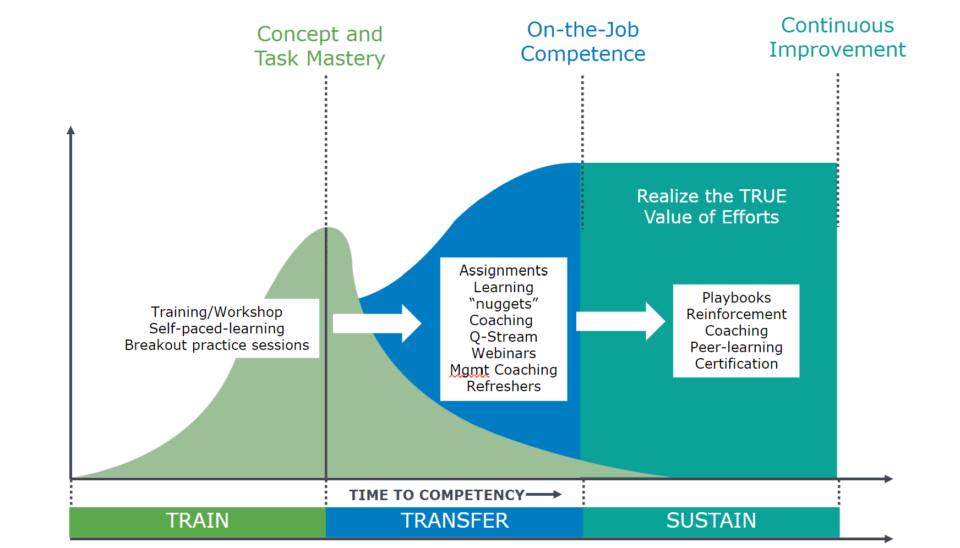
    1. Train

    Trainings and workshops are only one stage of the learning journey. For optimal effect, we work with various techniques in this stage, such as breakout sessions, self-paced learning and role-playing. These techniques make knowledge more digestible.

    2. Transfer

    In the next stage, we apply that knowledge to the workplace. Again, we deploy a mix of techniques and formats, such as working with assignments or incorporating learning nuggets.

    3. Sustain

    The most important thing, of course, is that learning not only leads to one-time knowledge accumulation, but also to long-term impact. Through coaching or peer-learning, for example, you not only embed knowledge, but you can also achieve a change in behavior and mindset.

    From our experience in designing learning journeys that really pay off, we’d like to offer some tips & tricks:


    We have never faced so many unpredictable parameters changing at the same time:

    • Market pivoting from avoiding supply chain risk to price decrease
    • Buyers are confronted with suppliers (having/still) passing on price increases
    • Some material indices are currently going down (eg. due to the oil price)
    • The supply chain starting to normalize but still volatile depending on region and business
    • Increased pressure from customers’ top management for procurement to “lower cost”
    • Increasing need to defend value which require moving from cost-plus to value-based pricing models

    All of above leading to customer conversations being tougher than ever before.

    The challenge for sales teams can be divided in 3 large buckets:

    1. Doing the right things at the wrong time leading to poor impact

    • Trying to influence the customer perceived value during the negotiation
    • Accepting concessions while there are still unsolved obstacles
    • Lack of preparation needed to have a good A/B win strategy

    2. Wrong or no assessment of the Balance of Power

    • Mis-reading the level of power you have over the customer
    • Not having access to key influencers and allow purchasing to keep you from talking to the business leaders
    • Lacking strong ‘why stay’ messaging to defend and increase the share of wallet

    3. Taking negotiations tactics too seriously

    • Techniques such as good cop/bad cop, pencil sharpening, red herring and selective memory are no more than tactics to get discount
    • Discount does not exist. It should be an exchange of value
    • Lack of confidence in the offering, services and pricing as if the competitors don’t have their own problems. A reality easily forgotten during the negotiation game

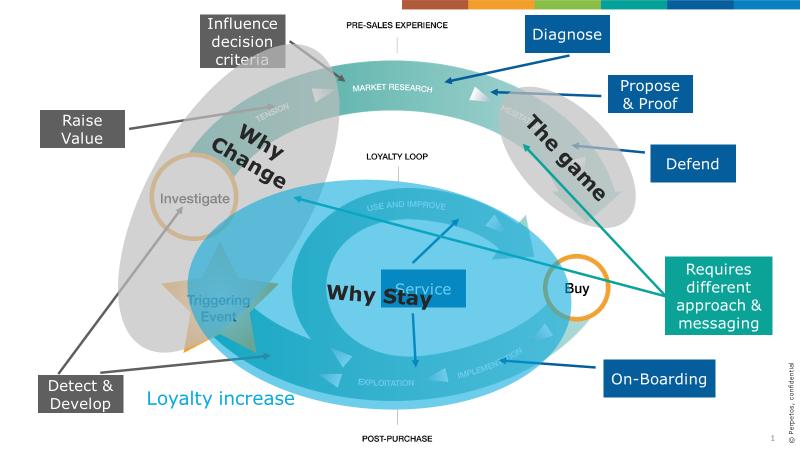
    The most important insight to gaining rapid impact on upcoming negotiations is acknowledging that Negotiation is no more than a game with lot’s of activities before and after. In other words, detect and change selling tactics depending on being ‘in’ or ‘out’ of the game as shown on the customer journey image below.

    Sellers spend way too little time in the Why Change phase which is the only time to sell value as explained in our blog “How to get started with value selling“

    Negotiation, like the game of chess, is a matter of making a move and anticipating the next move of your customer.

    Most sellers believe the balance of power lies with the customer. As a consequence, they often make unnecessary price concessions to win the business. Recent research shows that less than 25% of professional buyers award contracts to the lowest bidders. Clearly price isn’t the only issue buyers are concerned about. Power is critical to any negotiation. Having the upper hand on the balance of power allows you to control the endgame

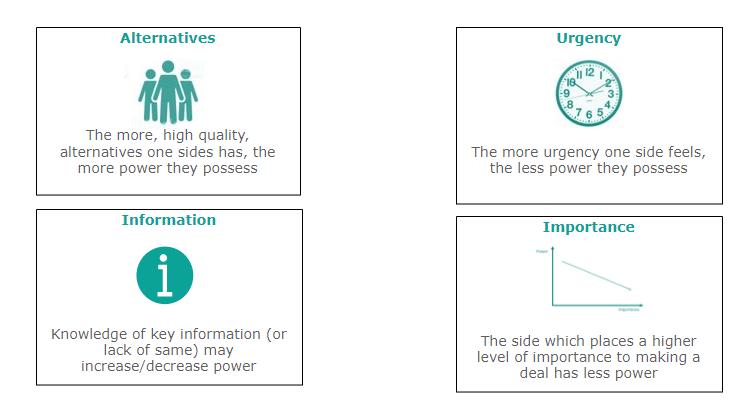
    The balance of power in any negotiation is in the minds of both the buyer and the seller and comes from several sources:

    Conducting an analysis of our strengths, and the risks the customer faces, may reveal we have more power than we think

    Negotiation is the process of coming to an agreement. Remember the quote from Benjamin Franklin:

    By failing to prepare, you are preparing to fail

    Interested in improving your negotiation skills?

    Book a meeting with one of our negotiation specialists


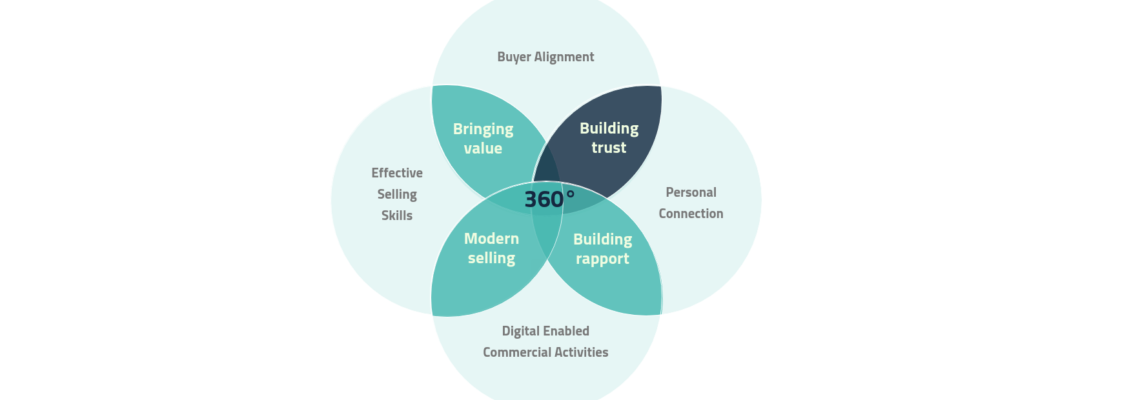
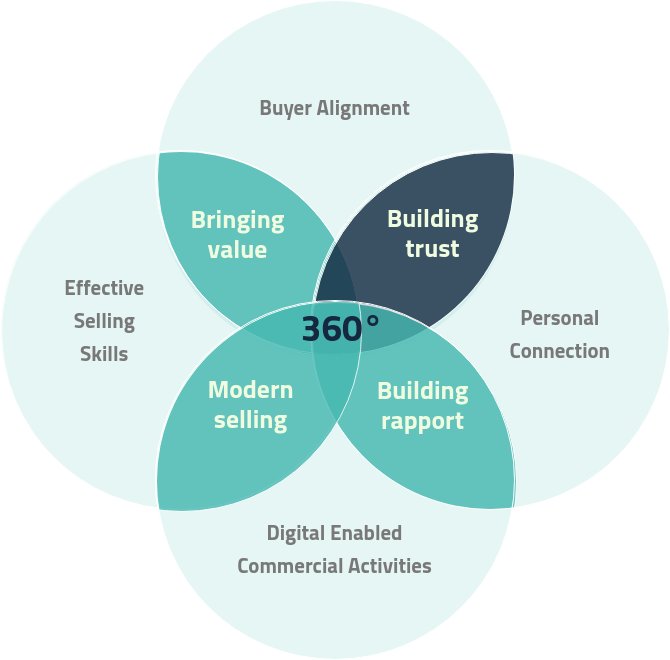
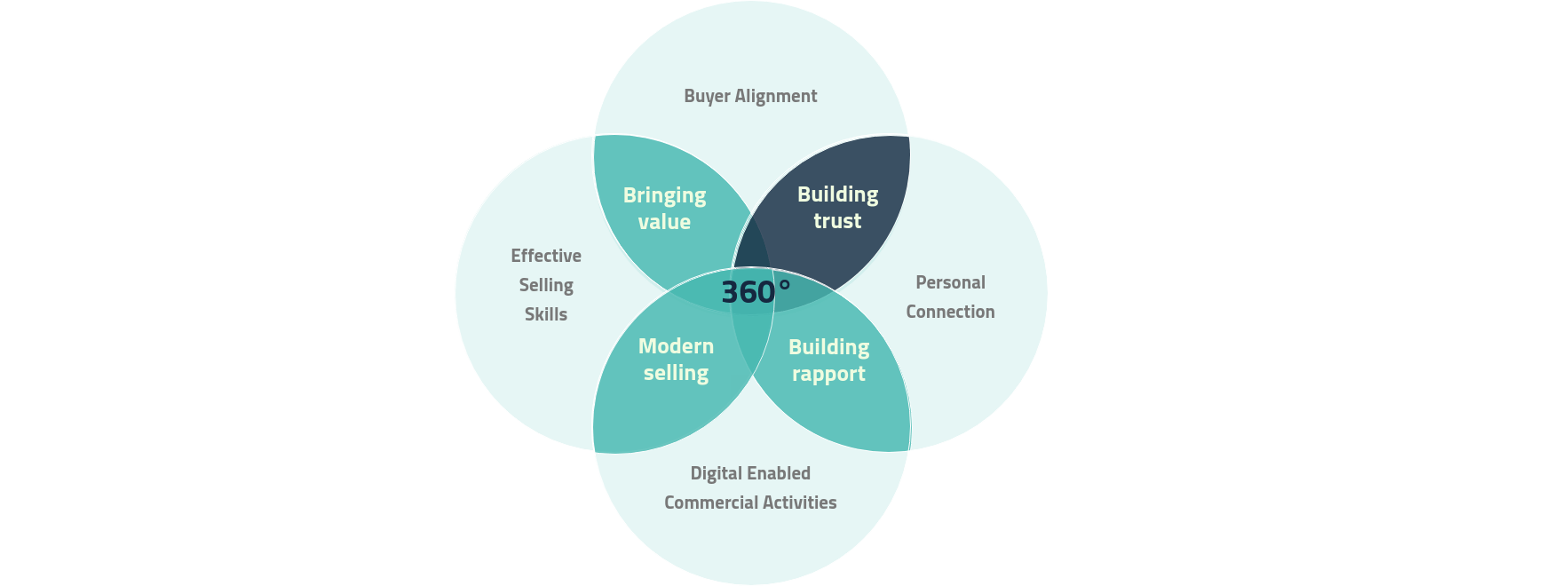
    360° Buyer Alignment - Building Trust

    Article 360° Buyer Alignment

    Selling through building trust

    How can you create and build trust, aligned to each step in the buying cycles of those involved?

    The name of the game: provide relevant and value-adding messaging in every customer contact moment.

    It almost sounds like a slogan but today, even more than before, it is the challenge for sales people.

    How do you create trust during brief, and especially during digital, contact moments?

    Building trust

    You can approach trust from many angles. Trust that you deliver what you promise, trust in your competences, or in you as a person or the team, …

    This quickly brings us to the personal connection one makes during (customer) interactions. Why do certain people manage to gain trust faster than others? Or why do you make a personal connection with certain people more easily or more quickly?

    There are various models that provide a framework for gaining insights into someone’s (preferred) behavior and for adapting your behavior and communication to the people you are in contact with (Insights, Social Styles, MBTI, DISC,…). Maximizing trust in today’s market means combining authenticity with the right message at the right time, to accelerate the effect of a good personal connection.

    Over the past decades, neuroscience has explored how to map the parts of the brain that play a role in decision making, which parts light up when different emotions are felt and what connections can be made with trust. It is a fascinating and still evolving scientific discipline.

    One thing we know for sure is that the salesperson who works primarily on the relational aspect is coming under increasing pressure. Time pressure, conflicting priorities and more choice are creating a dynamic where the purely relational is no longer enough to ‘spend time with a salesperson’.

    Sales people who can detect the willingness to buy of the various stakeholders during the buying cycle can add the right relevance and are able to build trust more quickly. They ask themselves questions such as:

    • How do I create trust among all those involved, taking into account the diversity of roles, expectations, personalities, buying cycle phases, etc.?
    • How do I align my interactions, tailor my sales messages and bring value so that stakeholders recognize me as the first person to contact for genuine and relevant answers to their questions.

    Building trust with each stakeholder in a buying cycle is only possible if you can add the right relevance and adapt this to the different personalities and the willingness to buy.

    Reading Tip
    Stephen M.R. Covey’s book “The speed of Trust” is a great book to deepen your understanding of how to build trust quickly.

    Buyer alignment – buyer center coverage

    In the previous sections, we talked about building trust through personal connection and relevance, tailored to the people involved. One of the challenges that every sales person experiences, regardless of whether you work in project-based sales or more recurring sales, is broadening your network with your customers.

    A lot of opportunities are lost or stagnate because of lack of contact with and insight into all the parties involved who influence the decision. Because people now inform themselves more and more via digital means, a large part of the influencing of decisions happens outside the reach of the sales person. This is a major risk if the sales person continues to sell via a ‘sponsor’ instead of managing and developing as many relationships as possible in parallel.

    Let’s take a side step:

    LinkedIn published an article at the end of October 2021: “The Great Reshuffle is Making Selling Hard. Here’s How to Best Adjust.”

    The article indicates that we are in the midst of the “Great Reshuffle” of talent. Globally, job rotations have increased by 28% in the last three months. Corporate director-level job turnover – i.e. the mass of B2B buyers – has risen by 31% globally over the last three months.

    No wonder a recent survey found that 80% of salespeople have delayed or lost a deal because of a change in function within an account. It is difficult to sell to a moving target.

    The blog also rightly highlights the positive side of function or job changes of buyers: this can also be your entry point into a new customer if you had built up a good relationship with the buyer in question.

    When a new buyer comes in, LinkedIn states that the salesperson must align the solution with the customers’ strategic initiatives and demonstrate its value.

    The following paragraphs from the blog reinforce this:

    If you are doing this well, then you can be an asset to a new executive sponsor and help them get up to speed on the critical initiatives your solution supports.

    In this environment, the gap between strategic partners and expendable vendors is growing. The difference is value delivered at the right level and time.

    It also means giving them the tools and training to be effective in virtual selling. After all, nothing builds morale quicker than success. And the right tools and training play a big part in that.

    The LinkedIn article nicely illustrates how job rotation can have a huge impact on the buying process both within sales teams and with buyers. In addition, the blog points to the importance of broadening relationships within a customer to accommodate this and why you can be successful when the right value is delivered at the right time.